Genome-edited Cells
Stomach
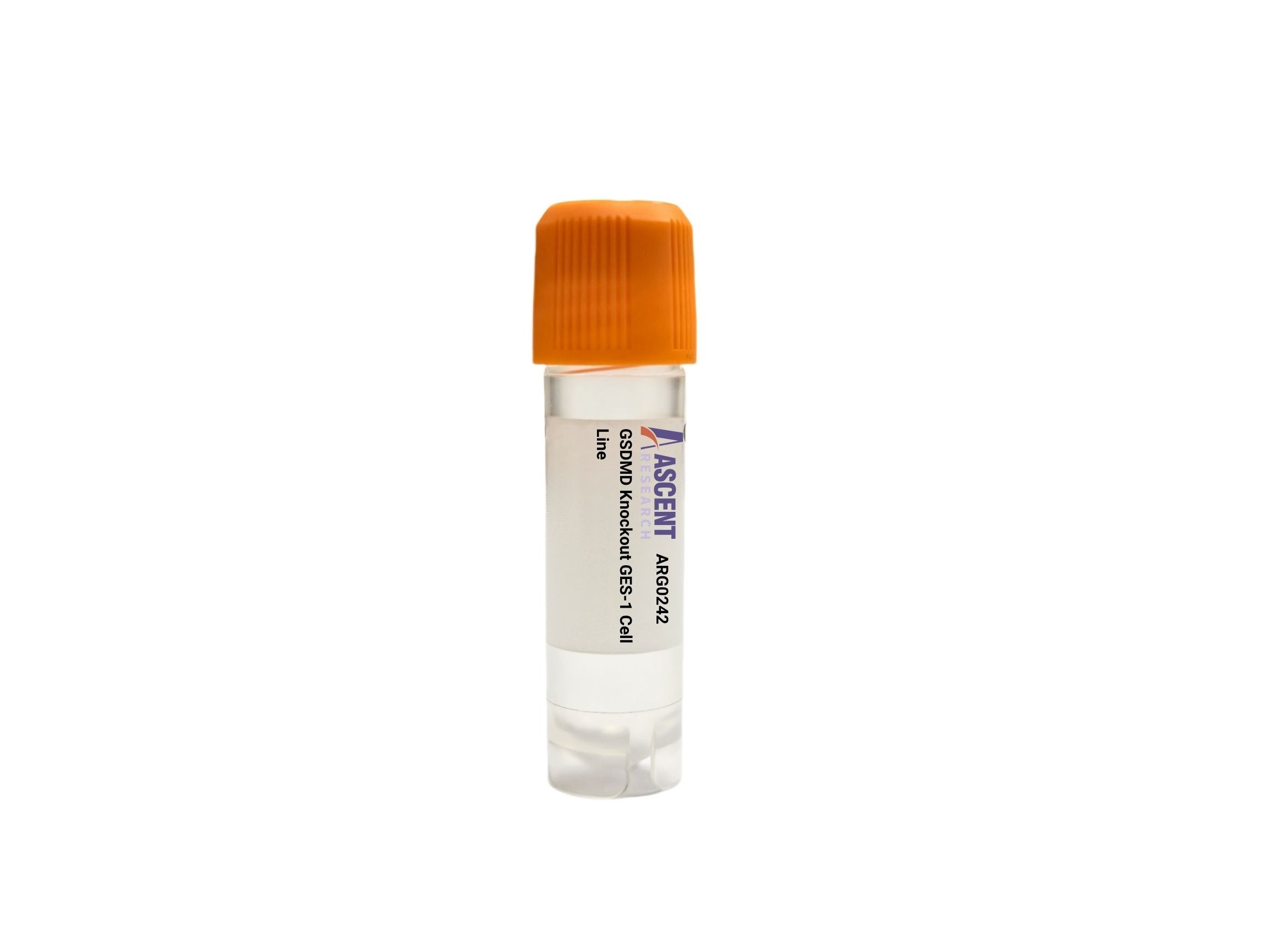
The GSDMD Knockout GES-1 Cell Line is a CRISPR/Cas9-edited human gastric epithelial cell line with targeted disruption of the GSDMD gene, the central executioner of pyroptosis. Lacking GSDMD, these cells are unable to form plasma membrane pores upon inflammasome activation, blocking pyroptotic cell death and unconventional IL-1??/IL-18 secretion downstream of caspase-1 and NLRP3. This model is ideal for investigating pyroptosis mechanisms in gastric epithelium, studying host-pathogen interactions with Helicobacter pylori, and screening inhibitors of the GSDMD pathway. Standard assays include Western blotting, LDH release, cytokine ELISA, and flow cytometry. Contact Ascent Research for additional details.
The GSDMD Knockout GES-1 Cell Line is a CRISPR/Cas9-edited knockout cell line derived from the immortalized normal human gastric epithelial cell line GES-1. The gene encoding gasdermin D (GSDMD), the executioner of pyroptosis, has been disrupted to create a stable loss-of-function model. This cell line provides a powerful tool for dissecting pyroptotic cell death and inflammasome-driven inflammatory responses in the context of the gastric epithelium, enabling mechanistic studies without the need for transient gene silencing.
The GES-1 parental line is a nontumorigenic, immortalized human gastric epithelial cell line that retains differentiated functions including mucus secretion and maintenance of the gastric mucosal barrier. It serves as a widely accepted in vitro model for normal gastric physiology and for investigating pathogenic processes such as Helicobacter pylori infection, chronic gastritis, and gastric carcinogenesis. The immortalized background ensures reproducible and scalable experiments, making it suitable for both fundamental discovery and preclinical drug screening.
The GSDMD gene encodes the executioner of pyroptosis. Inflammasomes (NLRP3, AIM2, NLRC4) assemble upon sensing danger signals, recruiting ASC and activating caspase-1. Cytosolic LPS activates caspase-4/5/11. Caspase-1 or -4 cleaves GSDMD, releasing its N-terminal domain from autoinhibition. The N-terminal fragment forms plasma membrane pores, causing cell lysis and unconventional secretion of IL-1?? and IL-18. GSDMD thus functions downstream of caspase-1 and -4, interacting with ASC and NLRP3. Upstream signals include TLR4/NF-??B-mediated transcription of pro-IL-1?? and NLRP3, while downstream effects include cytokine release and DAMP emission.
In gastric tissue, pyroptosis contributes to host defense against Helicobacter pylori and the progression of gastritis to gastric cancer. Using this GES-1 knockout model, researchers can dissect GSDMD-specific roles in mucosal inflammation, epithelial barrier disruption, and cytokine responses, isolating its function from other death pathways. This is critical for understanding how chronic inflammasome activation drives carcinogenesis in the stomach. Moreover, this model enables detailed investigation of host-pathogen dynamics, such as the interplay between H. pylori virulence factors and epithelial inflammasome responses.
This knockout line supports studies of pyroptosis in gastric epithelium, including inflammasome signaling and host-pathogen interactions with H. pylori. It is suitable for screening pyroptosis inhibitors and target validation. Typical assays are Western blot for GSDMD cleavage, LDH release, ELISA for IL-1??/IL-18, immunofluorescence for pore formation, flow cytometry (PI/Annexin V), caspase-1 activity, and RT-qPCR for NLRP3/IL-1??. For further information, please contact Ascent Research.