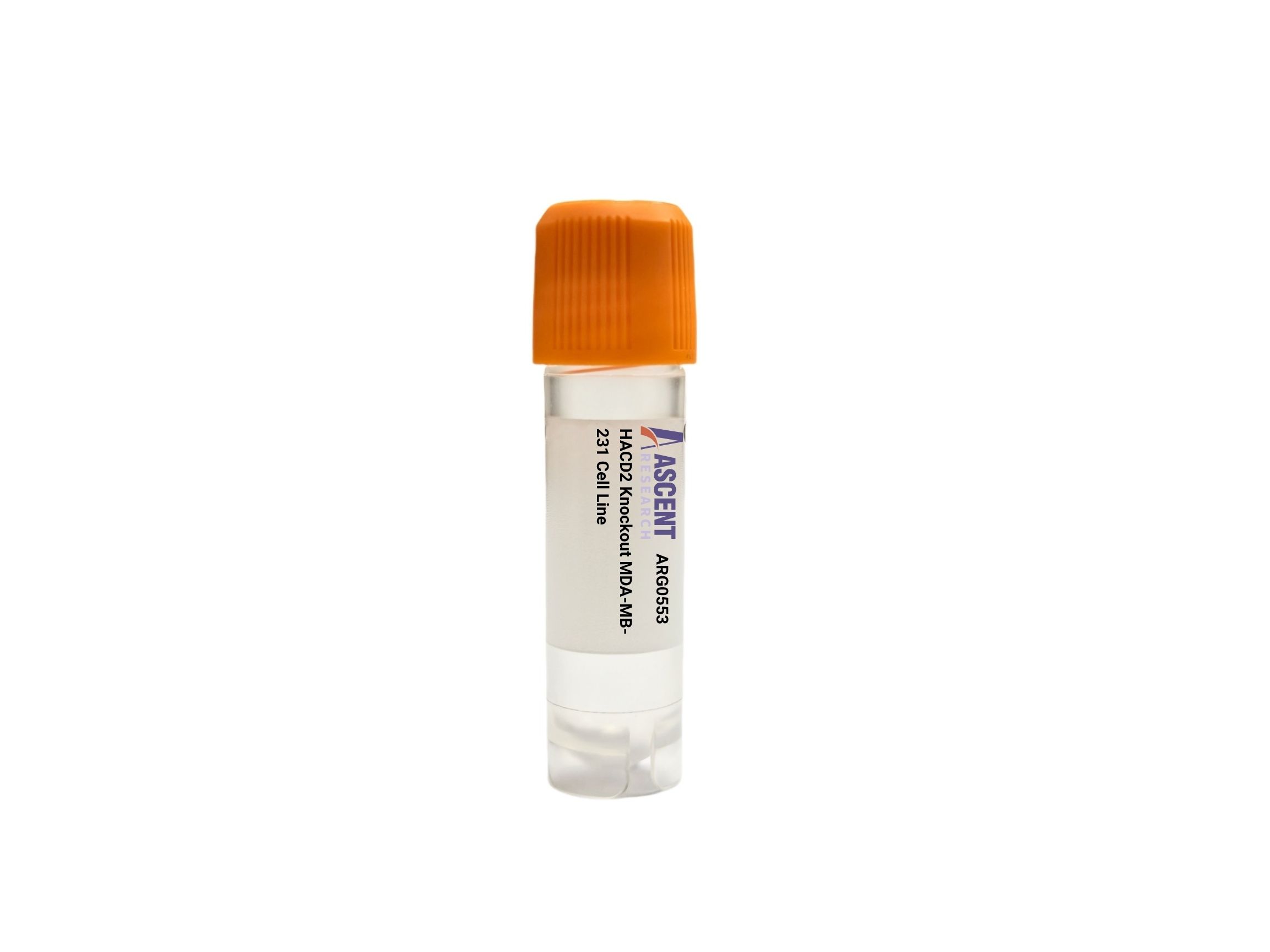
Genome-edited Cells
Breast (mammary gland)
The HACD2 Knockout MDA-MB-231 Cell Line is a CRISPR/Cas9-edited knockout cell line designed for studying very long-chain fatty acid (VLCFA) metabolism in triple-negative breast cancer (TNBC). This model disrupts the HACD2 gene, encoding 3-hydroxyacyl-CoA dehydratase, a critical enzyme in the VLCFA elongation cycle that acts downstream of ELOVL1/ELOVL3 and upstream of TECR to produce C24?CC26 fatty acids. Transcriptional control by SREBF1/2 and PPARs makes HACD2 a key node in lipid metabolic networks. Knockout in the aggressive MDA-MB-231 background impairs VLCFA synthesis, enabling applications in lipidomics, functional genomics, and drug target validation for TNBC and lipid metabolism disorders.
 Human Brachiocephalic Artery Endothelial Cells
Cat. No. ARP1105
Human Brachiocephalic Artery Endothelial Cells
Cat. No. ARP1105
 KSR2 Knockout HAP1 Polyclonal Cells
Cat. No. ARG23095
ANXA5 Knockout MES-OV Polyclonal Cells
Cat. No. ARG24162
MKRN2 Knockout MES-OV Polyclonal Cells
Cat. No. ARG6791
MCEE Knockout HEK293T Polyclonal Cells
Cat. No. ARG4287
KSR2 Knockout HAP1 Polyclonal Cells
Cat. No. ARG23095
ANXA5 Knockout MES-OV Polyclonal Cells
Cat. No. ARG24162
MKRN2 Knockout MES-OV Polyclonal Cells
Cat. No. ARG6791
MCEE Knockout HEK293T Polyclonal Cells
Cat. No. ARG4287
 GRB2 Knockout PK15 Cell Line
Cat. No. ARG0682
GRB2 Knockout PK15 Cell Line
Cat. No. ARG0682
The HACD2 Knockout MDA-MB-231 Cell Line is a CRISPR/Cas9-edited knockout cell line generated by disrupting the HACD2 gene in the MDA-MB-231 breast epithelial adenocarcinoma background. This stable loss-of-function model ablates expression of the 3-hydroxyacyl-CoA dehydratase 2 enzyme, a key component of the very long-chain fatty acid (VLCFA) elongation cycle. By eliminating HACD2 activity, researchers can interrogate the functional consequences of impaired VLCFA biosynthesis within a highly invasive, mesenchymal-like triple-negative breast cancer (TNBC) context.
The parental MDA-MB-231 cell line is a widely used human TNBC model derived from the pleural effusion of a 51-year-old Caucasian female with metastatic mammary adenocarcinoma. It is characterized by an aggressive, invasive phenotype and mesenchymal molecular features, lacking estrogen receptor, progesterone receptor, and HER2 amplification. As a representative TNBC line, MDA-MB-231 serves as a robust platform for studying tumor cell metastasis, epithelial-to-mesenchymal transition, and metabolic vulnerabilities, particularly those involving lipid dysregulation.
HACD2 catalyzes the dehydration of 3-hydroxyacyl-CoA to trans-2-enoyl-CoA in the third step of the microsomal VLCFA elongation cycle, operating in complex with ELOVL1, ELOVL3, HSD17B12, and TECR. This cycle sequentially extends acyl-CoA chains to produce C24?CC26 fatty acids essential for membrane phospholipids, sphingolipids, and signaling molecules. Transcriptional regulation of HACD2 is mediated by sterol regulatory element-binding proteins SREBF1 and SREBF2, as well as peroxisome proliferator-activated receptors PPARA and PPARG. Downstream, the dehydration product is further processed by TECR to generate VLCFAs, which serve as substrates for ceramide synthase CERS2 and sphingolipid synthesis pathways. Knockout of HACD2 disrupts VLCFA production, leading to altered lipid raft composition, impaired sphingolipid metabolism, and potential dysregulation of downstream signaling cascades.
In the MDA-MB-231 context, HACD2 loss creates a unique model for investigating the intersection of lipid metabolism and TNBC malignancy. VLCFA-dependent membrane remodeling influences cell migration, proliferation, and survival signaling, processes that are hyperactive in mesenchymal-like breast cancer cells. Disruption of HACD2 is expected to reduce cellular VLCFA pools, thereby compromising lipid raft integrity and perturbing pathways such as PI3K/AKT and FAK-mediated adhesion. This knockout cell line enables dissection of how VLCFA metabolism supports the aggressive characteristics of TNBC, offering a direct tool to assess the role of fatty acid elongation in cancer cell biology.
This cell line is ideal for lipid metabolism studies, functional genomics, drug target validation, and TNBC research. Researchers can employ fatty acid profiling by GC-MS or lipidomics to quantify changes in VLCFA species and global lipidome alterations. Western blotting and RT-qPCR enable confirmation of HACD2 knockout and expression analysis of pathway components. Immunofluorescence can visualize subcellular localization changes, while cell viability, migration/invasion, colony formation, and cell cycle assays assess functional consequences. Phospho-signaling analysis further elucidates affected kinase networks. For technical inquiries, please contact Ascent Research.