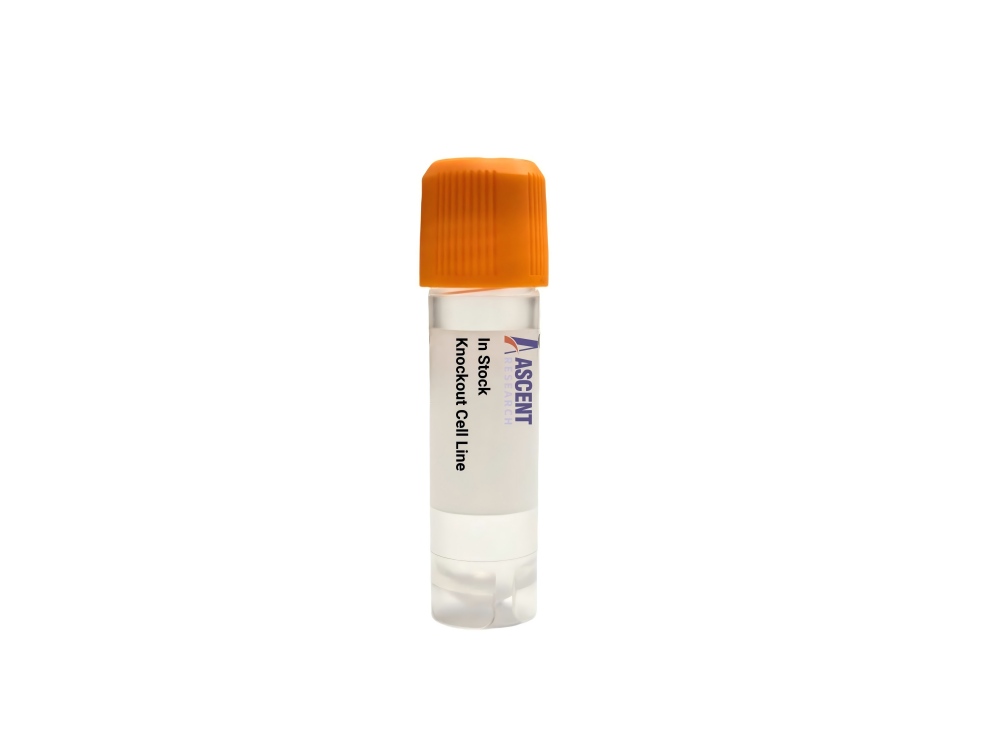
In Stock Cell Lines
Mus musculus (Mouse)
Testis
Adherent
The Hif1a Knockout TM4 Cell Line is a CRISPR/Cas9-edited knockout cell line derived from mouse testicular Sertoli cells. This loss-of-function model disrupts the Hif1a gene, which encodes HIF-1??, the master regulator of hypoxia responses. Under hypoxia, HIF-1?? stabilizes, dimerizes with ARNT, and drives transcription of downstream targets including VEGFA, EPO, and SLC2A1. This knockout cell line provides a valuable tool for studying hypoxia signaling, Sertoli cell biology, spermatogenesis, and testicular ischemia, and supports functional assays such as western blotting, RT-qPCR, and barrier integrity measurements.
The Hif1a Knockout TM4 Cell Line is a CRISPR/Cas9-edited knockout cell line designed for loss-of-function studies of the Hif1a gene in a Sertoli cell background. Derived from the TM4 mouse testicular Sertoli cell line, this product provides a stable, genetically defined model in which Hif1a expression has been disrupted via CRISPR/Cas9-mediated gene targeting. The knockout cell line enables precise interrogation of HIF-1??-dependent transcriptional programs without residual wild-type protein expression, serving as a critical tool for investigating hypoxia signaling pathways in a physiologically relevant testicular niche.
The TM4 cell line originates from normal mouse testicular Sertoli cells and retains many features of primary Sertoli cells, including the ability to form tight junctions, support germ cell development, and maintain the blood?Ctestis barrier. These cells exhibit characteristic epithelial morphology and express Sertoli cell markers, making them a widely used in vitro model for studying spermatogenesis, testicular toxicity, and Sertoli cell physiology. The TM4 line??s non-transformed nature and functional barrier properties render it particularly suitable for examining the interplay between oxygen sensing and reproductive tissue homeostasis.
Hif1a encodes the oxygen-sensitive ?? subunit of the heterodimeric transcription factor HIF-1. Under normoxia, HIF-1?? is hydroxylated by prolyl hydroxylases (e.g., EGLN1), recognized by VHL, and degraded. Hypoxia stabilizes HIF-1??, enabling nuclear translocation and dimerization with ARNT. The active complex recruits EP300 and CREBBP to activate genes such as VEGFA, EPO, SLC2A1, and PGK1. Upstream regulators including insulin-like growth factor 1, epidermal growth factor, tumor necrosis factor alpha, and reactive oxygen species modulate HIF-1?? activity, integrating metabolic and inflammatory signals.
In the testicular microenvironment, Sertoli cells experience physiological hypoxia, and HIF-1??-mediated gene regulation is thought to contribute to spermatogonial stem cell niche maintenance and barrier integrity. Disruption of Hif1a in TM4 cells eliminates hypoxia-driven transcription of targets like VEGFA and metabolic enzymes LDHA and PGK1. This loss-of-function model enables investigation of HIF-1??’s role in Sertoli cell metabolism, tight junction dynamics, and germ cell paracrine signaling. The cell line is valuable for assessing hypoxia-driven programs influencing blood?Ctestis barrier function and immune privilege.
Typical applications include hypoxia research, Sertoli cell biology, spermatogenesis studies, and testicular ischemia models. Researchers can map HIF-1 signaling, evaluate metabolic adaptation, and screen HIF inhibitors. Assays include western blotting, RT-qPCR, ChIP-qPCR, immunofluorescence, hypoxia reporter assay, cell viability, glucose uptake, lactate production, and barrier integrity measurements. For technical details, contact Ascent Research.