Primary Cells
Homo sapiens (Human)
Liver
Hepatic Stellate Cells, also known as Ito cells, lipocytes, vitamin A-storing cells, fat-storing cells, exist in the space of Disse in the liver, between hepatocytes and sinusoidal endothelial cells. These cells functions in two states, quiescent and activated, and involve in vitamin A storage, liver regeneration, and response to liver injury. In a quiescent state, hepatic stellate cells store vitamin A (in the form of retinoids) in lipid droplets within their cytoplasm. They can be activated by liver injury, inflammation, metabolic stress, or toxin conditions. Upon activation, hepatic stellate cells secrete extracellular matrix (ECM), such as collagen type I and III, which initially helps protect the liver and maintain structural integrity, release growth factors that participate in liver regeneration, and produce cytokines, contributing to the immune response in the liver. Otherwise, α-SMA is a marker of hepatic stellate cell activation. It allows activated cells to contract, helping regulate sinusoidal blood flow and help compress damaged areas of the liver, and mediate cytoskeletal changes that facilitate cells migration to sites of liver injury. However, persistent activation of HSCs leads to excessive ECM deposition, driving liver fibrosis.
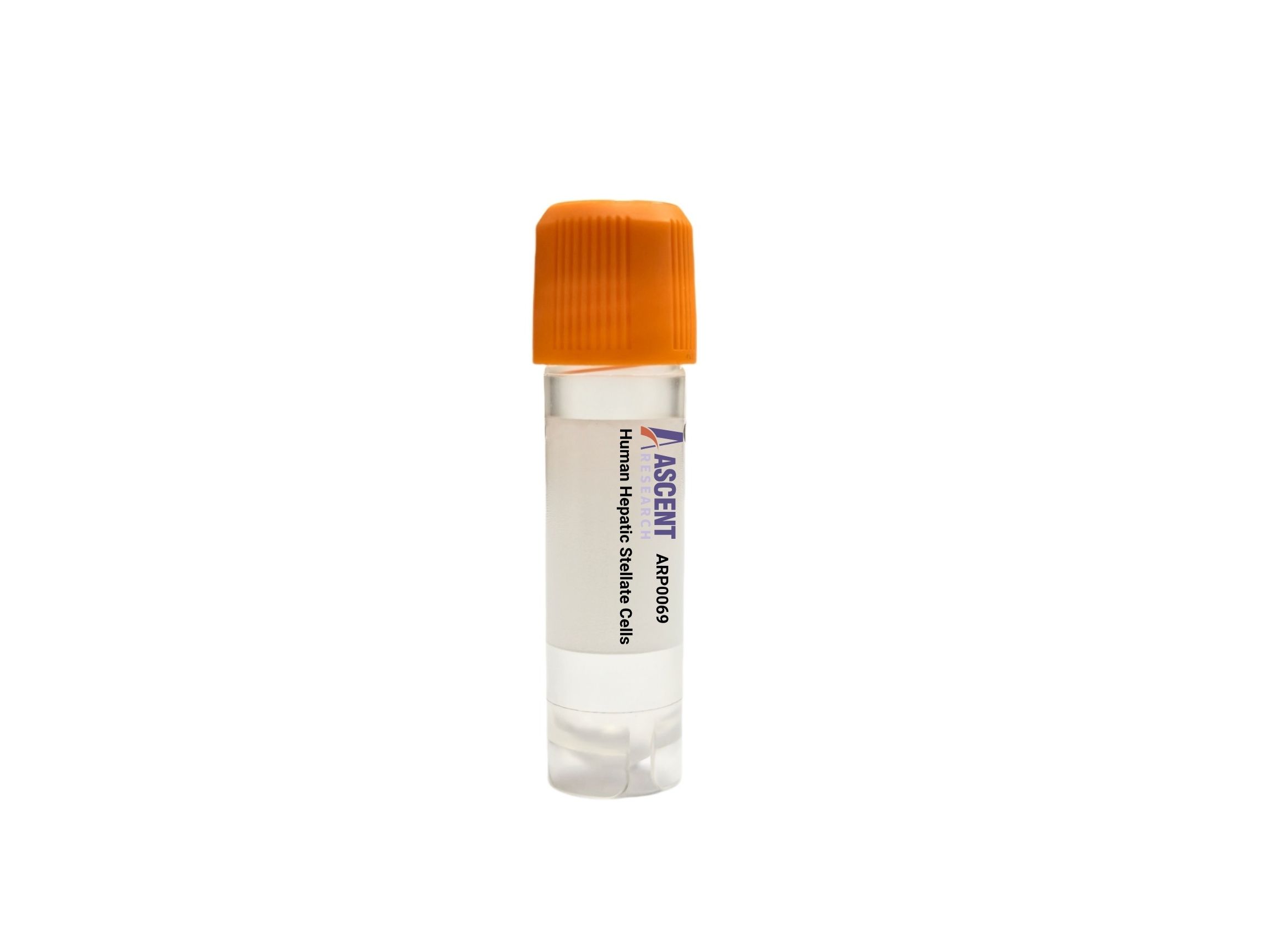
Human Hepatic Stellate Cells are freshly isolated from human health liver, cryopreserved at passage one and delivered frozen. Optimized medium and reagents for the growth of Human Hepatic Stellate Cells are also provided(Cat. No. ACM0069).
 MFN1 Knockout Hela Polyclonal Cells
Cat. No. ARG7904
AIMP2 Knockout HAP1 Polyclonal Cells
Cat. No. ARG21753
IMPACT Knockout MES-OV Polyclonal Cells
Cat. No. ARG24631
ABR Knockout AGS Polyclonal Cells
Cat. No. ARG26390
JADE3 Knockout jurkat Polyclonal Cells
Cat. No. ARG34381
CD59 Knockout Raji Polyclonal Cells
Cat. No. ARG43682
MFN1 Knockout Hela Polyclonal Cells
Cat. No. ARG7904
AIMP2 Knockout HAP1 Polyclonal Cells
Cat. No. ARG21753
IMPACT Knockout MES-OV Polyclonal Cells
Cat. No. ARG24631
ABR Knockout AGS Polyclonal Cells
Cat. No. ARG26390
JADE3 Knockout jurkat Polyclonal Cells
Cat. No. ARG34381
CD59 Knockout Raji Polyclonal Cells
Cat. No. ARG43682
Reference
[1] L. Atzori, G. Poli, and A. Perra, “Hepatic stellate cell: A star cell in the liver,” Int. J. Biochem. Cell Biol., vol. 41, no. 8–9, pp. 1639–1642, Aug. 2009, doi: 10.1016/j.biocel.2009.03.001.
[2] A. E. Barry et al., “Hepatic Stellate Cells and Hepatocarcinogenesis,” Front. Cell Dev. Biol., vol. 8, p. 709, Aug. 2020, doi: 10.3389/fcell.2020.00709.
[3] H. Senoo, “Structure and function of hepatic stellate cells,” Med. Electron Microsc., vol. 37, no. 1, pp. 3–15, Mar. 2004, doi: 10.1007/s00795-003-0230-3.
[4] M. L. Hautekeete and A. Geerts, “The hepatic stellate (Ito) cell: its role in human liver disease,” Virchows Arch. Int. J. Pathol., vol. 430, no. 3, pp. 195–207, Mar. 1997, doi: 10.1007/BF01324802.
[5] B. J. Potter, “Components of the Hepatic System,” in Reference Module in Biomedical Sciences, Elsevier, 2019, p. B9780128012383049357. doi: 10.1016/B978-0-12-801238-3.04935-7.