Genome-edited Cells
Liver
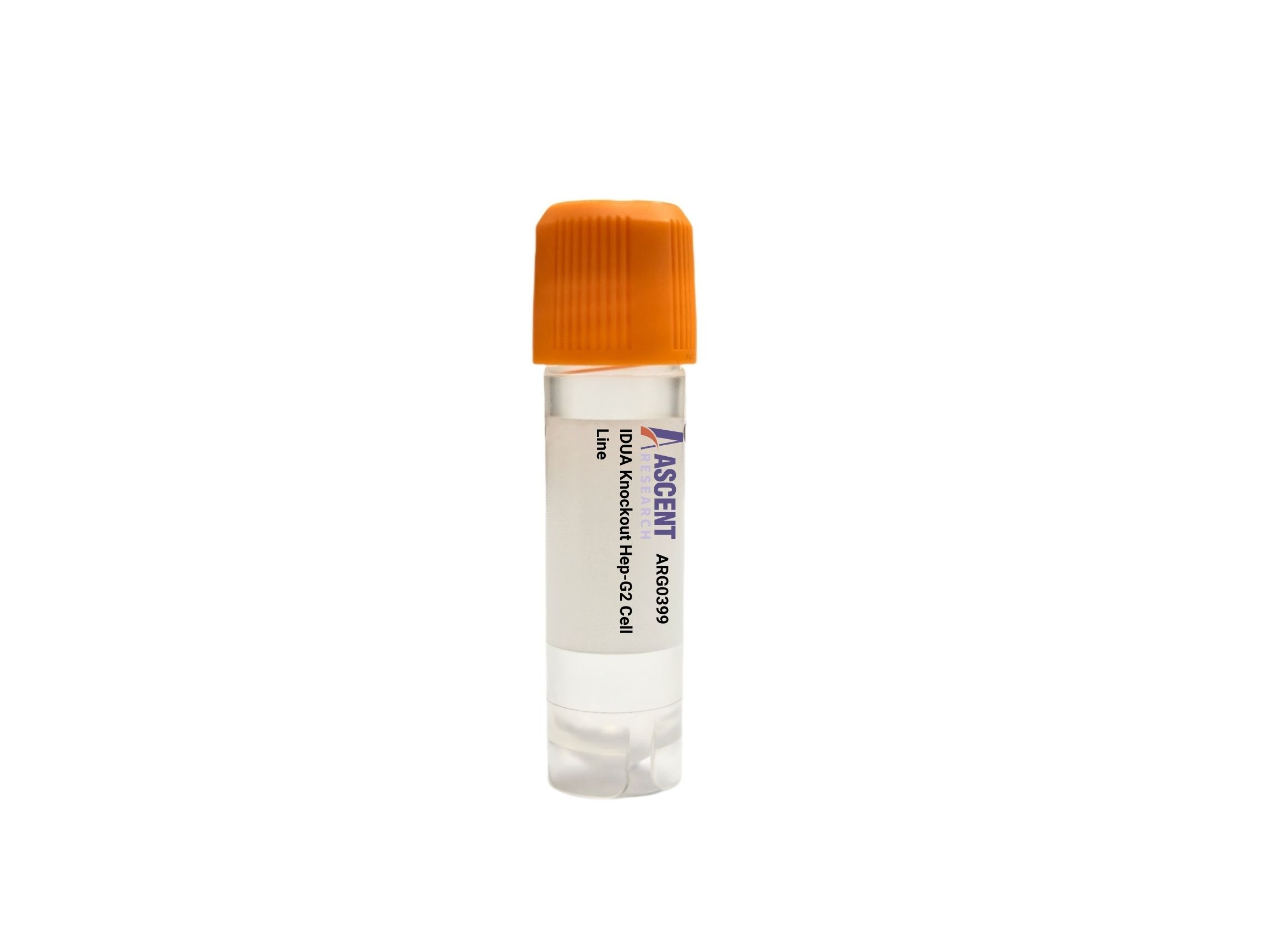
The IDUA Knockout Hep-G2 Cell Line is a CRISPR/Cas9-edited human hepatocellular carcinoma cell line with targeted disruption of the IDUA gene, encoding lysosomal alpha-L-iduronidase. This knockout model abolishes enzyme activity, creating a loss-of-function system for studying glycosaminoglycan degradation and related lysosomal storage diseases. IDUA expression is regulated by TFEB and MITF, and its absence leads to accumulation of dermatan and heparan sulfates, lysosomal dysfunction, and impaired autophagy. The Hep-G2 background provides a liver-specific platform for mucopolysaccharidosis type I modeling, enzyme replacement therapy screening, and hepatic glycosaminoglycan metabolism research.
 Immortalized Human T Cell
Cat. No. ARI0361
Immortalized Human T Cell
Cat. No. ARI0361
 GPR18 Knockout HAP1 Polyclonal Cells
Cat. No. ARG22332
IRF3 Knockout K562 Polyclonal Cells
Cat. No. ARG20697
HCLS1 Knockout MES-OV Polyclonal Cells
Cat. No. ARG24508
MTMR3 Knockout HEK293T Polyclonal Cells
Cat. No. ARG4364
GPR18 Knockout HAP1 Polyclonal Cells
Cat. No. ARG22332
IRF3 Knockout K562 Polyclonal Cells
Cat. No. ARG20697
HCLS1 Knockout MES-OV Polyclonal Cells
Cat. No. ARG24508
MTMR3 Knockout HEK293T Polyclonal Cells
Cat. No. ARG4364
 NCI-H1703 Luciferase Stable Cell Line
Cat. No. ARG0606
NCI-H1703 Luciferase Stable Cell Line
Cat. No. ARG0606
The IDUA Knockout Hep-G2 Cell Line is a CRISPR/Cas9-edited knockout cell line derived from the human hepatocellular carcinoma Hep-G2 cell line. This product features targeted disruption of the IDUA gene, which encodes the lysosomal enzyme alpha-L-iduronidase, generating a loss-of-function model for this critical glycosaminoglycan-degrading enzyme. By abrogating IDUA expression, this knockout cell line enables researchers to dissect the role of alpha-L-iduronidase in lysosomal catabolism and to model related lysosomal storage disorders in a liver-derived cellular context.
The Hep-G2 host cell line, originating from a 15-year-old male hepatocellular carcinoma patient, exhibits adherent epithelial morphology and is widely employed as a model for hepatic metabolism, toxicity, and drug screening. Hep-G2 cells retain many liver-specific functions, including synthesis and secretion of plasma proteins, cholesterol metabolism, and phase I/II enzyme activities, making them a physiologically relevant platform for studying hepatocyte biology. The integration of IDUA knockout into this established hepatic background provides a nuanced system for investigating liver-specific contributions to glycosaminoglycan metabolism and lysosomal homeostasis.
Mechanistically, IDUA encodes alpha-L-iduronidase, the enzyme responsible for hydrolyzing terminal iduronic acid residues in the glycosaminoglycans dermatan sulfate and heparan sulfate within lysosomes. Its expression is regulated by the transcription factors TFEB and MITF, master regulators of lysosomal biogenesis. Post-translationally, alpha-L-iduronidase is targeted to lysosomes via the mannose-6-phosphate receptor and undergoes proteolytic processing. In the absence of IDUA activity, dermatan and heparan sulfates accumulate, leading to lysosomal dysfunction, impaired autophagy, and disrupted cellular homeostasis. Representative pathway components??including IDUA, dermatan sulfate, heparan sulfate, and the mannose-6-phosphate receptor??constitute the core molecular network affected by this knockout.
In Hep-G2 hepatocellular carcinoma cells, IDUA knockout models mucopolysaccharidosis type I (MPS I), encompassing Hurler and Scheie syndromes. This liver-centric model is valuable as the liver is central for enzyme replacement therapy and susceptible to glycosaminoglycan-mediated pathology. It recapitulates lysosomal storage disorder features, including lysosomal engorgement and autophagic block, enabling study of hepatic metabolic dysregulation and toxicity from glycosaminoglycan accumulation. Additionally, it provides a system to examine how lysosomal dysfunction intersects with liver-specific pathways such as bile acid synthesis and detoxification.
This cell line supports a broad spectrum of research applications, including disease modeling of MPS I, screening of candidate enzyme replacement therapies, and elucidation of glycosaminoglycan catabolic pathways. Representative assays include IDUA activity measurement, quantitative PCR and Western blotting for IDUA expression, DMMB assay for glycosaminoglycan quantification, LAMP1 immunofluorescence, LC-MS/MS for dermatan and heparan sulfate profiling, lysosomal pH measurement, autophagy flux assessment (LC3), apoptosis assays, and RNA-seq transcriptomics. For further details, please contact Ascent Research.