Genome-edited Cells
Breast (mammary gland)
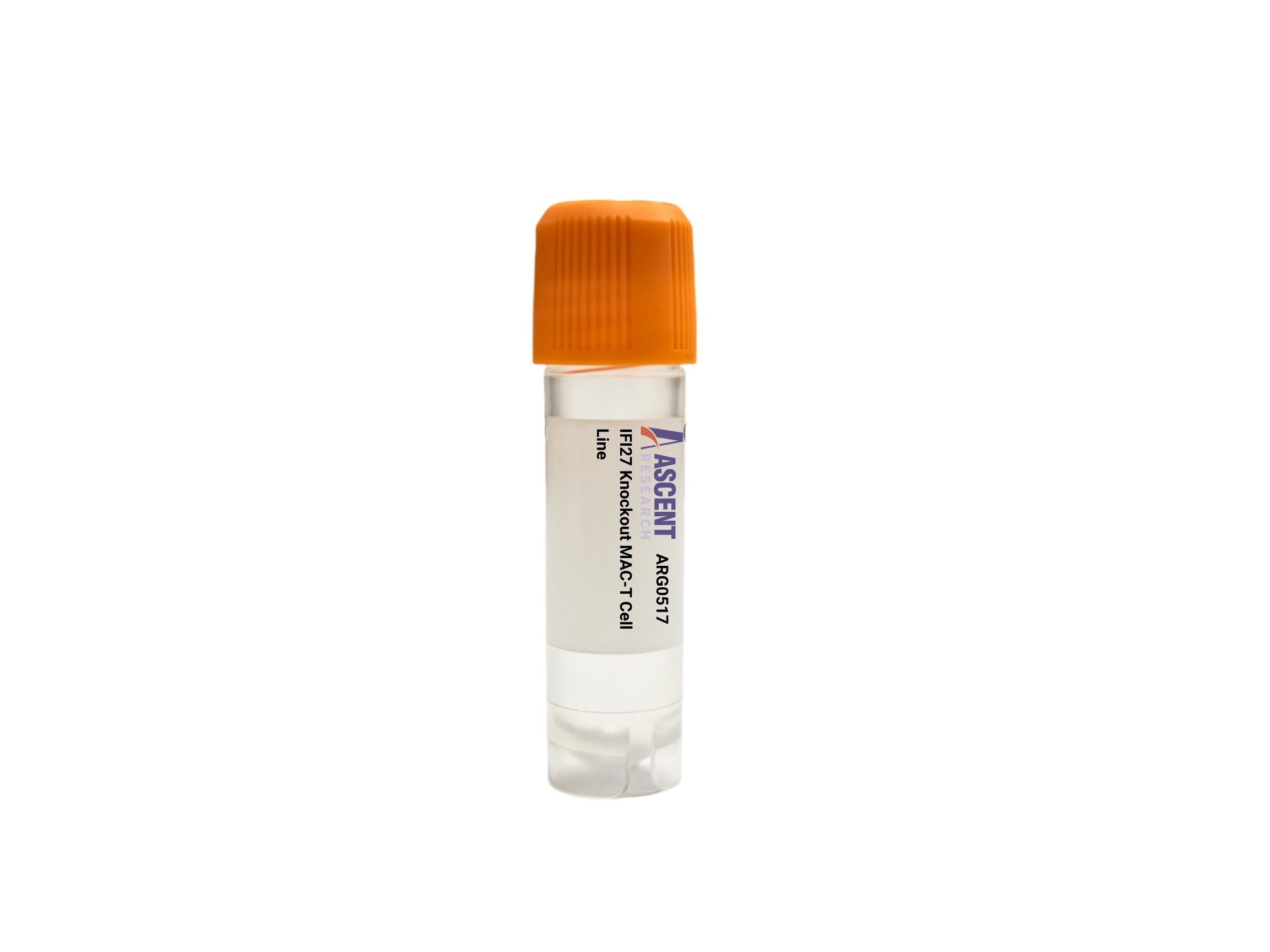
The IFI27 Knockout MAC-T Cell Line is a CRISPR/Cas9-edited knockout cell line derived from bovine MAC-T mammary epithelial cells. The target gene, IFI27, encodes an interferon-inducible protein that drives apoptosis and antiviral responses through mitochondrial interactions with Bcl-2 family members and GRIM-19, activating caspases. This model is designed for studying IFI27 function in interferon signaling, apoptosis, and innate immunity within a milk-synthesizing epithelial context. Researchers can perform caspase activity assays, viral replication experiments, and interferon stimulation followed by gene expression profiling.
 BOC Knockout HAP1 Polyclonal Cells
Cat. No. ARG22115
HABP4 Knockout HAP1 Polyclonal Cells
Cat. No. ARG35586
CADM1 Knockout HT29 Polyclonal Cells
Cat. No. ARG41786
HGSNAT Knockout huh-7 Polyclonal Cells
Cat. No. ARG28295
GMFB Knockout MES-OV Polyclonal Cells
Cat. No. ARG5841
PGRMC2 Knockout HEK293T Polyclonal Cells
Cat. No. ARG3755
BOC Knockout HAP1 Polyclonal Cells
Cat. No. ARG22115
HABP4 Knockout HAP1 Polyclonal Cells
Cat. No. ARG35586
CADM1 Knockout HT29 Polyclonal Cells
Cat. No. ARG41786
HGSNAT Knockout huh-7 Polyclonal Cells
Cat. No. ARG28295
GMFB Knockout MES-OV Polyclonal Cells
Cat. No. ARG5841
PGRMC2 Knockout HEK293T Polyclonal Cells
Cat. No. ARG3755
The IFI27 Knockout MAC-T Cell Line is a CRISPR/Cas9-edited knockout cell line providing loss-of-function for the interferon-inducible protein IFI27. This product enables investigation of IFI27-dependent pathways in a physiologically relevant bovine mammary epithelial background. The knockout was generated using CRISPR/Cas9-mediated gene disruption, yielding a stable model for studying apoptosis and antiviral innate immunity.
The host MAC-T cell line is an immortalized bovine mammary epithelial cell line that retains key functions of primary mammary epithelial cells, including the capacity for milk protein synthesis and secretion. Widely used in lactation biology and mastitis research, MAC-T cells provide a relevant in vitro system for examining how mammary epithelial cells respond to cytokines and pathogens.
IFI27 is transcriptionally induced by type I and type II interferons through the JAK-STAT pathway, involving upstream kinases JAK1 and TYK2, transcription factors STAT1, STAT2, and IRF9 (forming the ISGF3 complex), and interferon receptors IFNAR1 and IFNGR1. The IFI27 protein localizes to mitochondria, where it interacts with GRIM-19 (NDUFA13) and Bcl-2 family members including Bcl-2 and Bax, promoting cytochrome c release and activation of Caspase-3 and Caspase-9 to execute apoptosis. Additionally, IFI27 interacts with STAT3 and ISG12 family proteins to contribute to viral replication suppression.
In the MAC-T mammary epithelial context, IFI27 knockout allows dissection of apoptosis and antiviral signaling networks that are critical during mammary gland infection. Mammary epithelial cells frequently encounter viral challenges, and IFI27-mediated cell death may influence pathogen clearance and epithelial barrier integrity. This model is therefore valuable for exploring the intersection of interferon signaling and cell death in bovine mastitis and related inflammatory conditions.
Researchers can utilize this knockout cell line for diverse functional assays, including Annexin V apoptosis staining, Caspase-3/7 activity measurements, and RT-qPCR profiling of antiviral gene expression. Interferon stimulation followed by immunofluorescence for mitochondrial localization enables spatial analysis of IFI27 interactors. Viral replication assays provide direct antiviral assessment, while drug treatment studies support target validation in interferon-related diseases. For further product details or technical assistance, please contact Ascent Research.