Genome-edited Cells
Liver
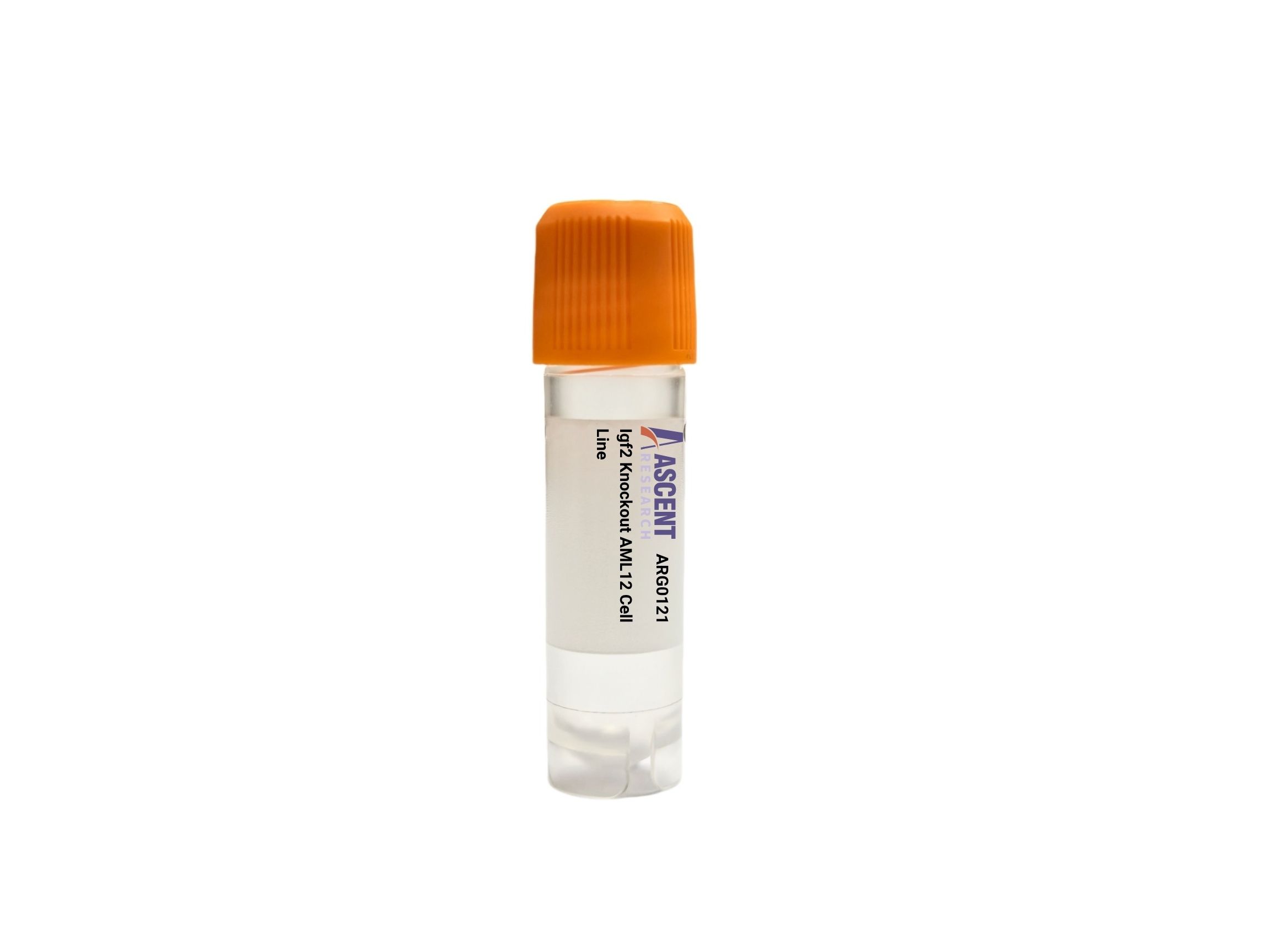
Igf2 Knockout AML12 is a CRISPR/Cas9-edited mouse hepatocyte-like cell line generated in the nontransformed AML12 background for studies of liver growth control, metabolism, and stress signaling. IGF2 normally acts through IGF1R and INSR to stimulate IRS1/IRS2-dependent PI3K-AKT-mTOR and MAPK signaling, influencing proliferation, survival, and glucose and lipid metabolic programs. Disruption of Igf2 provides a liver-relevant model for investigating IGF pathway regulation, imprinting-associated gene control at the Igf2/H19 locus, hepatocellular carcinoma biology, metabolic liver disease, and responses measured by phospho-signaling, ELISA, RT-qPCR, RNA-seq, and metabolic or drug sensitivity assays.
 FBN1 Knockout HT29 Polyclonal Cells
Cat. No. ARG14157
COPS7B Knockout Hela Polyclonal Cells
Cat. No. ARG8384
BCL7A Knockout huh-7 Polyclonal Cells
Cat. No. ARG28064
MYH7 Knockout KYSE30 Polyclonal Cells
Cat. No. ARG9731
FLG2 Knockout Raji Polyclonal Cells
Cat. No. ARG1390
FBN1 Knockout HT29 Polyclonal Cells
Cat. No. ARG14157
COPS7B Knockout Hela Polyclonal Cells
Cat. No. ARG8384
BCL7A Knockout huh-7 Polyclonal Cells
Cat. No. ARG28064
MYH7 Knockout KYSE30 Polyclonal Cells
Cat. No. ARG9731
FLG2 Knockout Raji Polyclonal Cells
Cat. No. ARG1390
 Human Annulus Fibrosus Cell Medium
Cat. No. ARM0159
Human Annulus Fibrosus Cell Medium
Cat. No. ARM0159
The Igf2 Knockout AML12 Cell Line is a CRISPR/Cas9-engineered mouse hepatocyte model in which the Igf2 gene has been disrupted to eliminate functional IGF2 expression. This stable gene-edited cell line is generated in AML12 cells, a nontransformed hepatocyte-like epithelial cell line, and provides an in vitro system for examining the consequences of Igf2 loss in liver parenchymal cells. Because IGF2 is a secreted growth factor with established roles in growth control, survival, and anabolic metabolism, this knockout model is suited for mechanistic studies of hepatocyte signaling and phenotype under defined culture conditions.
AML12 is an immortalized mouse liver parenchymal cell line with differentiated hepatocyte-like characteristics and is widely used to model hepatic metabolism, insulin responsiveness, lipid homeostasis, and cellular stress responses. As a nontransformed background, AML12 supports investigation of growth factor signaling without many of the confounding alterations present in highly transformed liver cancer models. The line is therefore useful for studies of hepatocyte proliferation, nutrient sensing, glucose and lipid metabolic regulation, and toxicologic stress, as well as for examining signaling crosstalk relevant to metabolic liver disease and hepatocellular carcinoma.
IGF2 functions as an autocrine and paracrine ligand that activates IGF1R and insulin receptor isoform A, engaging adaptor and effector proteins including IRS1, IRS2, SHC1, GRB2, and SOS1. These signaling inputs act upstream of PI3K-PDK1-AKT and HRAS-RAF1-MAP2K1-MAPK1 cascades, promoting phosphorylation of AKT and ERK1/2 and downstream activation of MTOR-RPTOR signaling, RPS6KB1/S6K, and EIF4EBP1/4E-BP1. IGF2 signaling also modulates FOXO transcription factors, GSK3B, cell-cycle progression, survival programs, and hepatic glucose and lipid metabolic outputs. At the regulatory level, Igf2 expression is controlled by genomic imprinting at the Igf2/H19 locus, with CTCF, DNA methylation, PLAG1, E2F transcription factors, developmental growth cues, and nutrient or hormonal status influencing transcript abundance. Dysregulation of this axis has broad relevance to overgrowth syndromes, insulin resistance, fatty liver disease, and cancer biology.
In AML12 cells, Igf2 knockout enables analysis of how loss of an endogenous growth factor reshapes hepatocyte-like signaling architecture and metabolic behavior. This context is particularly informative for defining dependence on local IGF signaling, separating ligand-driven effects from receptor-proximal mechanisms, and evaluating compensatory responses involving IGF1R, INSR, or IGF-binding proteins such as IGFBP1, IGFBP2, and IGFBP3. The model can support studies of growth control, stress adaptation, and pathway rewiring in a liver-relevant epithelial background.
Applications include RT-qPCR and RNA-seq analysis of imprinting-associated regulation and hepatic transcriptional programs; western blot or immunofluorescence assessment of phospho-AKT, phospho-ERK, RPS6KB1, and EIF4EBP1 signaling states; ELISA-based measurement of IGF2 depletion; and functional profiling by proliferation, apoptosis, glucose uptake, lipid accumulation, and other metabolic assays. The cell line is also applicable to drug sensitivity studies targeting IGF1R/INSR, PI3K-AKT-mTOR, or MAPK pathway components, as well as reporter assays and comparative analyses of hepatocyte survival or anabolic signaling under nutrient, hormonal, or toxicologic perturbation. Researchers may contact Ascent Research for additional technical information, product details, or related gene-edited cell models.