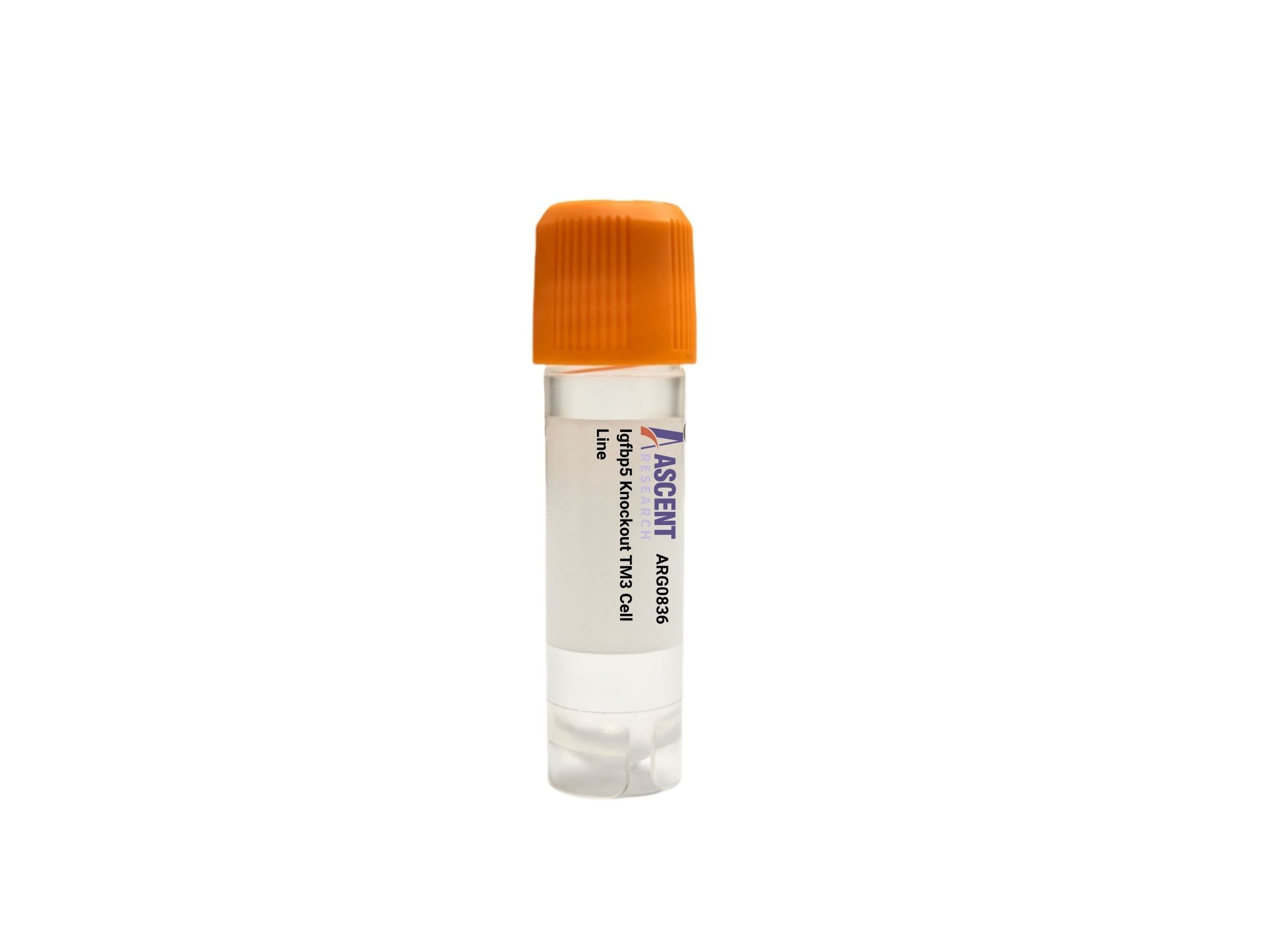
Genome-edited Cells
Testis
The Igfbp5 Knockout TM3 Cell Line is a CRISPR/Cas9-edited knockout cell line from Mus musculus, providing a loss-of-function model for insulin-like growth factor binding protein 5 in Leydig cells. IGFBP5 regulates IGF bioavailability and interacts with fibronectin, affecting PI3K-AKT and MAPK pathways, apoptosis (BAX/BCL2, CASP3), and cell adhesion. This model is suited for investigating testosterone synthesis, reproductive toxicity, and fertility. Standard assays include Western blotting for STAR and CYP11A1, ELISA for testosterone, cAMP quantification, and apoptosis/proliferation analyses via TUNEL or MTT.
 TP53 Knockout Marc-145 Cell Line
Cat. No. ARG44179
TP53 Knockout Marc-145 Cell Line
Cat. No. ARG44179
 AKAP13 Knockout MES-OV Polyclonal Cells
Cat. No. ARG24094
ANKS1A Knockout NCI-H1975 Polyclonal Cells
Cat. No. ARG31133
DECR2 Knockout HCT116 Polyclonal Cells
Cat. No. ARG6907
NUCB2 Knockout 786-O Polyclonal Cells
Cat. No. ARG5682
AKAP13 Knockout MES-OV Polyclonal Cells
Cat. No. ARG24094
ANKS1A Knockout NCI-H1975 Polyclonal Cells
Cat. No. ARG31133
DECR2 Knockout HCT116 Polyclonal Cells
Cat. No. ARG6907
NUCB2 Knockout 786-O Polyclonal Cells
Cat. No. ARG5682
 SW1417
Cat. No. ARC0912
SW1417
Cat. No. ARC0912
The Igfbp5 Knockout TM3 Cell Line is a CRISPR/Cas9-edited knockout cell line derived from Mus musculus, enabling stable disruption of the insulin-like growth factor binding protein 5 (Igfbp5) gene in an immortalized Leydig cell background. This model facilitates loss-of-function studies of IGFBP5, which modulates both IGF-dependent and IGF-independent signaling pathways critical for cell growth, differentiation, and apoptosis.
The parental TM3 cell line originates from BALB/c mouse testis and serves as a well-characterized Leydig cell model. These cells retain key steroidogenic functions, including androgen production and testosterone synthesis in response to luteinizing hormone (LH) stimulation, making them ideal for studying testicular interstitial cell biology and reproductive endocrinology.
IGFBP5 regulates insulin-like growth factor (IGF) bioavailability by binding IGF1 and IGF2, thereby controlling IGF1R activation. It also exerts IGF-independent effects through interactions with extracellular matrix proteins such as fibronectin, laminin, and integrins. Upstream regulators include TP53, progesterone, retinoic acid, cAMP, androgens, and glucocorticoids. Downstream, IGFBP5 influences the PI3K-AKT and MAPK pathways, modulates the BAX/BCL2 balance, activates CASP3, induces CDKN1A, and inhibits IGF1R signaling, thereby integrating multiple signals that govern cell survival and proliferation.
In TM3 Leydig cells, knockout of Igfbp5 likely enhances IGF1-mediated activation of PI3K-AKT and MAPK cascades, potentially increasing steroidogenic gene expression (e.g., STAR, CYP11A1) and testosterone output. Concurrent loss of pro-apoptotic IGFBP5 functions??such as caspase activation and CDKN1A induction??may shift cells toward proliferation, offering a model to dissect IGF-dependent versus -independent regulation of Leydig cell fate.
This cell line is applicable to reproductive toxicity screening, apoptosis studies, and drug testing for agents affecting testosterone synthesis. Representative assays include Western blotting (IGFBP5, STAR, CYP11A1), RT-qPCR (Igfbp5, steroidogenic genes), ELISA (testosterone), cAMP assays, TUNEL, BrdU/MTT proliferation assays, immunofluorescence, and RNA-seq. For further information, contact Ascent Research.