Genome-edited Cells
Kidney
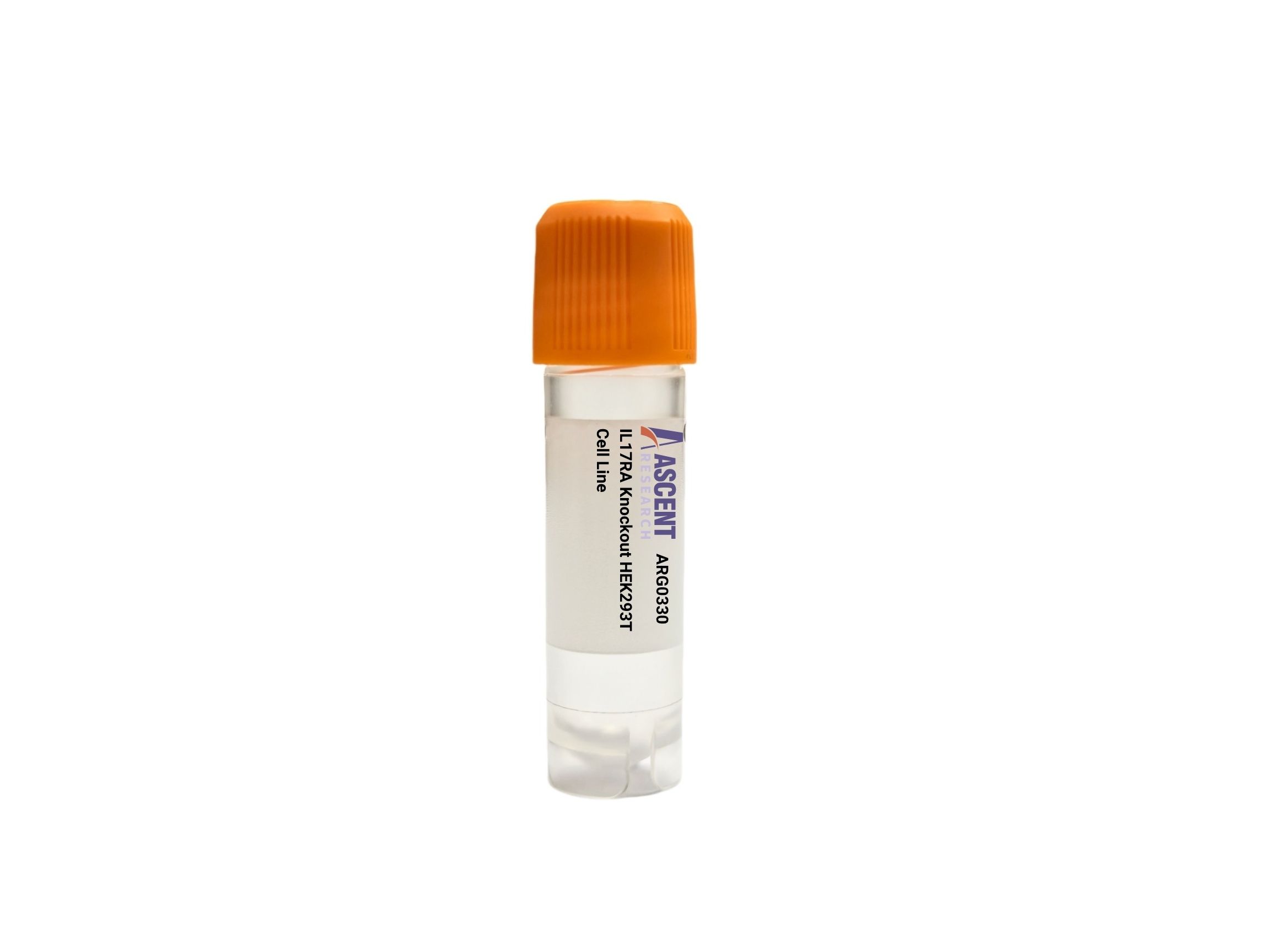
The IL17RA Knockout HEK293T Cell Line is a CRISPR/Cas9-edited knockout cell line derived from HEK293T cells, lacking the interleukin-17 receptor A subunit. This model abolishes IL-17A/F-induced signaling via the Act1/TRAF6 axis, preventing NF-??B and MAPK-driven expression of targets such as IL-6 and CXCL8. It is ideal for studying IL-17-dependent inflammatory pathways in diseases like psoriasis and rheumatoid arthritis, and for screening IL-17 inhibitors. Applications include luciferase reporter assays, RT-qPCR, and phospho-signaling analysis. Contact Ascent Research for more information.
 PABPC1L Knockout NCI-H1975 Polyclonal Cells
Cat. No. ARG17191
GAMT Knockout jurkat Polyclonal Cells
Cat. No. ARG13373
CSK Knockout A549 Polyclonal Cells
Cat. No. ARG10907
ACSS2 Knockout NCI-H1299 Polyclonal Cells
Cat. No. ARG30224
KIAA1191 Knockout HGC-27 Polyclonal Cells
Cat. No. ARG30112
IL1R1 Knockout Lovo Polyclonal Cells
Cat. No. ARG36388
PABPC1L Knockout NCI-H1975 Polyclonal Cells
Cat. No. ARG17191
GAMT Knockout jurkat Polyclonal Cells
Cat. No. ARG13373
CSK Knockout A549 Polyclonal Cells
Cat. No. ARG10907
ACSS2 Knockout NCI-H1299 Polyclonal Cells
Cat. No. ARG30224
KIAA1191 Knockout HGC-27 Polyclonal Cells
Cat. No. ARG30112
IL1R1 Knockout Lovo Polyclonal Cells
Cat. No. ARG36388
The IL17RA Knockout HEK293T Cell Line is a CRISPR/Cas9-edited knockout cell line derived from HEK293T cells. By disrupting the IL17RA gene, it eliminates expression of the interleukin-17 receptor A subunit, a key mediator of IL-17-driven pro-inflammatory signaling. This loss-of-function model enables precise dissection of IL-17-dependent pathways and cytokine responses in a defined cellular background.
The HEK293T host cell line is an immortalized human embryonic kidney epithelial line with an adherent phenotype, transformed with SV40 large T antigen. It is widely used for recombinant protein expression, efficient lentivirus production, and transient transfection due to its high transfectability and robust growth.
IL17RA is a transmembrane receptor that forms complexes with IL17RC to bind IL-17A, IL-17F, and the IL-17A/F heterodimer. Ligand engagement triggers recruitment of the adaptor Act1 (TRAF3IP2) via SEFIR domains, which then engages TRAF6. This activates kinases TAK1 and MEKK3, leading to IKK and MAPK (ERK, JNK, p38) phosphorylation. Consequently, NF-??B and C/EBP transcription factors drive expression of pro-inflammatory mediators such as IL-6, CXCL8, CXCL1, CCL20, beta-defensins, and S100A7. Knockout of IL17RA abrogates all IL-17-dependent signaling, providing a null background for receptor studies.
HEK293T cells exhibit low basal IL17RA expression, minimizing endogenous pathway interference. This makes the knockout line ideal for reconstitution with wild-type or mutant IL17RA to study structure-function relationships and disease-associated variants. The model also facilitates investigation of crosstalk with TNF-?? or IL-1?? signaling. It can be readily adapted with lentiviral reporters for high-throughput screening.
This IL17RA knockout cell line supports diverse applications in immunology and drug discovery. It is particularly suited for studying IL-17-mediated inflammatory mechanisms in diseases such as psoriasis, rheumatoid arthritis, multiple sclerosis, inflammatory bowel disease, and asthma. Standard assays include NF-??B luciferase reporter assays to measure transcriptional activation, phospho-signaling analysis by western blotting or flow cytometry, and quantitative gene expression analysis via RT-qPCR or ELISA for downstream targets like IL-6 and CXCL8. The cell line also enables screening of small-molecule inhibitors or biologics aimed at disrupting IL-17 signaling. For technical specifications and licensing inquiries, contact Ascent Research.