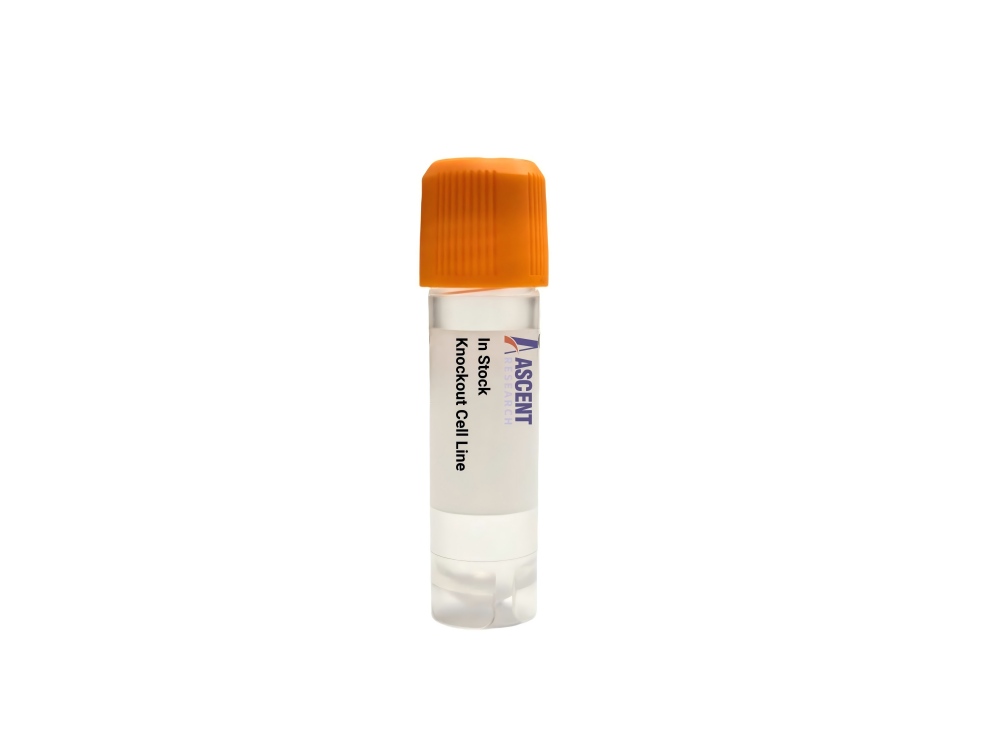
In Stock Cell Lines
Homo sapiens (Human)
Blood (peripheral blood)
Suspension
The IL23R Knockout THP-1 Cell Line is a CRISPR/Cas9-edited human monocytic cell line engineered to disrupt expression of the IL-23 receptor subunit. Derived from the widely used THP-1 acute monocytic leukemia line, these cells can be differentiated into macrophage-like cells, providing a physiologically relevant model for studying IL-23/Th17 pathway functions. IL23R forms a heterodimer with IL12RB1 to mediate pro-inflammatory signaling via JAK2/TYK2 kinases and downstream STAT3 activation, leading to expression of cytokines such as IL-17A and IL-22. This knockout cell line is ideal for investigating inflammatory disease mechanisms??including inflammatory bowel disease and psoriasis??and for screening compounds that target the IL-23 receptor axis.
 NBL1 Knockout A549 Polyclonal Cells
Cat. No. ARG10330
KLC1 Knockout Hela Polyclonal Cells
Cat. No. ARG26372
GAMT Knockout 786-O Polyclonal Cells
Cat. No. ARG5295
GM2A Knockout 786-O Polyclonal Cells
Cat. No. ARG4722
CENPB Knockout Raji Polyclonal Cells
Cat. No. ARG1576
NBL1 Knockout A549 Polyclonal Cells
Cat. No. ARG10330
KLC1 Knockout Hela Polyclonal Cells
Cat. No. ARG26372
GAMT Knockout 786-O Polyclonal Cells
Cat. No. ARG5295
GM2A Knockout 786-O Polyclonal Cells
Cat. No. ARG4722
CENPB Knockout Raji Polyclonal Cells
Cat. No. ARG1576
 Rat Aortic Arch Endothelial Cells
Cat. No. ARP0206
Rat Aortic Arch Endothelial Cells
Cat. No. ARP0206
The IL23R Knockout THP-1 Cell Line is a CRISPR/Cas9-edited human cell line that features targeted disruption of the IL23R gene. This knockout cell line is derived from the THP-1 monocytic leukemia cell line and provides a defined loss-of-function model for studying interleukin-23 (IL-23) receptor signaling. The product is supplied as an engineered cell line suitable for direct use in functional assays, pathway analysis, and drug development applications.
THP-1 cells are spontaneously immortalized human monocytic cells isolated from the peripheral blood of a one-year-old male with acute monocytic leukemia. This cell line exhibits monocyte-like characteristics and can be induced to differentiate into macrophage-like cells upon treatment with phorbol esters such as PMA. THP-1 is widely used to investigate monocyte and macrophage biology, including phagocytosis, cytokine production, and inflammatory signaling. Its capacity to model both resting and activated macrophage states makes it an ideal host for studying IL-23/Th17 pathway-related processes.
IL23R encodes a subunit of the interleukin-23 receptor, which upon IL-23 binding pairs with IL12RB1 to activate the associated kinases JAK2 and TYK2. This triggers phosphorylation of STAT3 and transcription of Th17 cytokines such as IL17A, IL17F, and IL22. Upstream regulators include IL-23, IL-6, TGF-??, and IL-21, which promote STAT3 and RORC expression. SOCS3 acts as a feedback inhibitor. Disruption of IL23R blocks receptor assembly, preventing JAK/STAT signaling and subsequent pro-inflammatory gene expression, making the cell line a precise tool for dissecting IL-23-dependent pathways.
In THP-1 macrophages, IL23R knockout abrogates IL-23-induced inflammatory programs, establishing a model relevant to autoimmune and autoinflammatory diseases such as inflammatory bowel disease, psoriasis, and ankylosing spondylitis. The THP-1 background enables controlled analysis of macrophage-intrinsic signaling and paracrine effects on T cells. This line facilitates dissection of how macrophages propagate Th17 responses and serves as a platform for evaluating inhibitors of the IL-23 receptor axis.
Applications include cytokine signaling analysis, macrophage differentiation studies, and drug screening for anti-inflammatory agents. Assays such as PMA-triggered differentiation, phospho-STAT3 flow cytometry, ELISA for IL-17A and IL-22, and co-culture with T cells are routinely performed. The engineered cells also support luciferase reporter assays and high-throughput compound screening. For further details, please contact Ascent Research.