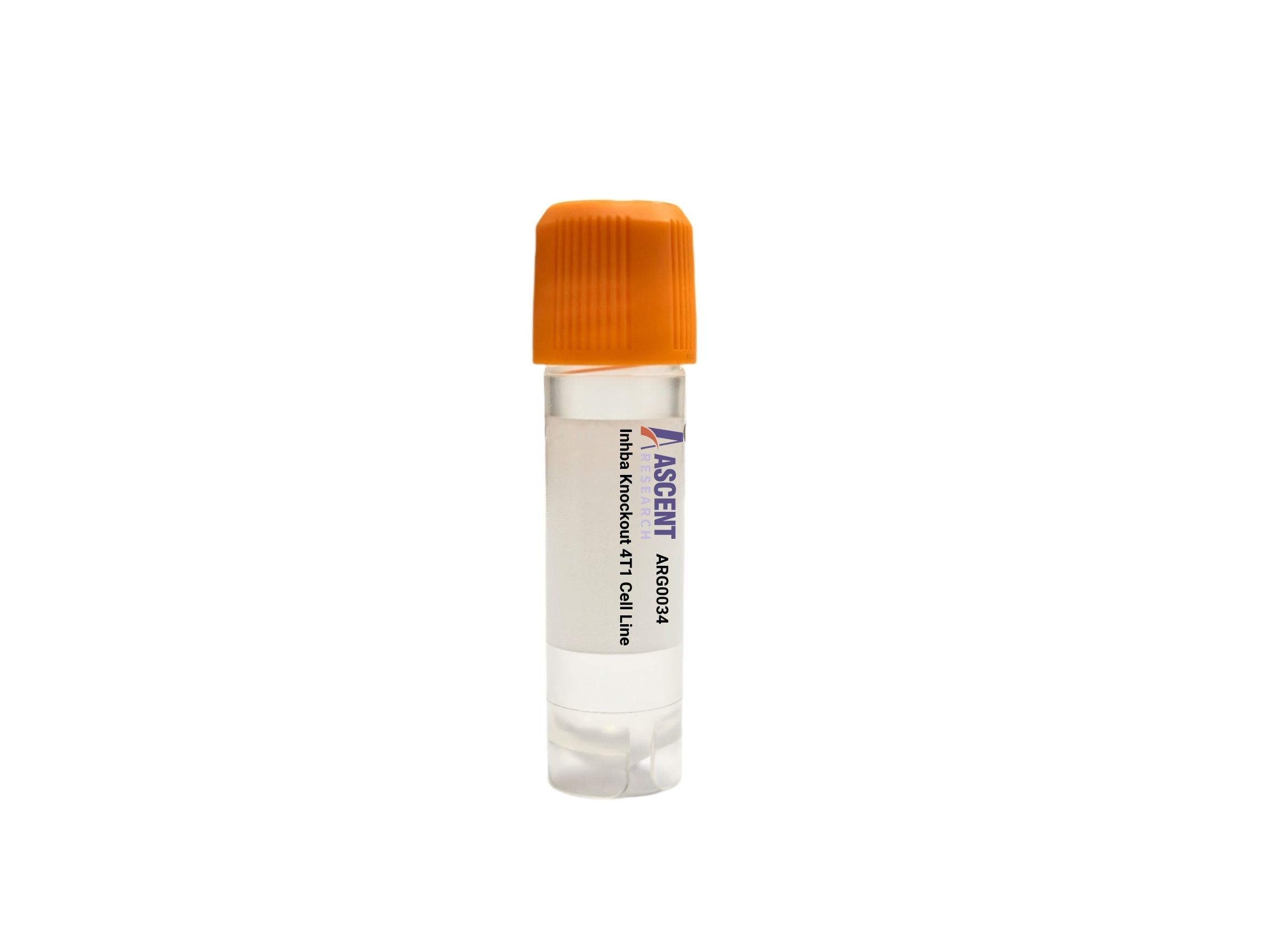
Genome-edited Cells
Breast (mammary gland)
The Inhba Knockout 4T1 Cell Line is a CRISPR/Cas9-engineered mouse mammary carcinoma model generated in the metastatic 4T1 triple-negative breast cancer background. INHBA encodes inhibin beta A, which forms activin A or activin AB and signals through ACVR2A/ACVR2B and ACVR1B to activate SMAD2/3-SMAD4 transcriptional programs. Disruption of Inhba enables loss-of-function studies of activin signaling, EMT-associated regulation, migration, invasion, and tumor-microenvironment communication in an immune-relevant syngeneic system. Applications include phospho-SMAD2/3 analysis, RT-qPCR, RNA-seq, ELISA for activin A, migration and invasion assays, and in vivo metastasis studies.
 DAGLB Knockout NCI-H1299 Polyclonal Cells
Cat. No. ARG17722
CRTC1 Knockout NCI-H1975 Polyclonal Cells
Cat. No. ARG17138
ATAD2B Knockout huh-7 Polyclonal Cells
Cat. No. ARG28011
AGFG1 Knockout huh-7 Polyclonal Cells
Cat. No. ARG27827
KCNK3 Knockout 786O Polyclonal Cells
Cat. No. ARG35743
DAGLB Knockout NCI-H1299 Polyclonal Cells
Cat. No. ARG17722
CRTC1 Knockout NCI-H1975 Polyclonal Cells
Cat. No. ARG17138
ATAD2B Knockout huh-7 Polyclonal Cells
Cat. No. ARG28011
AGFG1 Knockout huh-7 Polyclonal Cells
Cat. No. ARG27827
KCNK3 Knockout 786O Polyclonal Cells
Cat. No. ARG35743
 GC-1spg
Cat. No. ARI0036
GC-1spg
Cat. No. ARI0036
The Inhba Knockout 4T1 Cell Line is a CRISPR/Cas9-engineered mouse mammary carcinoma model in which the Inhba gene has been disrupted to eliminate functional expression of inhibin beta A. This gene-edited derivative of 4T1 provides a stable in vitro system for investigating loss of activin-related signaling in an aggressive breast cancer setting. The model is designed for studies requiring defined perturbation of a TGF-beta superfamily ligand component within tumor epithelial cells and is suitable for mechanistic, phenotypic, and translational research applications.
4T1 is a murine mammary carcinoma cell line derived from BALB/c mouse and is widely used as a syngeneic model of highly invasive, metastatic triple-negative breast cancer. It recapitulates key features of aggressive disease biology, including tumor growth, dissemination, and strong tumor-host immune interactions. Because 4T1 cells are frequently applied in studies of metastatic progression, epithelial-mesenchymal transition, extracellular matrix remodeling, and immune-relevant tumor biology, they provide an experimentally valuable host background for assessing how disruption of specific signaling nodes alters malignant phenotype and microenvironmental communication.
INHBA encodes the beta A subunit of inhibin/activin ligands and forms activin A homodimers as well as activin AB heterodimers with INHBB. Activin ligands signal through ACVR2A or ACVR2B together with ACVR1B/ALK4, resulting in phosphorylation and activation of SMAD2 and SMAD3, followed by SMAD4-dependent transcriptional regulation. INHBA activity is regulated upstream by factors including TGF-beta1, SMAD3, NF-kB, hypoxia-associated HIF-1alpha signaling, inflammatory cytokines, and MAPK pathway inputs. Its signaling output is modulated by extracellular binding proteins such as follistatin (FST) and FSTL3, and by accessory components including TGFBR3/betaglycan. Downstream consequences of activin pathway engagement can include altered expression of SERPINE1/PAI-1, CDKN1A/p21, MMP2, MMP9, and SNAI1, linking INHBA to SMAD2/3 transcriptional programs, migration, invasion, EMT-associated gene regulation, and extracellular matrix remodeling.
In the 4T1 context, loss of Inhba provides a focused model for examining activin-dependent contributions to tumor progression and metastatic behavior. Because 4T1 cells are strongly relevant to triple-negative breast cancer and immune-competent tumor studies, this knockout can support dissection of how autocrine or paracrine activin signaling influences proliferation, colony formation, invasiveness, and gene-expression states associated with stemness, fibrosis-related signaling, or cachexia-relevant secretory programs.
This cell line can be applied in pathway loss-of-function studies using phospho-SMAD2/3 analysis, SMAD-responsive luciferase reporter assays, RT-qPCR, western blotting, and RNA-seq to characterize transcriptional and signaling changes downstream of Inhba disruption. It is also suitable for ELISA-based analysis of activin A, immunofluorescence or flow cytometry for phenotypic profiling, and functional assays including proliferation, apoptosis, migration, invasion, and colony formation. In vivo syngeneic tumor growth and metastasis studies may further enable evaluation of Inhba-dependent tumor-microenvironment interactions and therapeutic target validation for modulators of activin or broader TGF-beta superfamily signaling. Researchers may contact Ascent Research for additional technical information, product details, or related gene-edited cell models.