Genome-edited Cells
Bone
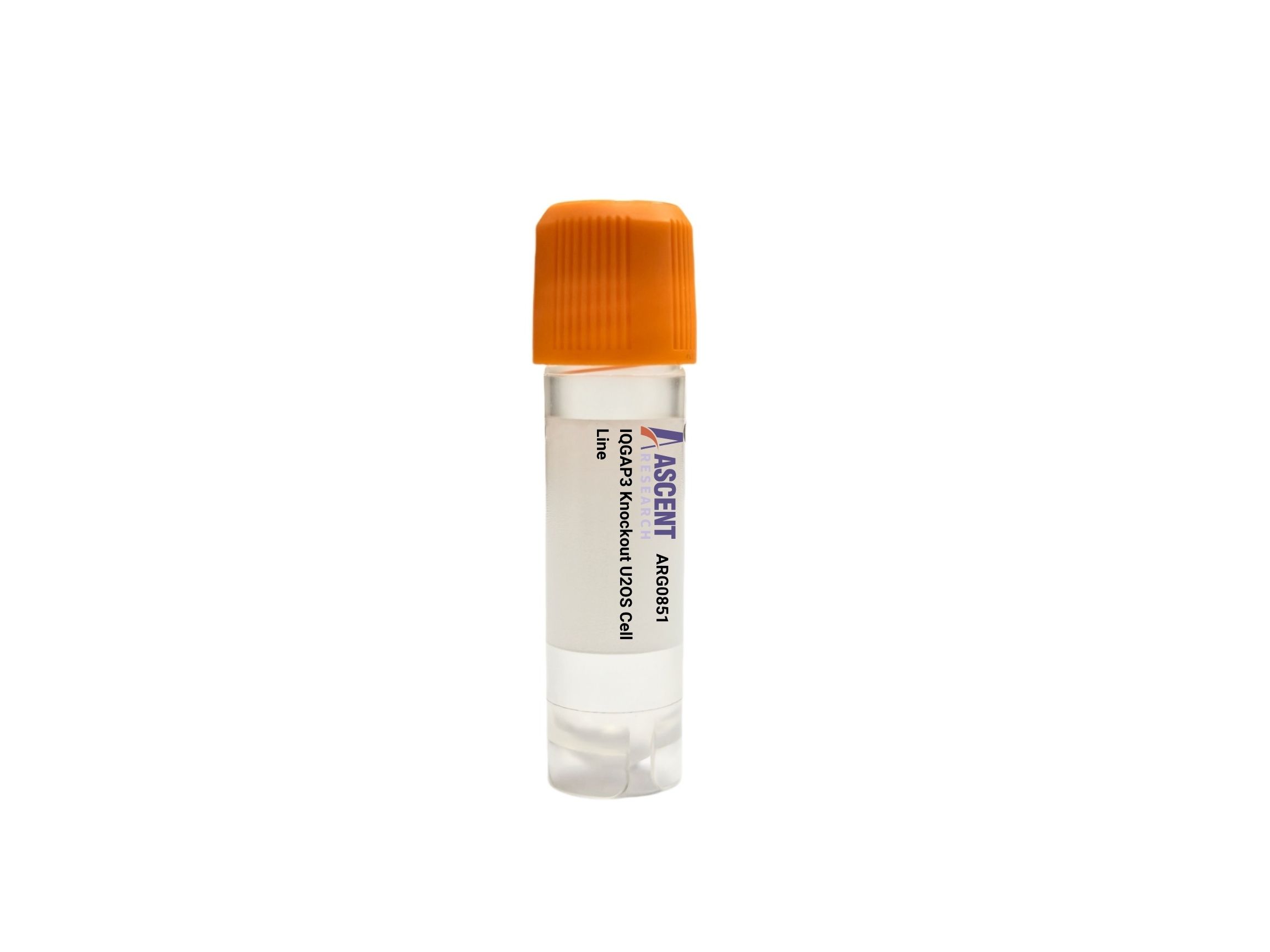
The IQGAP3 Knockout U2OS Cell Line is a CRISPR/Cas9-edited human osteosarcoma U2OS cell line featuring disruption of the IQGAP3 gene. IQGAP3 encodes a multi-domain scaffold that integrates EGF, HGF, and Wnt/??-catenin signals to coordinate actin dynamics and cell cycle entry. Derived from a moderately differentiated tibial osteosarcoma, U2OS cells provide a relevant background for bone cancer studies. Knockout of IQGAP3 impairs Rac1/Cdc42-mediated cytoskeletal reorganization and ERK/MAPK-driven proliferation, making this model valuable for metastasis, invasion, and drug sensitivity assays. Standard applications include transwell migration, wound healing, immunofluorescence for actin, and co-immunoprecipitation of IQGAP3 partners such as ??-catenin and calmodulin.
 P2RX4 Knockout A2780 Polyclonal Cells
Cat. No. ARG18628
CEP131 Knockout HEK293T Polyclonal Cells
Cat. No. ARG4038
BCORL1 Knockout A549 Polyclonal Cells
Cat. No. ARG31933
CARS2 Knockout 786-O Polyclonal Cells
Cat. No. ARG42349
MYO6 Knockout 786-O Polyclonal Cells
Cat. No. ARG4725
P2RX4 Knockout A2780 Polyclonal Cells
Cat. No. ARG18628
CEP131 Knockout HEK293T Polyclonal Cells
Cat. No. ARG4038
BCORL1 Knockout A549 Polyclonal Cells
Cat. No. ARG31933
CARS2 Knockout 786-O Polyclonal Cells
Cat. No. ARG42349
MYO6 Knockout 786-O Polyclonal Cells
Cat. No. ARG4725
 Human Esophageal Microvascular Endothelial Cell Medium
Cat. No. ARM0040
Human Esophageal Microvascular Endothelial Cell Medium
Cat. No. ARM0040
The IQGAP3 Knockout U2OS Cell Line is a genetically engineered human osteosarcoma cell line in which the IQGAP3 gene has been disrupted using CRISPR/Cas9-mediated gene editing. This cell line serves as a stable loss-of-function model for investigating the scaffolding functions of IQGAP3 in actin cytoskeleton dynamics, cell migration, and proliferation. The CRISPR/Cas9 approach introduces targeted disruptions within the IQGAP3 locus, abrogating functional protein expression, and providing a reliable tool for dissecting IQGAP3-dependent signaling networks in a bone cancer context.
The parental U2OS cell line is a widely utilized human osteosarcoma model originally derived from a moderately differentiated sarcoma of the tibia. U2OS cells are characterized by their adherent epithelial-like morphology, p53 wild-type status, and robust expression of osteoblastic markers, making them a standard system for studying bone cancer biology, osteoblast differentiation, and cellular responses to genotoxic stress. This knockout derivative retains the essential genetic background of U2OS, allowing direct comparison to wild-type controls in experiments examining osteosarcoma progression and metastasis.
IQGAP3 (IQ motif-containing GTPase-activating protein 3) functions as a multi-domain scaffold that integrates extracellular cues to regulate the actin cytoskeleton and cell cycle progression. It is activated downstream of growth factors such as EGF and HGF, and is transcriptionally upregulated by the ??-catenin/TCF complex upon Wnt signaling activation. IQGAP3 directly binds to actin, calmodulin, and the small GTPases Rac1 and Cdc42, facilitating their activation. Key effector pathways include the Rac1/Cdc42??PAK??LIMK??Cofilin axis, which controls actin filament dynamics and cell motility, and the ERK/MAPK pathway, which promotes Cyclin D1 expression and G1/S transition. Additionally, IQGAP3 interacts with APC, CLIP-170, and ??-catenin, linking microtubule plus-end tracking to cytoskeletal coordination and intercellular adhesion via E-cadherin modulation.
In the U2OS osteosarcoma background, IQGAP3 is implicated in maintaining the aggressive migratory and proliferative phenotype characteristic of bone cancers. Disruption of IQGAP3 in this cell line is expected to attenuate growth factor-induced actin remodeling, impair directed cell migration, and reduce ERK/MAPK-dependent cell cycle entry, thus providing a physiologically relevant model for studying metastatic dissemination and therapeutic resistance. The U2OS-specific genetic milieu, including its p53 status and osteoblastic gene expression profile, permits nuanced investigation of IQGAP3??s role in bone tumorigenesis and its crosstalk with pathways frequently altered in osteosarcoma, such as PI3K/Akt and Wnt signaling.
This knockout cell line is suitable for a broad range of functional studies. Researchers can employ transwell migration and invasion assays to quantify the effect of IQGAP3 loss on mesenchymal motility, and wound healing assays to assess collective cell migration. Immunofluorescence staining for F-actin or E-cadherin localizes cytoskeletal and adhesion defects, while Western blotting and RT-qPCR confirm downstream effector changes in the ERK/MAPK and Cyclin D1 signaling modules. Cell cycle analysis by flow cytometry and MTS/MTT proliferation assays characterize IQGAP3??s impact on mitotic progression and viability. Co-immunoprecipitation experiments can validate interactions with Rac1, Cdc42, or ??-catenin, and drug sensitivity screens may reveal IQGAP3-dependent vulnerabilities in osteosarcoma. These applications make the IQGAP3 Knockout U2OS Cell Line a versatile platform for cancer cell biology and targeted therapy discovery. For additional information or to discuss your specific requirements, please contact Ascent Research.