Genome-edited Cells
Blood (peripheral blood)
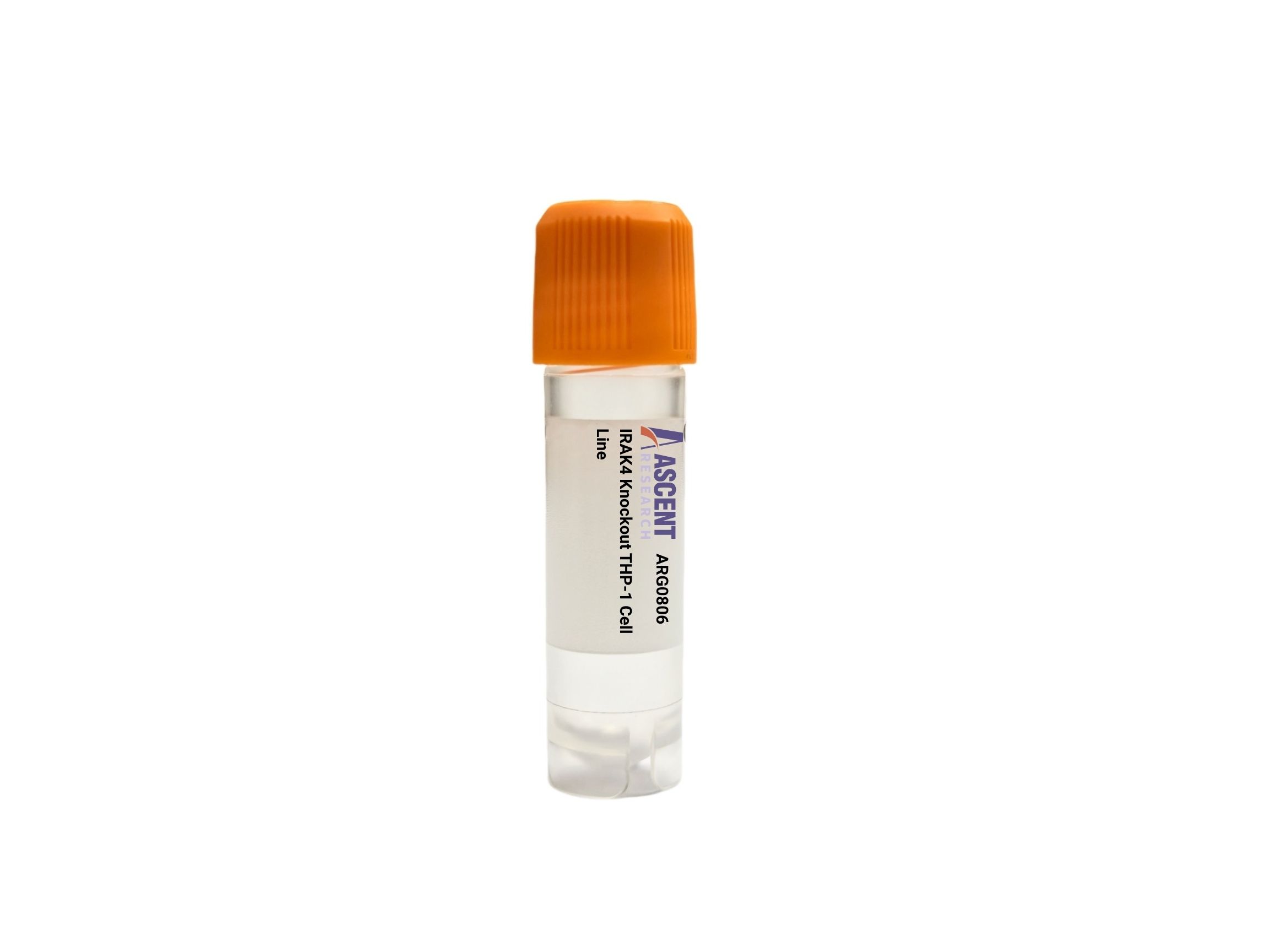
The IRAK4 Knockout THP-1 Cell Line is a CRISPR/Cas9-edited knockout cell line derived from the human monocytic THP-1 cell line, with targeted disruption of the IRAK4 gene. IRAK4 encodes a critical serine/threonine kinase that mediates MyD88-dependent signaling downstream of Toll-like receptors (TLRs) and the IL-1 receptor, leading to NF-??B and MAPK activation and production of pro-inflammatory cytokines such as TNF-?? and IL-6. This knockout model abrogates innate immune responses in a macrophage-like context, enabling studies on IRAK-4 deficiency, immunodeficiency, and inflammatory diseases. It serves as a powerful platform for dissecting TLR/IL-1R pathways, screening IRAK4 inhibitors, and evaluating anti-inflammatory drug candidates in a relevant human monocytic background.
 CXCR4 Knockout A549 Polyclonal Cells
Cat. No. ARG10727
ARHGAP18 Knockout SK-HEP-1 Polyclonal Cells
Cat. No. ARG32239
BST2 Knockout huh-7 Polyclonal Cells
Cat. No. ARG28122
ESYT1 Knockout PATU8988T Polyclonal Cells
Cat. No. ARG11331
MELK Knockout Hepa 1-6 Polyclonal Cells
Cat. No. ARG11280
MGST3 Knockout Raji Polyclonal Cells
Cat. No. ARG1394
CXCR4 Knockout A549 Polyclonal Cells
Cat. No. ARG10727
ARHGAP18 Knockout SK-HEP-1 Polyclonal Cells
Cat. No. ARG32239
BST2 Knockout huh-7 Polyclonal Cells
Cat. No. ARG28122
ESYT1 Knockout PATU8988T Polyclonal Cells
Cat. No. ARG11331
MELK Knockout Hepa 1-6 Polyclonal Cells
Cat. No. ARG11280
MGST3 Knockout Raji Polyclonal Cells
Cat. No. ARG1394
The IRAK4 Knockout THP-1 Cell Line is a CRISPR/Cas9-edited knockout cell line derived from the THP-1 human monocytic leukemia cell line. This product features targeted disruption of the IRAK4 gene, generating a loss-of-function model that abolishes IRAK4 protein expression and downstream signaling, providing a robust tool for studying innate immune pathways.
THP-1 cells, upon differentiation with PMA into macrophage-like cells, exhibit key features of primary macrophages including adherence, phagocytosis, and inflammatory cytokine production. As a well-established monocyte/macrophage model, THP-1 cells are widely used to investigate human innate immunity and inflammatory responses.
IRAK4 is a serine/threonine kinase that acts as a central adaptor in MyD88-dependent signaling cascades downstream of Toll-like receptors (TLRs) and the interleukin-1 receptor (IL-1R). Upon exposure to TLR ligands such as LPS, flagellin, or CpG DNA, or cytokines IL-1?? and IL-18, IRAK4 is recruited to the receptor complex via MyD88. It subsequently phosphorylates IRAK1, triggering the recruitment and activation of TRAF6 and the TAK1?CTAB1?CTAB2 kinase complex. This leads to activation of the IKK complex, which phosphorylates I??B and enables NF-??B nuclear translocation, as well as activation of MAP kinases p38 and JNK. These pathways converge to induce expression of pro-inflammatory cytokines (TNF-??, IL-6, IL-1??), chemokines, and interferon regulatory factors. IRAK4 also interacts with IRAK2 and Pellino proteins, which contribute to signal diversification. Consequently, disruption of IRAK4 abolishes innate immune responses to a wide array of stimuli.
In the THP-1 macrophage model, IRAK4 knockout profoundly impairs TLR/IL-1R-dependent inflammatory cytokine production and downstream gene expression. This recapitulates features of human IRAK-4 deficiency, a primary immunodeficiency characterized by heightened susceptibility to pyogenic bacterial infections. The knockout cell line provides a genetically clean background to dissect IRAK4-dependent and -independent branches of innate signaling, enabling detailed mechanistic studies. It is also valuable for investigating the role of IRAK4 in macrophage differentiation, polarization, and inflammatory pathologies, including sepsis and autoimmune disorders.
This cell line supports a variety of experimental applications, including western blot analysis of phosphorylated NF-??B and MAP kinases, RT-qPCR and ELISA-based quantification of pro-inflammatory cytokines, and NF-??B-dependent luciferase reporter assays. Protein interaction studies can be performed via co-immunoprecipitation of MyD88 and IRAK4. TLR ligand stimulation assays, flow cytometry for surface receptor expression, and functional phagocytosis assays are also feasible. The model is ideal for screening small-molecule IRAK4 inhibitors and assessing anti-inflammatory drug candidates in a human monocyte/macrophage system. For further technical information and purchasing details, please contact Ascent Research.