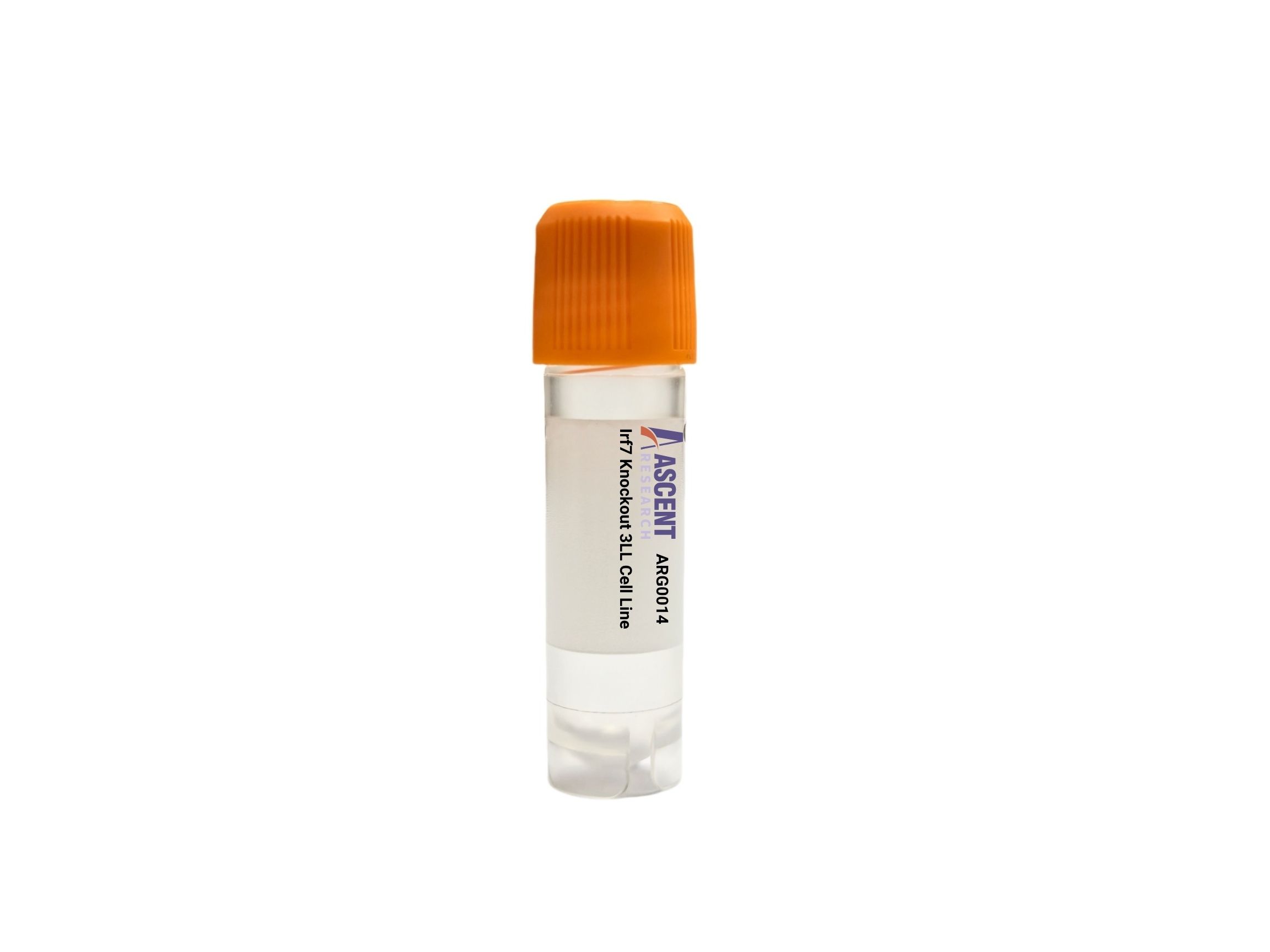
Genome-edited Cells
Lung
Irf7 Knockout 3LL is a CRISPR/Cas9-edited mouse Lewis lung carcinoma cell line with disruption of the master interferon regulator Irf7. In 3LL tumor cells, IRF7 functions downstream of nucleic acid sensing pathways involving MYD88, STING/TMEM173, TBK1, and IKBKE to drive type I interferon and interferon-stimulated gene expression, including Ifnb1, Cxcl10, and Isg15. This model supports studies of tumor cell-intrinsic antiviral signaling, STING and TLR pathway responses, cancer immunology, tumor-immune interactions, cytokine regulation, and immunotherapy-related mechanisms using assays such as RT-qPCR, RNA-seq, ELISA, western blotting, and viral challenge.
 CISD2 Knockout NCI-H1975 Polyclonal Cells
Cat. No. ARG16752
CHD9 Knockout jurkat Polyclonal Cells
Cat. No. ARG12933
IGF2BP3 Knockout HT29 Polyclonal Cells
Cat. No. ARG33424
DIAPH1 Knockout HAP1 Polyclonal Cells
Cat. No. ARG38745
CISD2 Knockout NCI-H1975 Polyclonal Cells
Cat. No. ARG16752
CHD9 Knockout jurkat Polyclonal Cells
Cat. No. ARG12933
IGF2BP3 Knockout HT29 Polyclonal Cells
Cat. No. ARG33424
DIAPH1 Knockout HAP1 Polyclonal Cells
Cat. No. ARG38745
 Anglne
Cat. No. ARC0049
Anglne
Cat. No. ARC0049
 KLF4 Knockout Hep 3B2.1-7 Cell Line
Cat. No. ARG0363
KLF4 Knockout Hep 3B2.1-7 Cell Line
Cat. No. ARG0363
The Irf7 Knockout 3LL Cell Line is a CRISPR/Cas9-engineered murine cancer cell model in which the Irf7 gene has been disrupted to eliminate functional IRF7 expression. This edited line is generated in 3LL cells, a mouse Lewis lung carcinoma background, to provide a stable in vitro system for investigating IRF7-dependent transcriptional regulation, innate immune signaling, and tumor cell-intrinsic interferon biology. The model is particularly relevant for studies requiring controlled interrogation of type I interferon pathway amplification in a lung tumor context.
3LL is an epithelial-like Lewis lung carcinoma cell line syngeneic to C57BL/6 mice and is widely used in transplantable tumor studies of lung cancer progression, metastatic behavior, and tumor-immune interactions. Because this host line is well established in experimental oncology and immunology, it provides a useful platform for examining how tumor cells respond to inflammatory cues, nucleic acid sensing agonists, and immunomodulatory conditions. Its murine origin and frequent use in syngeneic settings also support translationally relevant analyses of cancer-immune crosstalk and tumor-associated cytokine regulation.
IRF7 is a master interferon-regulatory transcription factor that functions downstream of endosomal and cytosolic nucleic acid sensing pathways. It is activated by signaling networks involving TLR7, TLR9, MYD88, IRAK1, TRAF6, MAVS, and STING/TMEM173, with phosphorylation and activation linked to TBK1 and IKBKE/IKKepsilon. IRF7 cooperates with transcriptional cofactors such as CBP/EP300 and intersects with IRF3 and the IFNAR1/IFNAR2-JAK1-TYK2-STAT1-STAT2-IRF9 axis to amplify type I interferon responses. Downstream, IRF7 promotes expression of Ifnb1, Ifna genes, and interferon-stimulated genes including Isg15, Ifit1, Ifit2, Ifit3, Oas1, Oas2, Rsad2/Viperin, Cxcl10, Ccl5, Mx1, and Mx2. Accordingly, Irf7 loss is expected to attenuate transcriptional amplification of antiviral and inflammatory programs relevant to viral infection, interferonopathies, innate immune dysregulation, and cancer immunology.
In the 3LL background, Irf7 knockout provides a focused system for dissecting how tumor cells integrate innate immune sensing with immune-modulatory output. This is useful for evaluating tumor cell-intrinsic contributions to interferon secretion, chemokine production, immune ligand regulation, and response to STING pathway activation or TLR agonism. The model can also support studies of tumor immune evasion, lung cancer inflammatory states, and pathway dependence in response to cytokine or nucleic acid stimulation.
Representative applications include RT-qPCR or RNA-seq profiling of interferon-stimulated transcriptional programs; western blotting for IRF7-associated signaling nodes and phospho-STAT1 or phospho-TBK1; ELISA-based quantification of IFN-beta or CXCL10; interferon-stimulated response element reporter assays; immunofluorescence analysis of IRF nuclear translocation; flow cytometry of immune surface markers; viral challenge assays to assess tumor cell-intrinsic antiviral competence; cytokine profiling under STING, RIG-I-like receptor, or TLR pathway stimulation; co-immunoprecipitation studies of signaling complexes; and drug sensitivity experiments examining responses to immunomodulatory or pathway-targeted agents. Researchers may contact Ascent Research for additional technical information, product details, or related gene-edited cell models.