Genome-edited Cells
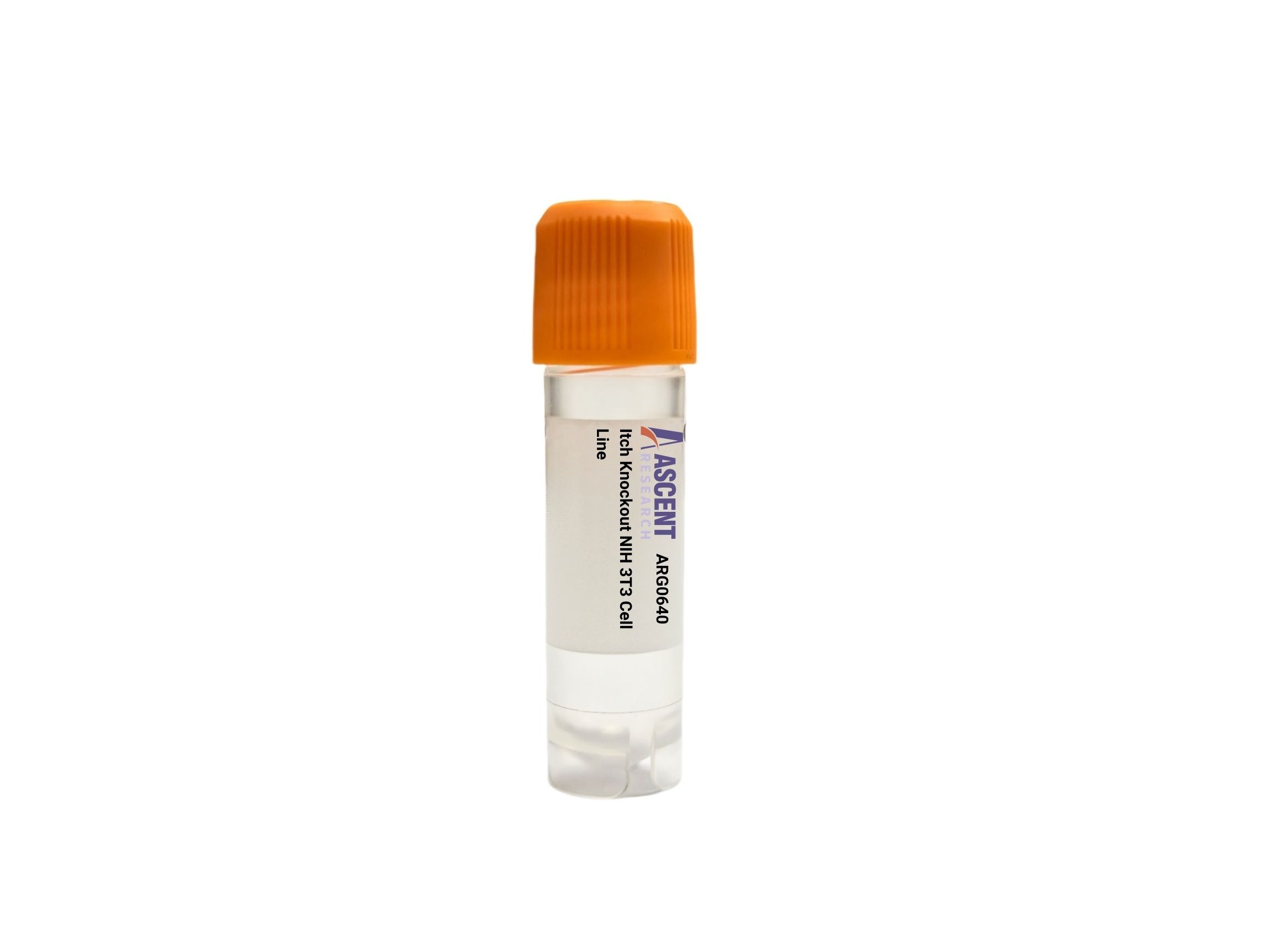
The Itch Knockout NIH 3T3 Cell Line provides a constitutive loss-of-function model for the E3 ubiquitin ligase Itch, generated by CRISPR/Cas9-mediated gene disruption in immortalized mouse embryonic fibroblasts. This line facilitates dissection of Itch-dependent ubiquitination and degradation of key signaling proteins, including c-FLIP, Notch intracellular domain, and Smad7, and is ideal for studying TGF-??, TNF-??/NF-??B, and Notch pathways. Applications include protein turnover analysis, ubiquitination assays, co-immunoprecipitation, reporter gene studies, and flow cytometry-based receptor quantification. It is particularly suited for investigations into autoimmune and inflammatory disease mechanisms, cancer signaling, and drug target validation.
 CALM1 Knockout Raji Polyclonal Cells
Cat. No. ARG21458
CALM1 Knockout Raji Polyclonal Cells
Cat. No. ARG21458
 Piezo1 Knockout MC3T3 Cell Line
Cat. No. ARG44038
EML1 Knockout SK-HEP-1 Polyclonal Cells
Cat. No. ARG16235
GIT2 Knockout HT29 Polyclonal Cells
Cat. No. ARG14428
NMRAL1 Knockout HT29 Polyclonal Cells
Cat. No. ARG14280
FGA Knockout Hela Polyclonal Cells
Cat. No. ARG7889
Piezo1 Knockout MC3T3 Cell Line
Cat. No. ARG44038
EML1 Knockout SK-HEP-1 Polyclonal Cells
Cat. No. ARG16235
GIT2 Knockout HT29 Polyclonal Cells
Cat. No. ARG14428
NMRAL1 Knockout HT29 Polyclonal Cells
Cat. No. ARG14280
FGA Knockout Hela Polyclonal Cells
Cat. No. ARG7889
The Itch Knockout NIH 3T3 Cell Line is a CRISPR/Cas9-edited murine fibroblast model with targeted disruption of the Itch gene, which encodes a HECT-type E3 ubiquitin ligase. This constitutive loss-of-function line enables rigorous investigation of ubiquitin-mediated degradation pathways without residual Itch activity. It serves as an essential tool for dissecting how Itch governs protein turnover, signal transduction, and cellular homeostasis in a non-immune context.
NIH 3T3 is an immortalized embryonic fibroblast line derived from NIH Swiss mouse cultures, extensively used in signal transduction, proliferation, and transformation studies. The cells display robust growth, are easily transfectable, and respond to diverse extracellular ligands. This background is particularly suited for analyzing receptor-coupled signaling cascades, mitogenic responses, and stress-activated pathways, providing a well-characterized platform for studying the functional consequences of Itch loss.
Itch functions as an E3 ubiquitin ligase that catalyzes ubiquitination of target proteins, typically marking them for proteasomal degradation. Its catalytic activity is stimulated by JNK-mediated phosphorylation at Ser199/Thr222, often downstream of TCR signaling or inflammatory cytokines such as TNF-?? and IL-1. Adaptor proteins Ndfip1 and Ndfip2 recruit Itch to substrates including c-FLIP, Notch intracellular domain, Smad7, RIP1, p73, p63, and EGFR. Through these interactions, Itch negatively regulates TGF-??, TNF-??/NF-??B, and Notch pathways, while also intersecting with endocytic trafficking and the JNK cascade.
The Itch knockout NIH 3T3 model is uniquely positioned to explore the ligase??s function in fibroblasts, where it may critically influence TGF-??/Smad, NF-??B, and Notch signaling dynamics. In these cells, Itch loss can be probed to determine its impact on basal and ligand-induced protein stability, cell cycle progression, and apoptosis sensitivity. This system complements immunological studies, revealing cell-type?Cspecific regulatory mechanisms mediated by Itch.
This engineered cell line supports a broad range of applications, including ubiquitination assays, co-immunoprecipitation of Itch?Csubstrate complexes, Western blot-based protein turnover analysis, NF-??B luciferase reporter assays, and flow cytometry for surface receptor quantification. It is valuable for research on signaling nodes, autoimmune mechanisms (e.g., lymphoproliferative syndrome), inflammatory disorders, and cancer biology. For further information, please contact Ascent Research.