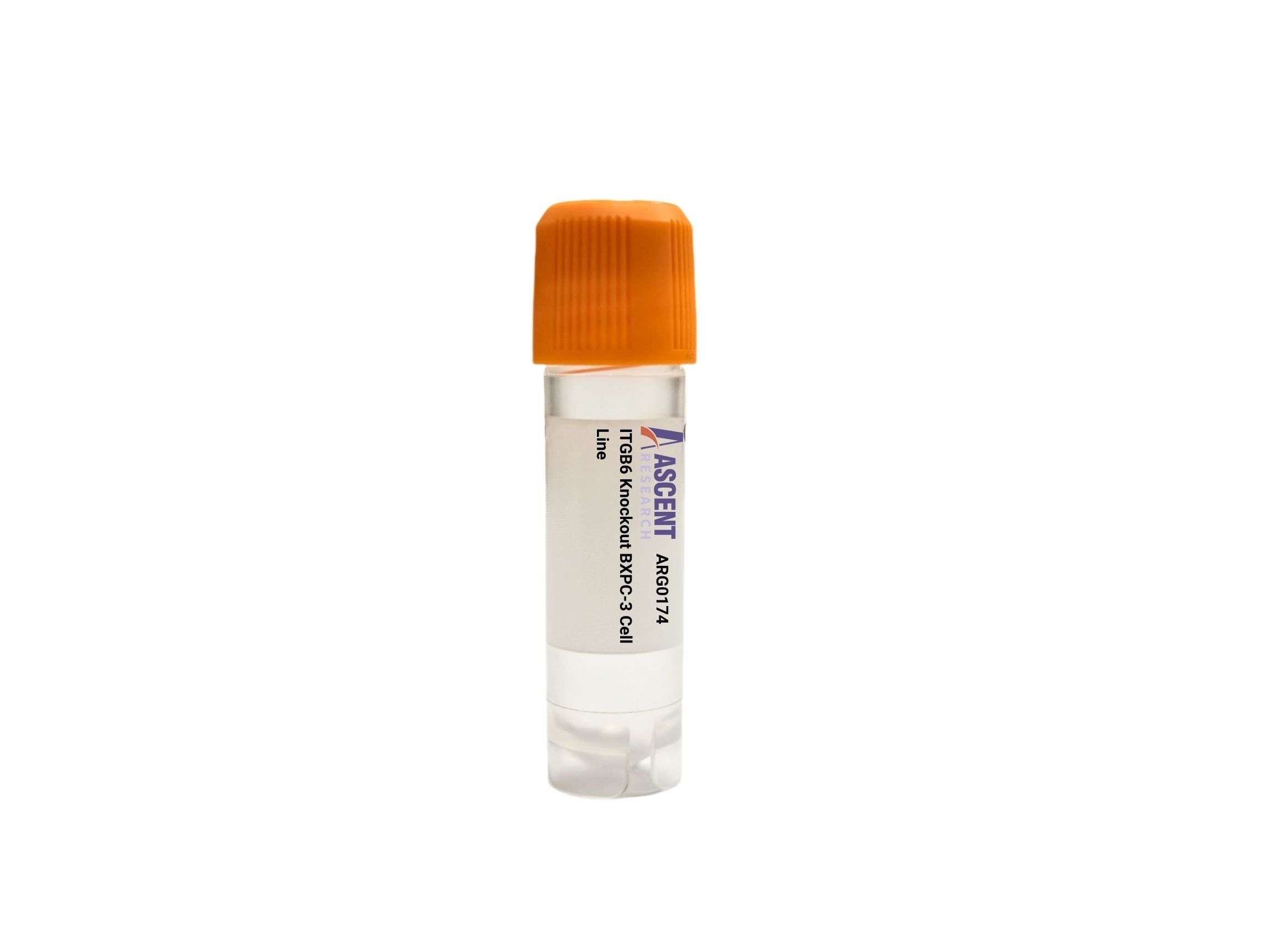
Genome-edited Cells
Pancreas
The ITGB6 Knockout BXPC-3 Cell Line is a human CRISPR/Cas9-edited pancreatic ductal adenocarcinoma epithelial model with disruption of ITGB6, which encodes integrin beta-6. In BXPC-3 cells, ITGB6 normally pairs with ITGAV to form ??v??6, mediating extracellular matrix adhesion and activation of latent TGF-??, with downstream effects on SMAD2/3, FAK-SRC, ERK1/2, AKT, migration, and invasion. This model is useful for mechanistic studies of pancreatic cancer signaling, cell-matrix interactions, TGF-?? activation, focal adhesion pathways, extracellular matrix remodeling, and therapeutic response using assays such as western blotting, flow cytometry, reporter assays, adhesion, migration, invasion, and drug sensitivity studies.
 ATG13 Knockout MES-OV Polyclonal Cells
Cat. No. ARG24256
EIF2AK4 Knockout Raji Polyclonal Cells
Cat. No. ARG40988
Dcaf1 Knockout RAW 264.7 Polyclonal Cells
Cat. No. ARG40221
DAAM1 Knockout MES-OV Polyclonal Cells
Cat. No. ARG6701
ATG13 Knockout MES-OV Polyclonal Cells
Cat. No. ARG24256
EIF2AK4 Knockout Raji Polyclonal Cells
Cat. No. ARG40988
Dcaf1 Knockout RAW 264.7 Polyclonal Cells
Cat. No. ARG40221
DAAM1 Knockout MES-OV Polyclonal Cells
Cat. No. ARG6701
 RPMI-1846
Cat. No. ARC0780
RPMI-1846
Cat. No. ARC0780
 Human Cervical Epithelial Cells
Cat. No. ARP0006
Human Cervical Epithelial Cells
Cat. No. ARP0006
The ITGB6 Knockout BXPC-3 Cell Line is a human CRISPR/Cas9-engineered pancreatic cancer cell model in which the ITGB6 gene has been disrupted to eliminate functional integrin beta-6 expression. This edited line is generated in BXPC-3, a human pancreatic ductal adenocarcinoma epithelial cell line, and provides a stable in vitro system for investigating ITGB6-dependent signaling and phenotype in an epithelial tumor background. The model is suited for studies requiring defined loss of ??v??6-associated functions in the context of pancreatic cancer cell adhesion, invasion, and signaling.
BXPC-3 is widely used as a pancreatic ductal adenocarcinoma model because it captures key features of epithelial tumor biology relevant to cell-matrix interaction, invasive behavior, and therapeutic response. As an epithelial cancer cell line, it is particularly useful for examining how extracellular matrix engagement influences tumor cell signaling networks and phenotype. BXPC-3 supports studies of focal adhesion dynamics, migration, invasion, and drug sensitivity, making it a relevant host background for evaluating genes that regulate epithelial-stromal communication and matrix-dependent signaling in pancreatic cancer.
ITGB6 encodes integrin beta-6, an epithelial-restricted integrin subunit that forms the ??v??6 heterodimer with ITGAV at the cell surface. This receptor binds extracellular matrix ligands including fibronectin, vitronectin, and tenascin-C and interacts with the LTBP1-associated latent TGF-?? complex to promote mechanical activation of TGFB1. ITGB6 is regulated by epithelial injury-associated signaling, inflammatory cytokines, EGFR signaling, KRAS-MAPK pathway activity, and TGF-??1-SMAD2/3 signaling. Through ??v??6-dependent matrix engagement, ITGB6 acts upstream of focal adhesion and growth factor-linked pathways involving PTK2/FAK, SRC, PXN, ERK1/2, and AKT1, and contributes to downstream events such as SMAD2 and SMAD3 phosphorylation, MMP9 expression, and migratory or invasive phenotypes.
Within BXPC-3 cells, ITGB6 loss provides a mechanistically relevant system for interrogating how epithelial integrin signaling supports pancreatic cancer-associated behaviors. Disruption of ITGB6 is expected to impair ??v??6-dependent latent TGF-?? activation and attenuate signaling outputs linked to focal adhesion assembly and matrix-responsive kinase activation. In this host-cell context, the model can help distinguish ITGB6-dependent contributions to adhesion signaling, invasion programs, and TGF-??-related transcriptional responses from other pathways active in pancreatic tumor cells.
This knockout line can be applied in western blotting, RT-qPCR, flow cytometry, and immunofluorescence workflows to assess ITGB6 loss and pathway-associated markers. Researchers may use phospho-signaling analysis to examine changes in FAK, SRC, ERK1/2, AKT, SMAD2, and SMAD3 activation; co-immunoprecipitation to study interactions involving ITGAV or focal adhesion components; and SMAD reporter assays to evaluate effects on TGFBR1/TGFBR2-linked signaling. Functional studies can include cell adhesion assays on fibronectin or vitronectin, migration and invasion assays, RNA-seq for transcriptional profiling, and drug sensitivity studies designed to probe dependence on integrin, TGF-??, EGFR, or MAPK-associated signaling mechanisms in pancreatic ductal adenocarcinoma cells. Researchers may contact Ascent Research for additional technical information, product details, or related gene-edited cell models.