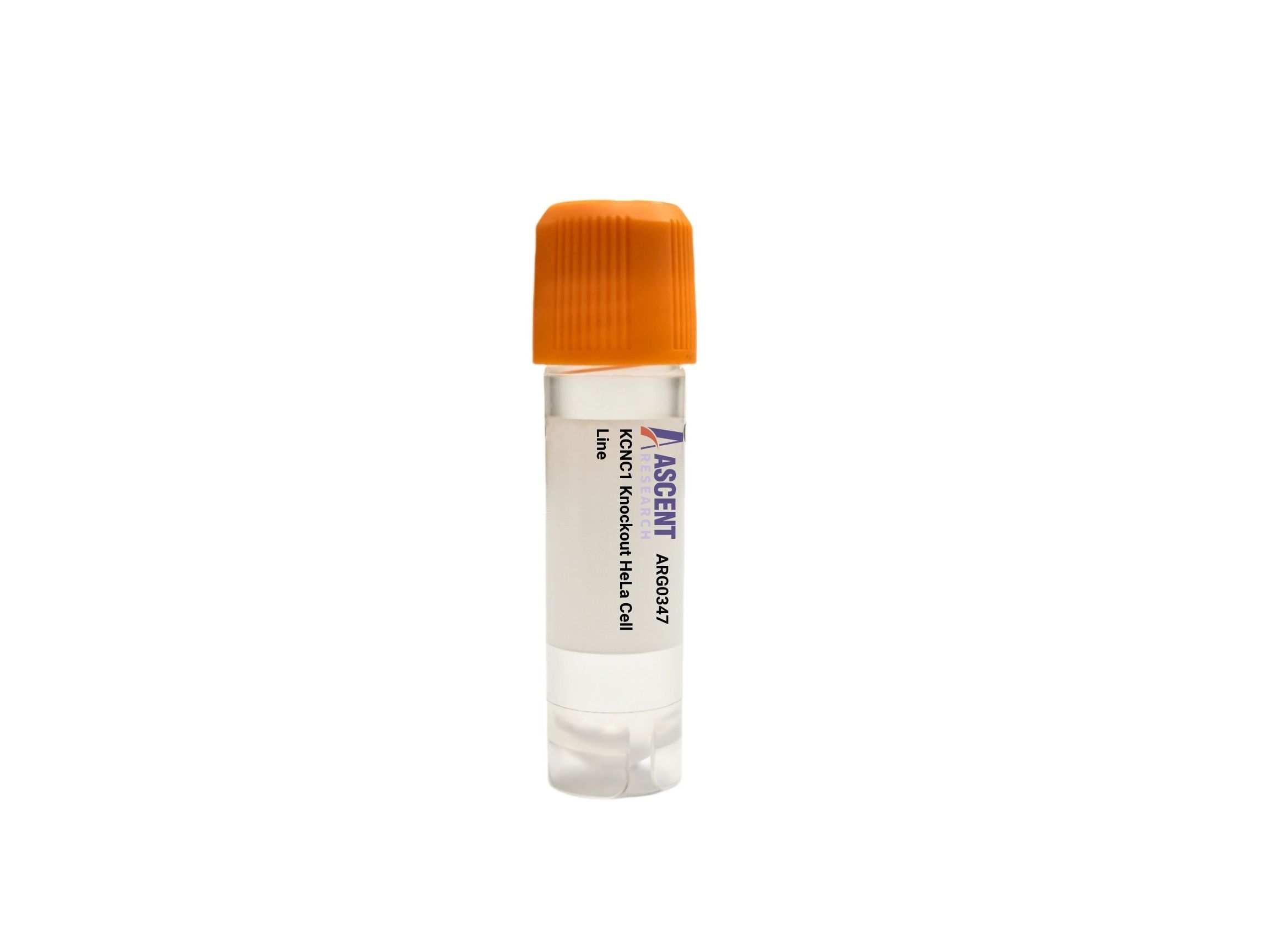
Genome-edited Cells
Uterus (cervix)
This CRISPR/Cas9-edited knockout cell line, derived from HeLa cervical adenocarcinoma cells, targets the KCNC1 gene encoding the Kv3.1 potassium channel. Kv3.1 is modulated by PKA, PKC, and MAPK/ERK cascades and interacts with PSD-95 and calmodulin, influencing calcium influx and downstream effectors such as Cyclin D1 and CREB. It enables studies of ion channel roles in cancer biology using techniques like patch-clamp, calcium imaging, and migration assays, and is suitable for drug screening and complementation experiments.
 MUC1 Knockout NCI-H1299 Polyclonal Cells
Cat. No. ARG17507
EPCAM Knockout DLD-1 Polyclonal Cells
Cat. No. ARG12091
GOLGA4 Knockout HT29 Polyclonal Cells
Cat. No. ARG33249
ANXA7 Knockout A549 Polyclonal Cells
Cat. No. ARG34514
C15orf40 Knockout jurkat Polyclonal Cells
Cat. No. ARG34044
DDAH2 Knockout 786-O Polyclonal Cells
Cat. No. ARG4683
MUC1 Knockout NCI-H1299 Polyclonal Cells
Cat. No. ARG17507
EPCAM Knockout DLD-1 Polyclonal Cells
Cat. No. ARG12091
GOLGA4 Knockout HT29 Polyclonal Cells
Cat. No. ARG33249
ANXA7 Knockout A549 Polyclonal Cells
Cat. No. ARG34514
C15orf40 Knockout jurkat Polyclonal Cells
Cat. No. ARG34044
DDAH2 Knockout 786-O Polyclonal Cells
Cat. No. ARG4683
The KCNC1 Knockout HeLa Cell Line is a CRISPR/Cas9-edited knockout cell line derived from human cervical adenocarcinoma HeLa cells. This genetically engineered model features targeted disruption of the KCNC1 gene, which encodes the Kv3.1 voltage-gated potassium channel subunit. By abolishing KCNC1 expression, the cell line serves as a loss-of-function model for investigating the physiological roles of Kv3.1-mediated potassium currents and their impact on cellular signaling and pathology.
HeLa cells are an immortalized epithelial cell line originating from a cervical adenocarcinoma and are characterized by the presence of human papillomavirus type 18 (HPV-18) sequences. This widely used model exhibits robust proliferation, a stable karyotype, and well-characterized signaling pathways, making it suitable for genetic manipulation and functional studies in cancer biology, virology, and signal transduction.
The Kv3.1 channel is activated by membrane depolarization and modulated by intracellular cascades involving protein kinase A (PKA), protein kinase C (PKC), and the MAPK/ERK pathway. It interacts with auxiliary Kv?? subunits, scaffolding proteins such as PSD-95/DLG4 and SAP97, and components of the actin cytoskeleton. These interactions couple potassium efflux to structural rearrangements and downstream signaling events, including calcium influx, calmodulin activation, CREB-mediated transcription, and regulation of cell cycle and apoptotic regulators like Cyclin D1 and Bcl-2 family members. Consequently, KCNC1 knockout disrupts these networks, providing a system to study ion channel-dependent control of cellular proliferation and survival.
In HeLa cervical adenocarcinoma cells, KCNC1 knockout offers a defined model to examine the roles of Kv3.1 in cancer cell physiology. Loss of this channel can alter membrane potential, calcium dynamics, and downstream signaling that govern cell cycle progression and apoptosis. This system is particularly relevant for studying the emerging functions of potassium channels in cancer proliferation, migration, and drug resistance, and for dissecting the crosstalk between ion homeostasis and oncogenic pathways.
This cell line enables functional studies using patch-clamp electrophysiology, calcium imaging, and a variety of cellular assays. Researchers can validate KCNC1 disruption by RT-qPCR and Western blotting, assess proliferation via MTT or BrdU assays, and quantify apoptosis with Annexin V staining. Migration and invasion assays, flow cytometric cell cycle analysis, and drug screening for Kv3.1 modulators are also feasible. Complementation with wild-type KCNC1 permits phenotype rescue, confirming the specificity of observed effects. For technical inquiries, please contact Ascent Research.