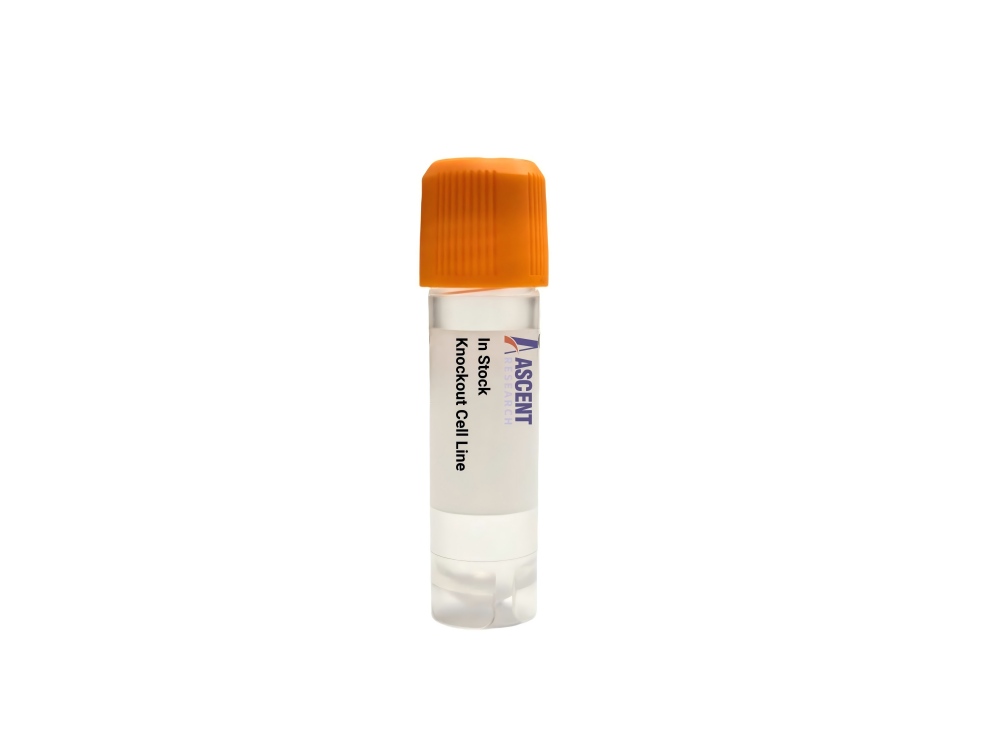
In Stock Cell Lines
Mus musculus (Mouse)
Large intestine (colon)
Adherent
The Kdm3a Knockout CT26.WT Cell Line is a CRISPR/Cas9-edited murine colorectal carcinoma cell line with targeted disruption of the Kdm3a gene. KDM3A is a histone H3K9me1/2 demethylase and transcriptional coactivator that regulates Wnt/??-catenin and hypoxia-responsive gene expression by interacting with ??-catenin and promoting transcription of downstream targets like CCND1 and MYC. This loss-of-function model is valuable for studying epigenetic regulation of colorectal cancer growth, metastasis, metabolic reprogramming, and drug target validation. Assays such as ChIP-qPCR, RT-qPCR, RNA-seq, and cell proliferation, migration, and metabolic analyses can be performed. Please contact Ascent Research for further details.
 GOLGA8B Knockout SW620 Cell Line
Cat. No. ARG43882
GOLGA8B Knockout SW620 Cell Line
Cat. No. ARG43882
 COQ7 Knockout SK-HEP-1 Polyclonal Cells
Cat. No. ARG15375
ANO10 Knockout HAP1 Polyclonal Cells
Cat. No. ARG27271
IDH2 Knockout HT29 Polyclonal Cells
Cat. No. ARG33408
BCL2L11 Knockout HAP1 Polyclonal Cells
Cat. No. ARG27383
COQ7 Knockout SK-HEP-1 Polyclonal Cells
Cat. No. ARG15375
ANO10 Knockout HAP1 Polyclonal Cells
Cat. No. ARG27271
IDH2 Knockout HT29 Polyclonal Cells
Cat. No. ARG33408
BCL2L11 Knockout HAP1 Polyclonal Cells
Cat. No. ARG27383
 Human Intestinal Microvascular Endothelial Cells
Cat. No. ARP0048
Human Intestinal Microvascular Endothelial Cells
Cat. No. ARP0048
The Kdm3a Knockout CT26.WT Cell Line is a CRISPR/Cas9-edited knockout cell line engineered to disrupt the Kdm3a gene in the murine CT26.WT colorectal carcinoma background. This loss-of-function model enables investigation of KDM3A-dependent epigenetic regulation and its role in tumor cell biology. By abolishing KDM3A expression, researchers can directly examine the consequences of impaired histone H3K9me1/2 demethylation in a genetically defined cancer cell context.
The CT26.WT cell line is a well-characterized murine colon carcinoma model derived from BALB/c mice following chemical induction with N-nitroso-N-methylurethane. It is widely utilized in colorectal cancer and immunotherapy research due to its syngeneic compatibility and reproducible tumor growth. The parental CT26.WT line retains key signaling pathway activities relevant to human colorectal cancer, making it a suitable host for targeted gene disruption studies.
KDM3A (lysine demethylase 3A) functions as a histone H3K9me1/2 demethylase and transcriptional coactivator, regulating chromatin accessibility and gene expression programs. It is activated by upstream signals including androgen receptor, HIF1A, TGF-??, and Wnt/??-catenin, and interacts with ??-catenin, CREB-binding protein (CBP), and Sp1 to drive transcription of downstream targets such as CCND1, MYC, SREBF1, GLUT1, and VEGF. KDM3A-mediated H3K9me1/2 demethylation relieves repressive chromatin marks, thereby facilitating activation of genes involved in cell proliferation, metabolism, and hypoxia response.
In CT26.WT colorectal carcinoma cells, KDM3A knockout eliminates its demethylase activity, leading to increased repressive H3K9me1/2 methylation at promoters of Wnt/??-catenin and hypoxia-responsive genes. This epigenetic silencing results in downregulation of critical oncogenic effectors including CCND1 and MYC, suppressing cell cycle progression and metabolic reprogramming. Consequently, KDM3A-deficient CT26.WT cells exhibit reduced proliferation, colony formation, migration, and tumorigenic potential, highlighting KDM3A as a key mediator of colorectal cancer aggressiveness.
This knockout cell line is suitable for a wide range of research applications, including dissecting epigenetic regulation of colorectal tumor growth and metastasis, functional analysis of histone demethylases, Wnt/??-catenin pathway interrogation, drug target validation, and study of metabolic reprogramming in cancer. Researchers can employ assays such as ChIP-qPCR for H3K9me2 enrichment at target gene promoters, RT-qPCR for transcript quantification (Ccnd1, Myc, Glut1), RNA-seq for whole-transcriptome profiling, cell proliferation and colony formation assays, Transwell migration/invasion assays, and metabolic flux analyses (glucose uptake, lactate production). For additional information or technical support, please contact Ascent Research.