Genome-edited Cells
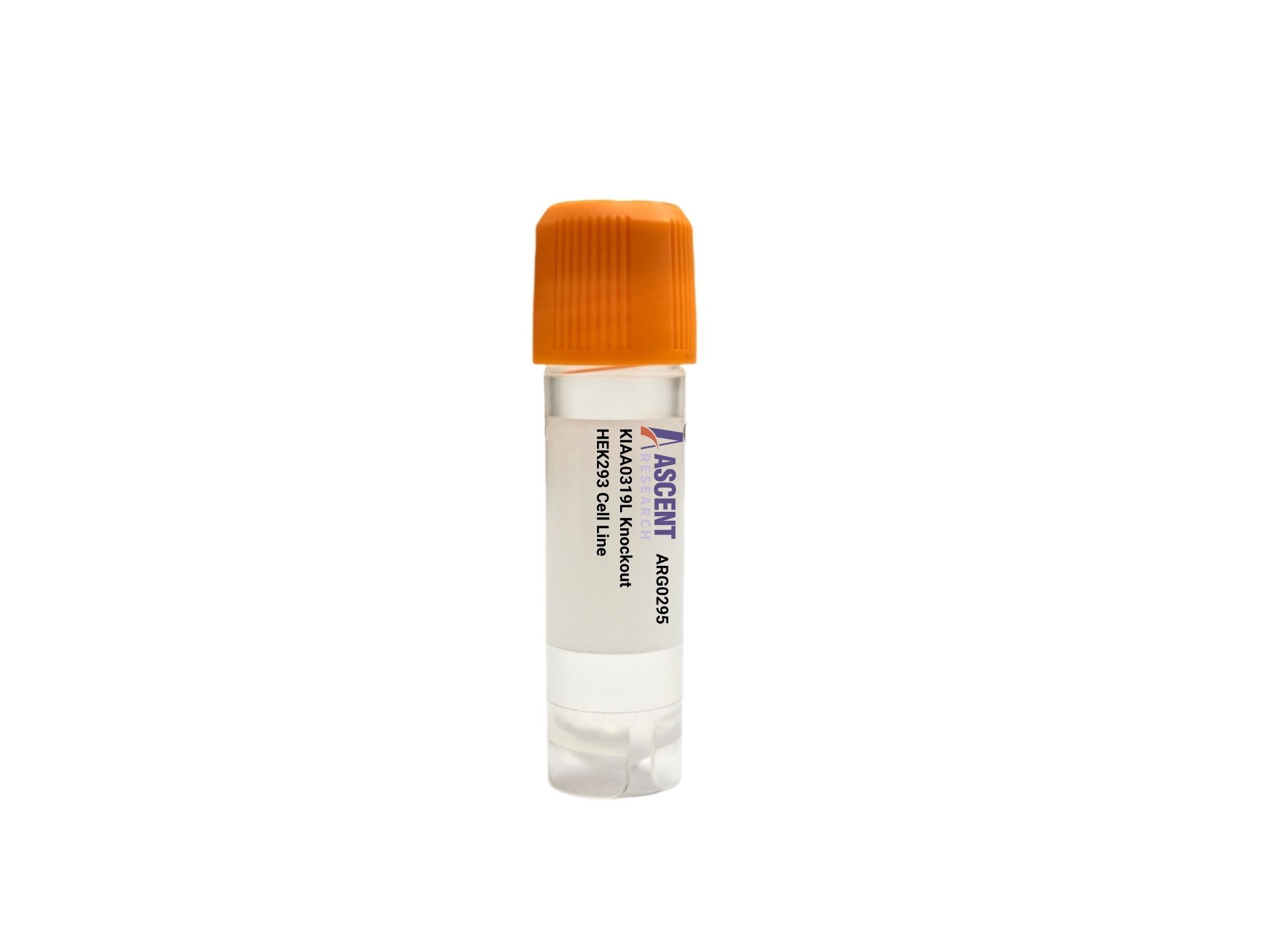
The KIAA0319L Knockout HEK293 Cell Line is a CRISPR/Cas9-edited knockout cell line that disrupts the human KIAA0319L gene, the primary receptor for adeno-associated viruses (AAV). This model leverages the widely used HEK293 background, known for its high transfectability and viral production capacity, to eliminate endogenous KIAA0319L expression, thereby blocking AAV transduction. KIAA0319L initiates clathrin-mediated endocytosis by directly binding AAV capsid proteins and recruiting adaptor AP2, with subsequent trafficking through Rab5 and Rab7 endosomes. This knockout line is ideal for AAV gene therapy vector screening, host-virus interaction studies, and endocytosis pathway analysis.
 FILIP1L Knockout NCI-H1299 Polyclonal Cells
Cat. No. ARG17659
LCOR Knockout T47D Polyclonal Cells
Cat. No. ARG11955
LANCL2 Knockout Hela Polyclonal Cells
Cat. No. ARG8627
CRTC3 Knockout Hela Polyclonal Cells
Cat. No. ARG8457
KCNK9 Knockout HAP1 Polyclonal Cells
Cat. No. ARG22961
ANKRD16 Knockout NCI-H1975 Polyclonal Cells
Cat. No. ARG31126
FILIP1L Knockout NCI-H1299 Polyclonal Cells
Cat. No. ARG17659
LCOR Knockout T47D Polyclonal Cells
Cat. No. ARG11955
LANCL2 Knockout Hela Polyclonal Cells
Cat. No. ARG8627
CRTC3 Knockout Hela Polyclonal Cells
Cat. No. ARG8457
KCNK9 Knockout HAP1 Polyclonal Cells
Cat. No. ARG22961
ANKRD16 Knockout NCI-H1975 Polyclonal Cells
Cat. No. ARG31126
The KIAA0319L Knockout HEK293 Cell Line is a CRISPR/Cas9-edited knockout cell line in which the human KIAA0319L gene has been disrupted to eliminate functional protein expression. This cell line serves as a defined loss-of-function model for studying the role of KIAA0319L, the primary receptor for adeno-associated viruses (AAV), in a human embryonic kidney background. By leveraging CRISPR/Cas9-mediated gene disruption, researchers can investigate AAV host interactions and endocytic trafficking without interference from endogenous receptor activity.
The host cell line, HEK293, is derived from human embryonic kidney cells transformed with adenovirus 5 DNA. This cell line is widely employed in biomedical research due to its robust protein expression capabilities, ease of transfection, and permissiveness to viral production. Its use as a platform for AAV vector manufacturing and host-virus interaction studies makes it an ideal context for examining KIAA0319L function and the effects of its ablation.
KIAA0319L encodes a transmembrane protein that acts as the essential host receptor for multiple AAV serotypes. It directly binds to AAV capsid proteins and subsequently recruits the clathrin adaptor AP2 complex, initiating clathrin-mediated endocytosis. Downstream of receptor engagement, the internalized virion is routed through dynamin-dependent vesicle scission and traffics sequentially through Rab5-positive early endosomes and Rab7-positive late endosomes. This endosomal sorting ultimately facilitates viral genome escape and nuclear import, steps critical for transgene expression. Beyond its virological role, KIAA0319L has been implicated in neuronal migration and cell adhesion, although its upstream transcriptional regulators remain poorly defined.
In the HEK293 context, knockout of KIAA0319L completely abrogates AAV transduction, rendering the cells refractory to infection. This phenotype provides a stringent negative control for experiments dissecting the cellular machinery of AAV entry and for validating the specificity of AAV-based gene delivery vectors. Furthermore, the HEK293 background, permissive for many steps of viral replication, allows researchers to recapitulate early infection events while eliminating the confounding variable of endogenous receptor expression. This model thus enables clean gain-of-function reconstitution studies with mutant receptors or alternative serotypes.
This knockout cell line supports applications including AAV gene therapy vector development, host-virus interaction studies, and high-throughput AAV variant screening. Essential assays such as AAV transduction with GFP reporters, Western blotting for KIAA0319L, immunofluorescence for viral capsid uptake, and flow cytometry for transduction efficiency can be readily employed. RT-qPCR for viral genome trafficking and co-immunoprecipitation with AAV capsid further dissect entry mechanisms, while T7E1 assay validates genomic editing. For further details or to discuss custom projects, please contact Ascent Research.