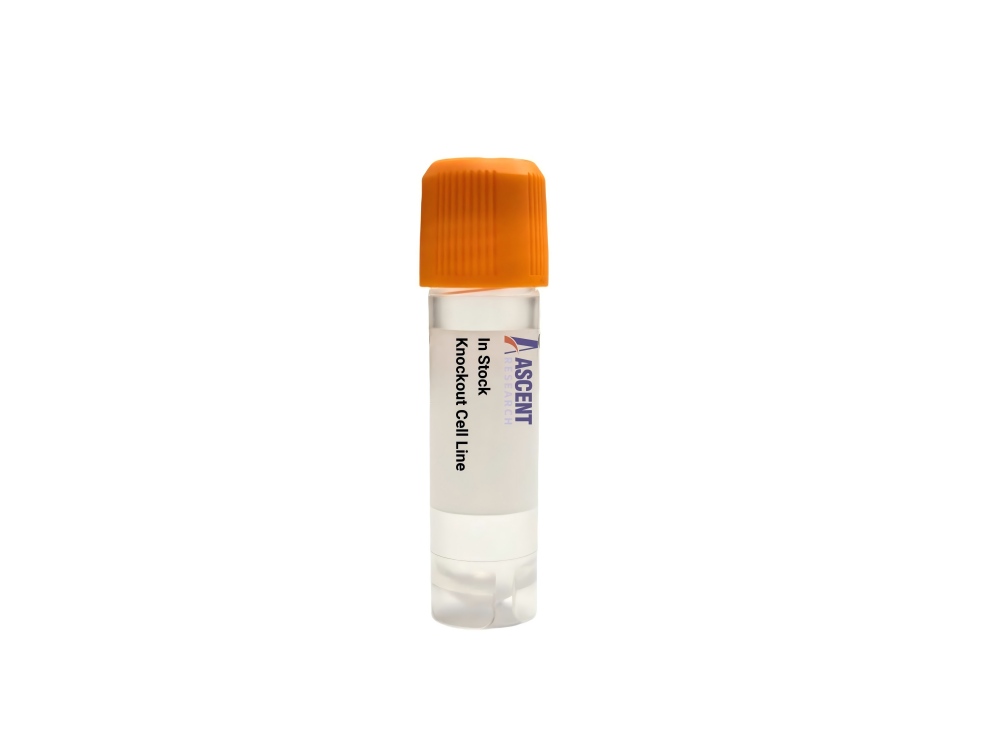
In Stock Cell Lines
Homo sapiens (Human)
Skin
Adherent
The KRT32 Knockout HaCaT Cell Line is a CRISPR/Cas9-edited human keratinocyte line with targeted disruption of the KRT32 gene. It provides a stable loss-of-function model for studying hair keratin function in a HaCaT background, which retains key epidermal features including barrier formation and wound healing. KRT32 encodes a type I hair keratin that forms intermediate filaments with type II keratins such as KRT82 and is regulated by WNT/??-catenin and FOXN1. This knockout line enables investigation of hair follicle biology, intermediate filament organization, and keratin-related disorders, supporting applications in drug screening and cosmetic research.
 CLIC1 Knockout NCI-H1975 Polyclonal Cells
Cat. No. ARG16343
IPO5 Knockout NCI-H1299 Polyclonal Cells
Cat. No. ARG30837
EHD3 Knockout NCI-H1975 Polyclonal Cells
Cat. No. ARG40811
MED16 Knockout Hela Polyclonal Cells
Cat. No. ARG7808
CLIC1 Knockout NCI-H1975 Polyclonal Cells
Cat. No. ARG16343
IPO5 Knockout NCI-H1299 Polyclonal Cells
Cat. No. ARG30837
EHD3 Knockout NCI-H1975 Polyclonal Cells
Cat. No. ARG40811
MED16 Knockout Hela Polyclonal Cells
Cat. No. ARG7808
 KG-1a
Cat. No. ARC0391
KG-1a
Cat. No. ARC0391
 Mouse Bladder Stromal Fibroblasts
Cat. No. ARP0501
Mouse Bladder Stromal Fibroblasts
Cat. No. ARP0501
The KRT32 Knockout HaCaT Cell Line is a CRISPR/Cas9-edited knockout cell line that disrupts the KRT32 gene in the human HaCaT keratinocyte background. This stable loss-of-function model enables targeted investigation of KRT32-dependent processes without the off-target effects and transient nature of RNA interference. The cell line carries a CRISPR/Cas9-mediated gene disruption, ensuring a heritable knockout phenotype suitable for reproducible functional studies. Researchers can employ this model to dissect the role of KRT32 in intermediate filament biology, keratinocyte differentiation, and hair follicle homeostasis.
HaCaT is a spontaneously immortalized, non-tumorigenic human epidermal keratinocyte cell line derived from adult skin. It retains hallmark keratinocyte functions, including barrier formation, cytokine production, and wound healing. Due to its robust growth and genetic stability, HaCaT is widely used in skin biology and dermatological research. The cells express epidermal differentiation markers and respond to calcium-induced differentiation. Importantly, HaCaT cells can be stimulated to express hair follicle-associated genes, making them a pertinent host for studying hair keratin function in a keratinocyte context.
KRT32 encodes a type I hair keratin that is a structural component of the inner root sheath of hair follicles. It forms obligate heterodimers with type II keratins, such as KRT82, to assemble intermediate filaments that confer mechanical strength. KRT32 is transcriptionally regulated by FOXN1, HOXC13, LEF1, and WNT/??-catenin signaling, which coordinate hair follicle differentiation. Downstream, KRT32-containing filaments interact with desmosomal proteins (desmoplakin, plakoglobin) and trichohyalin to stabilize cell?Ccell junctions. Knockout of KRT32 disrupts intermediate filament integrity, compromises desmosome stability, and reduces mechanical resilience, leading to hair shaft defects observed in monilethrix.
In the HaCaT keratinocyte model, KRT32 knockout provides a powerful tool to investigate hair keratin function in epithelial cells. Although HaCaT cells are epidermal, they share core signaling modules with hair follicle keratinocytes, including WNT/??-catenin, BMP, NOTCH, and SHH pathways. This model allows dissection of how type I hair keratin loss alters intermediate filament networks, desmosome assembly, and cellular responses to mechanical stress. Furthermore, the knockout line enables exploration of compensatory mechanisms, such as upregulation of other keratins, offering insights into the molecular pathology of keratin-related genodermatoses.
Research applications of the KRT32 Knockout HaCaT Cell Line span hair follicle biology, skin disease modeling, and cosmetic science. The line is suitable for drug screening to identify compounds that ameliorate hair shaft abnormalities, and for safety and efficacy testing of cosmetic ingredients. Representative assays include Western blotting and RT-qPCR for KRT32 expression, immunofluorescence for intermediate filament architecture, wound healing assays for keratinocyte migration, and electron microscopy for filament ultrastructure. For further technical details or custom requests, please contact Ascent Research.