Genome-edited Cells
Breast (mammary gland)
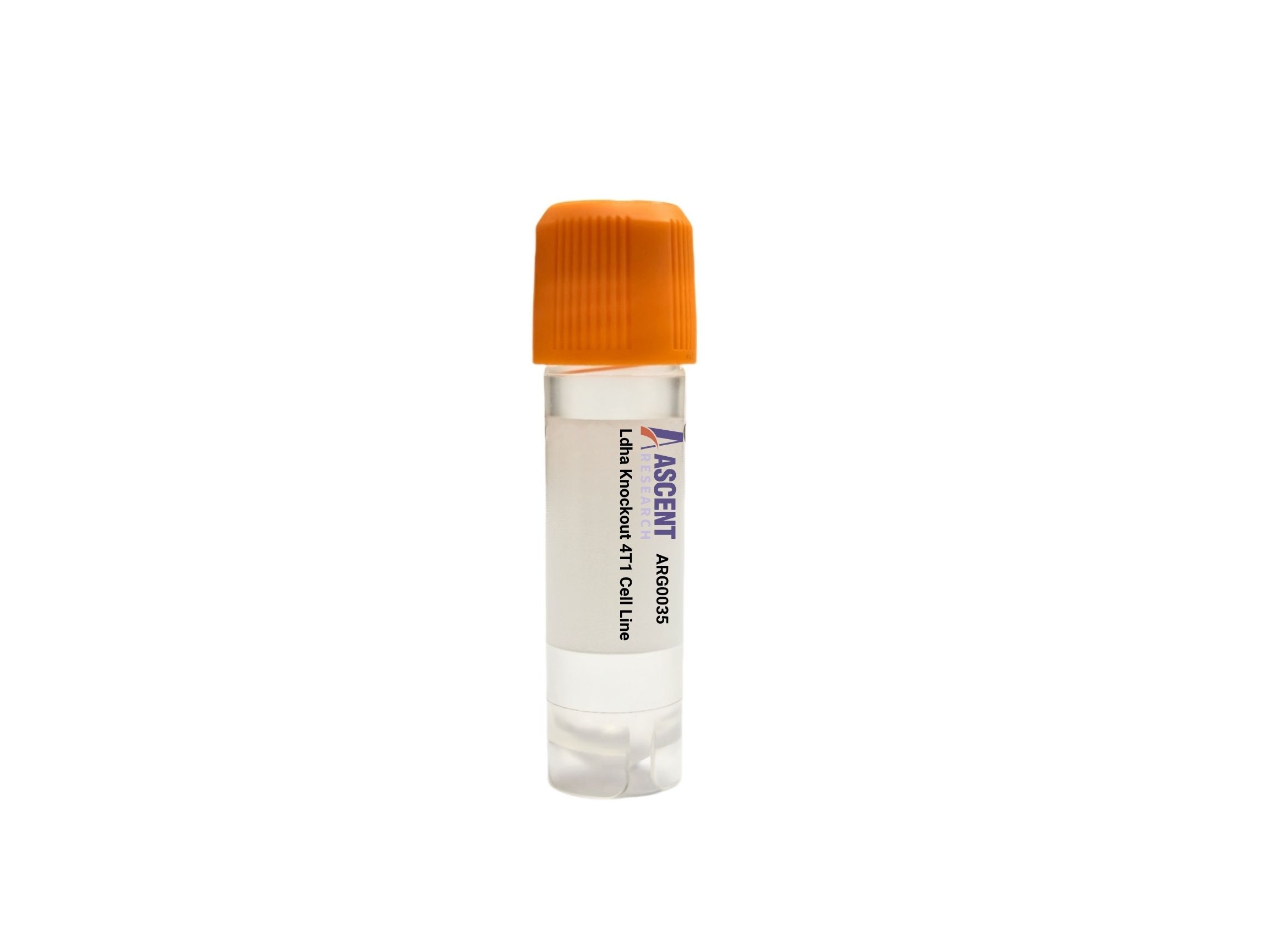
Ldha Knockout 4T1 is a CRISPR/Cas9-edited mouse mammary carcinoma cell line with disruption of Ldha in the aggressive 4T1 triple-negative breast cancer model. LDHA functions downstream of glycolysis to convert pyruvate to lactate and regenerate NAD+, and is regulated by factors including HIF1A and MYC. In 4T1 cells, Ldha loss provides a useful system to study glycolytic flux, lactate secretion, redox balance, extracellular acidification, hypoxia adaptation, and metabolic plasticity. Typical applications include lactate and NAD+/NADH assays, Seahorse metabolic flux analysis, proliferation studies, migration/invasion assays, RNA-seq, and drug sensitivity testing.
 BCO1 Knockout Hela Polyclonal Cells
Cat. No. ARG21488
PDE5A Knockout K562 Polyclonal Cells
Cat. No. ARG19385
MINPP1 Knockout NCI-H1299 Polyclonal Cells
Cat. No. ARG18088
EPHA3 Knockout Jurkat Polyclonal Cells
Cat. No. ARG13778
ABCC5 Knockout A2780 Polyclonal Cells
Cat. No. ARG28531
BCO1 Knockout Hela Polyclonal Cells
Cat. No. ARG21488
PDE5A Knockout K562 Polyclonal Cells
Cat. No. ARG19385
MINPP1 Knockout NCI-H1299 Polyclonal Cells
Cat. No. ARG18088
EPHA3 Knockout Jurkat Polyclonal Cells
Cat. No. ARG13778
ABCC5 Knockout A2780 Polyclonal Cells
Cat. No. ARG28531
 Mouse Mammary Ductal Epithelial Cells
Cat. No. ARP0541
Mouse Mammary Ductal Epithelial Cells
Cat. No. ARP0541
The Ldha Knockout 4T1 Cell Line is a CRISPR/Cas9-engineered mouse mammary carcinoma model in which the Ldha gene has been disrupted to abolish functional LDHA expression. This edited cell line provides a stable in vitro system for investigating LDHA-dependent metabolic phenotypes in a tumor epithelial-like background. Because 4T1 cells are extensively used to study aggressive triple-negative breast cancer biology, the model is well suited for mechanistic analysis of glycolytic dependence, lactate metabolism, and hypoxia-associated tumor cell behavior.
4T1 is a murine mammary carcinoma cell line derived from BALB/c mouse and is widely used as a syngeneic model of highly tumorigenic and metastatic breast cancer. Its utility in oncology research stems from its relevance to tumor growth, invasion, metastatic dissemination, and host-tumor interactions in immunocompetent settings. As a mammary carcinoma model with aggressive behavior, 4T1 is commonly used to examine pathways that support rapid proliferation, metabolic adaptation, and survival in stressed tumor microenvironments, including hypoxia and nutrient limitation.
LDHA catalyzes the reduction of pyruvate to lactate with concomitant oxidation of NADH to NAD+, a reaction that sustains glycolytic flux and supports the Warburg phenotype. In tumor cells, Ldha expression is regulated by HIF1A, MYC, PI3K-AKT-mTOR signaling, AMPK, glucose availability, and hypoxia. LDHA functions within a metabolic network that includes SLC2A1/GLUT1-mediated glucose uptake, HK2, PFK1, PFKFB3, GAPDH, PKM, pyruvate, LDHB, and the PDH complex. By acting downstream of glycolytic pyruvate production and upstream of lactate export through SLC16A1/MCT1 and SLC16A3/MCT4, LDHA influences lactate production, extracellular acidification, NAD+/NADH balance, pyruvate utilization, and partitioning between fermentation and mitochondrial oxidative metabolism. These relationships are central to cancer metabolism, hypoxia-adapted tumors, metastatic progression, and lactic acidosis research.
Loss of Ldha in the 4T1 background provides a relevant model for examining how aggressive breast cancer cells respond when a major route for NAD+ regeneration and lactate production is removed. In this context, researchers can investigate altered glycolytic throughput, changes in redox homeostasis, increased reliance on pyruvate oxidation via PDHA1 and the PDH complex, and differential proliferation under hypoxic conditions. The model is also useful for studying metabolic plasticity and the contribution of lactate handling to tumor-associated phenotypes in triple-negative breast cancer.
This knockout cell line can be applied in targeted studies using western blotting, RT-qPCR, and Sanger sequencing of the edited locus to assess gene disruption and pathway-associated expression changes. Functional characterization may include lactate secretion assays, glucose uptake assays, extracellular acidification rate and oxygen consumption rate measurements, Seahorse metabolic flux analysis, NAD+/NADH quantification, ATP assays, and proliferation or colony formation assays under normoxia or hypoxia. The model is additionally suitable for apoptosis analysis, migration and invasion assays, RNA-seq-based profiling of metabolic rewiring, immunometabolic studies, and drug sensitivity experiments evaluating responses to glycolysis, mitochondrial metabolism, or redox-targeting interventions. Researchers may contact Ascent Research for additional technical information, product details, or related gene-edited cell models.