Genome-edited Cells
Placenta
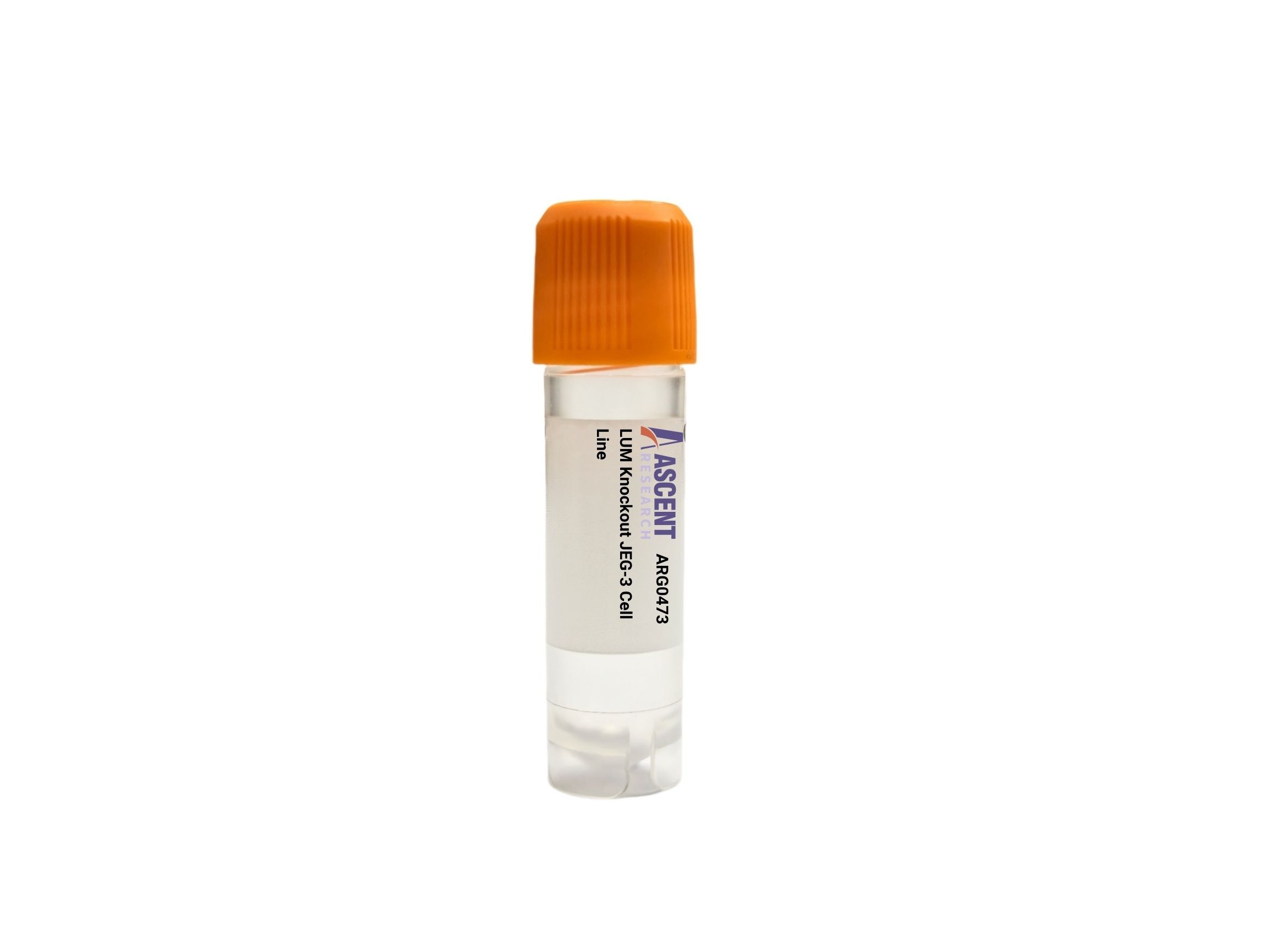
The LUM Knockout JEG-3 Cell Line is a CRISPR/Cas9-edited human choriocarcinoma cell line lacking lumican expression. Lumican, a collagen-binding proteoglycan, signals through integrin ??2??1 and TLR4 to regulate FAK, Akt, and ERK1/2 pathways, influencing adhesion, migration, and matrix organization. This knockout model enables precise dissection of lumican function in a trophoblast background that secretes hCG and models placental invasion. JEG-3 cells provide a well-characterized platform for studying placentation disorders and cancer. LUM disruption impairs collagen fibril assembly and downstream signaling, making the cell line suitable for research on preeclampsia, tumor microenvironment remodeling, and fibrosis. Applications include migration assays, phospho-signaling analysis, and hormone secretion profiling.
 MGME1 Knockout NCI-H1975 Polyclonal Cells
Cat. No. ARG16944
ATG14 Knockout Hela Polyclonal Cells
Cat. No. ARG20941
CAV1 Knockout HT29 Polyclonal Cells
Cat. No. ARG42617
DOCK2 Knockout HGC-27 Polyclonal Cells
Cat. No. ARG39564
CLCN7 Knockout AGS Polyclonal Cells
Cat. No. ARG2997
MGME1 Knockout NCI-H1975 Polyclonal Cells
Cat. No. ARG16944
ATG14 Knockout Hela Polyclonal Cells
Cat. No. ARG20941
CAV1 Knockout HT29 Polyclonal Cells
Cat. No. ARG42617
DOCK2 Knockout HGC-27 Polyclonal Cells
Cat. No. ARG39564
CLCN7 Knockout AGS Polyclonal Cells
Cat. No. ARG2997
 23132/87
Cat. No. ARC0004
23132/87
Cat. No. ARC0004
The LUM Knockout JEG-3 Cell Line is a CRISPR/Cas9-edited human choriocarcinoma line with targeted disruption of the LUM gene encoding lumican. This loss-of-function model enables analysis of lumican’s roles in extracellular matrix organization, cell adhesion, and signaling in a trophoblast context. The cell line retains the epithelial morphology and hormonal secretion properties of parental JEG-3 cells, providing a well-defined system for investigating lumican-mediated processes.
JEG-3 is a clonal derivative of a placental choriocarcinoma, exhibiting epithelial growth and constitutive expression of trophoblast markers including human chorionic gonadotropin (hCG). It serves as a standard in vitro model for trophoblast invasion, placentation, and endocrine function, and is extensively used in cancer biology studies of choriocarcinoma. The line’s stable characteristics and robust growth make it suitable for precise gene ablation studies.
Lumican is a small leucine-rich proteoglycan that binds collagen types I and IV, fibronectin, and membrane receptors integrin ??2??1 and TLR4. It modulates collagen fibrillogenesis and triggers intracellular signals via FAK, Akt, and ERK1/2 kinases. Upstream regulators include TGF-??1, TNF-??, HIF1A, IL-1??, and progesterone; downstream targets encompass NF-??B, Smad2/3, and Caspase-8. These interactions coordinate cell adhesion, migration, proliferation, and apoptosis, integrating matrix remodeling with immune and angiogenic responses.
In JEG-3 trophoblasts, lumican is critical for collagen organization and integrin-mediated adhesion, processes underlying invasive placentation and hormone secretion. LUM knockout likely disrupts focal adhesion kinase (FAK) and Akt signaling, alters matrix metalloproteinase activity, and reduces hCG production. This cell line thus offers a platform to study defective trophoblast invasion associated with preeclampsia and to explore lumican’s tumor-modulating functions in choriocarcinoma.
The line is amenable to migration and invasion assays (wound healing, transwell), adhesion assays on ECM substrates, and immunofluorescence for focal adhesion components. Phospho-signaling can be assessed by Western blot for p-FAK, p-Akt, and p-ERK1/2; apoptosis by Annexin V; and hormone secretion by hCG ELISA. Global transcriptomic analysis via RNA-seq and targeted RT-qPCR complement these approaches. These tools facilitate research on trophoblast biology, ECM remodeling, tumor microenvironment, and drug sensitivity screening. For further information, contact Ascent Research.