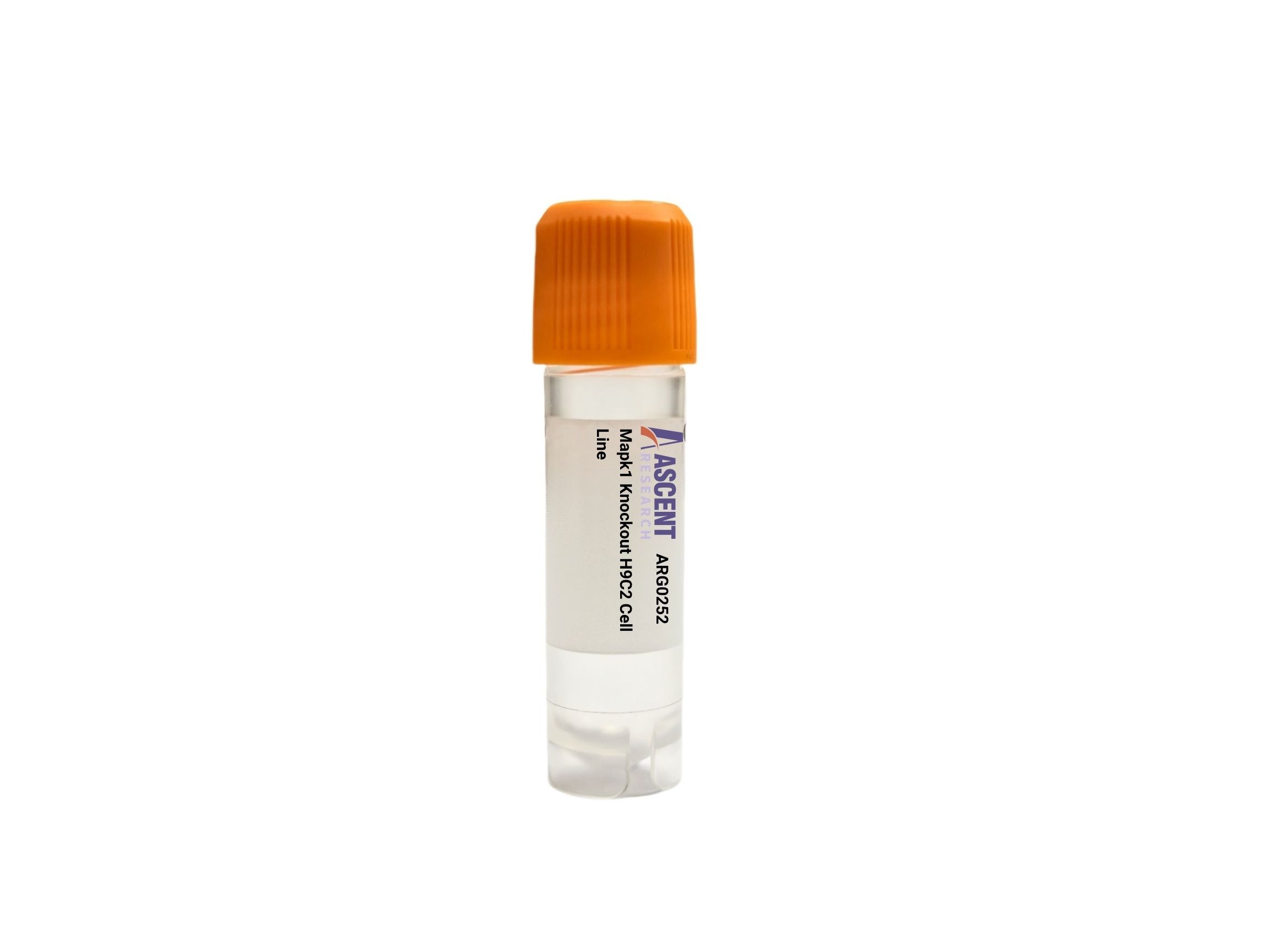
Genome-edited Cells
The Mapk1 Knockout H9C2 Cell Line is a CRISPR/Cas9-edited loss-of-function model in rat H9C2 cardiomyoblasts. Mapk1 encodes ERK2, the terminal kinase of the MAPK/ERK cascade, which is activated by MEK1/2 and phosphorylates Elk-1 and RSK to control proliferation and survival. This knockout cell line supports studies of cardiac hypertrophy, heart failure, and ERK-dependent gene expression. Applications include drug screening, growth factor signaling analysis, and reporter assays. Key techniques are phospho-ERK western blotting and Elk-1 luciferase reporters.
 CSDE1 Knockout A2780 Polyclonal Cells
Cat. No. ARG19209
PAK2 Knockout Jurkat Polyclonal Cells
Cat. No. ARG12914
FLAD1 Knockout Hela Polyclonal Cells
Cat. No. ARG8148
APOB Knockout A2780 Polyclonal Cells
Cat. No. ARG28740
HDAC4 Knockout A2780 Polyclonal Cells
Cat. No. ARG29077
ACBD3 Knockout SK-HEP-1 Polyclonal Cells
Cat. No. ARG32068
CSDE1 Knockout A2780 Polyclonal Cells
Cat. No. ARG19209
PAK2 Knockout Jurkat Polyclonal Cells
Cat. No. ARG12914
FLAD1 Knockout Hela Polyclonal Cells
Cat. No. ARG8148
APOB Knockout A2780 Polyclonal Cells
Cat. No. ARG28740
HDAC4 Knockout A2780 Polyclonal Cells
Cat. No. ARG29077
ACBD3 Knockout SK-HEP-1 Polyclonal Cells
Cat. No. ARG32068
The Mapk1 Knockout H9C2 Cell Line is a CRISPR/Cas9-edited knockout cell line generated from the H9C2 rat embryonic ventricular cardiomyocyte line (Rattus norvegicus). CRISPR/Cas9-mediated gene disruption of Mapk1 abolishes expression of the encoded ERK2 serine/threonine kinase, establishing a stable loss-of-function model for investigating mitogen-activated protein kinase (MAPK) signaling. This engineered cell line provides a defined genetic background for dissecting ERK2-dependent processes without the complexity of pharmacological inhibition.
The H9C2 host cell line is a well-characterized cardiac myoblast line originally derived from embryonic rat ventricular tissue. These cells exhibit many properties of developing cardiomyocytes, including expression of cardiac-specific markers and the capacity for myotube formation under appropriate conditions. As a widely adopted in vitro model for cardiac biology, H9C2 cells enable reproducible studies of cardiac hypertrophy, apoptosis, and metabolic responses. Its robust, homogenous nature suits high-throughput and mechanistic analyses.
Mapk1, encoding ERK2, functions as a terminal kinase in the classical MAPK/ERK cascade. It is activated by MEK1/2 downstream of receptors including those for EGF, FGF, and PDGF, following Ras- and Raf-mediated signal transduction. Activated ERK2 phosphorylates a broad array of cytoplasmic and nuclear substrates, such as the transcription factors Elk-1, c-Fos, c-Jun, and c-Myc, and the kinases RSK, MNK, and MSK. ERK2 also interacts with scaffold proteins like KSR and IQGAP1 that modulate pathway fidelity, and its activity is attenuated by DUSP6. Thus, ERK2 coordinates cell proliferation, differentiation, and survival.
Mapk1 ablation in H9C2 cardiomyoblasts disrupts growth factor-induced ERK signaling, impairing downstream phosphorylation and cardiac gene expression programs. This knockout model is particularly relevant for studying ERK2 roles in cardiac hypertrophy and heart failure, where ERK1/2 signaling transduces hypertrophic agonists. Additionally, as ERK2 is implicated in cancer and RASopathies like Noonan syndrome, this cell line enables investigation of disease-relevant signaling in a cardiac environment.
Applications of the Mapk1 Knockout H9C2 Cell Line include cardiac hypertrophy signaling studies, MAPK pathway functional analyses, and drug screening for heart disease. It supports western blotting for phospho-ERK1/2, RT-qPCR of immediate early genes (e.g., c-Fos), immunofluorescence for ERK translocation, cell proliferation and apoptosis assays, and luciferase reporter assays for Elk-1 activity. These assays enable precise quantification of ERK2-dependent signaling outputs and therapeutic responses. For additional information or technical support, please contact Ascent Research.