Genome-edited Cells
Placenta
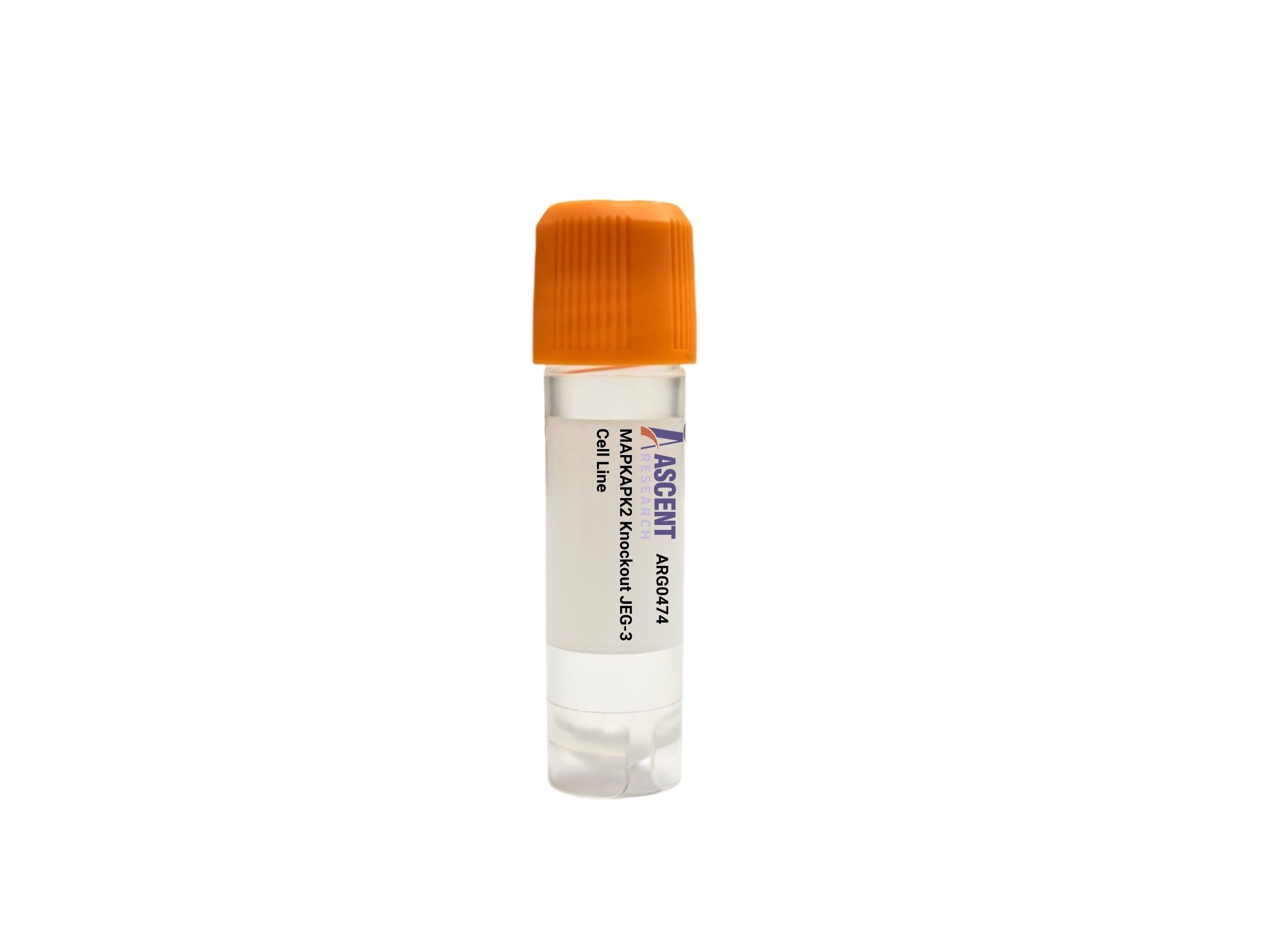
CRISPR/Cas9-edited MAPKAPK2 knockout JEG-3 cell line. JEG-3 is a human choriocarcinoma line serving as a trophoblast model, secreting hCG and forming epithelial barriers. MAPKAPK2, a kinase downstream of p38 MAPK, phosphorylates HSPB1 and ZFP36 to regulate actin dynamics and mRNA stability of pro-inflammatory cytokines. This knockout model facilitates research into inflammatory signaling, post-transcriptional gene regulation, trophoblast function, and cancer cell migration. Key applications include cytokine profiling, mRNA decay assays, wound healing, and drug target validation.
 MROH1 Knockout NCI-H1299 Polyclonal Cells
Cat. No. ARG17542
GYS1 Knockout Raji Polyclonal Cells
Cat. No. ARG23662
BMPR1A Knockout Jurkat Polyclonal Cells
Cat. No. ARG23348
IFNGR1 Knockout HEK293T Polyclonal Cells
Cat. No. ARG26109
MID1IP1 Knockout 786-O Polyclonal Cells
Cat. No. ARG4934
MROH1 Knockout NCI-H1299 Polyclonal Cells
Cat. No. ARG17542
GYS1 Knockout Raji Polyclonal Cells
Cat. No. ARG23662
BMPR1A Knockout Jurkat Polyclonal Cells
Cat. No. ARG23348
IFNGR1 Knockout HEK293T Polyclonal Cells
Cat. No. ARG26109
MID1IP1 Knockout 786-O Polyclonal Cells
Cat. No. ARG4934
 EFM-19
Cat. No. ARC0187
EFM-19
Cat. No. ARC0187
The MAPKAPK2 Knockout JEG-3 Cell Line is a CRISPR/Cas9-edited knockout cell line for functional studies of MAPKAPK2 in human placental choriocarcinoma cells. Targeted gene disruption in the JEG-3 background creates a stable loss-of-function model to investigate MAPKAPK2-dependent signaling pathways, gene regulation, and cellular stress responses without reliance on transient knockdown methods.
The parental JEG-3 cell line is an adherent epithelial line derived from a trophoblastic tumor, widely used as a model for trophoblast function. It secretes human chorionic gonadotropin (hCG) and forms epithelial barriers, making it suitable for research in placental biology, hormone regulation, and cancer. JEG-3 cells retain features of extravillous trophoblasts, including invasiveness and responsiveness to inflammatory mediators, offering a relevant context for studying signaling networks in reproduction and oncology.
MAPKAPK2 encodes a serine/threonine kinase that acts downstream of p38 MAPK, a central stress-activated kinase. Upon stimulation by TNF-??, IL-1??, or other stress signals, p38 MAPK??activated by MKK3 and MKK6??phosphorylates MAPKAPK2. Active MAPKAPK2 then phosphorylates HSPB1 (Hsp27) to modulate actin cytoskeleton remodeling and ZFP36 (tristetraprolin) to enhance decay of AU-rich element (ARE)-containing mRNAs, including those encoding TNF-?? and IL-6. Additional substrates include CREB, SRF, and EEF2K, and the kinase interacts with scaffold protein JIP2. This pathway integrates environmental cues to coordinate inflammatory gene expression, mRNA stability, and cell motility.
Disruption of MAPKAPK2 in JEG-3 cells allows dissection of its role in trophoblast biology and choriocarcinoma pathogenesis. The knockout model permits analysis of p38-MAPKAPK2-mediated control of hCG secretion, epithelial barrier integrity, and inflammatory gene expression relevant to placental disorders such as preeclampsia. Concurrently, it enables study of tumor cell migration and invasion, as MAPKAPK2 regulates actin dynamics through HSPB1 and cytokine mRNA turnover through ZFP36 in a cell type that naturally expresses these components.
Applications include inflammatory signaling studies using ELISA and RT-qPCR for cytokines, actinomycin D mRNA decay assays, and ARE-luciferase reporters; migration and actin remodeling assessed by wound healing and F-actin immunofluorescence; and stress response profiling via phospho-HSPB1 Western blotting and sensitivity to p38 inhibitors like SB203580. Co-immunoprecipitation and RNA-seq can further define altered protein interactions and transcriptomes. For detailed characterization or technical inquiries, please contact Ascent Research.