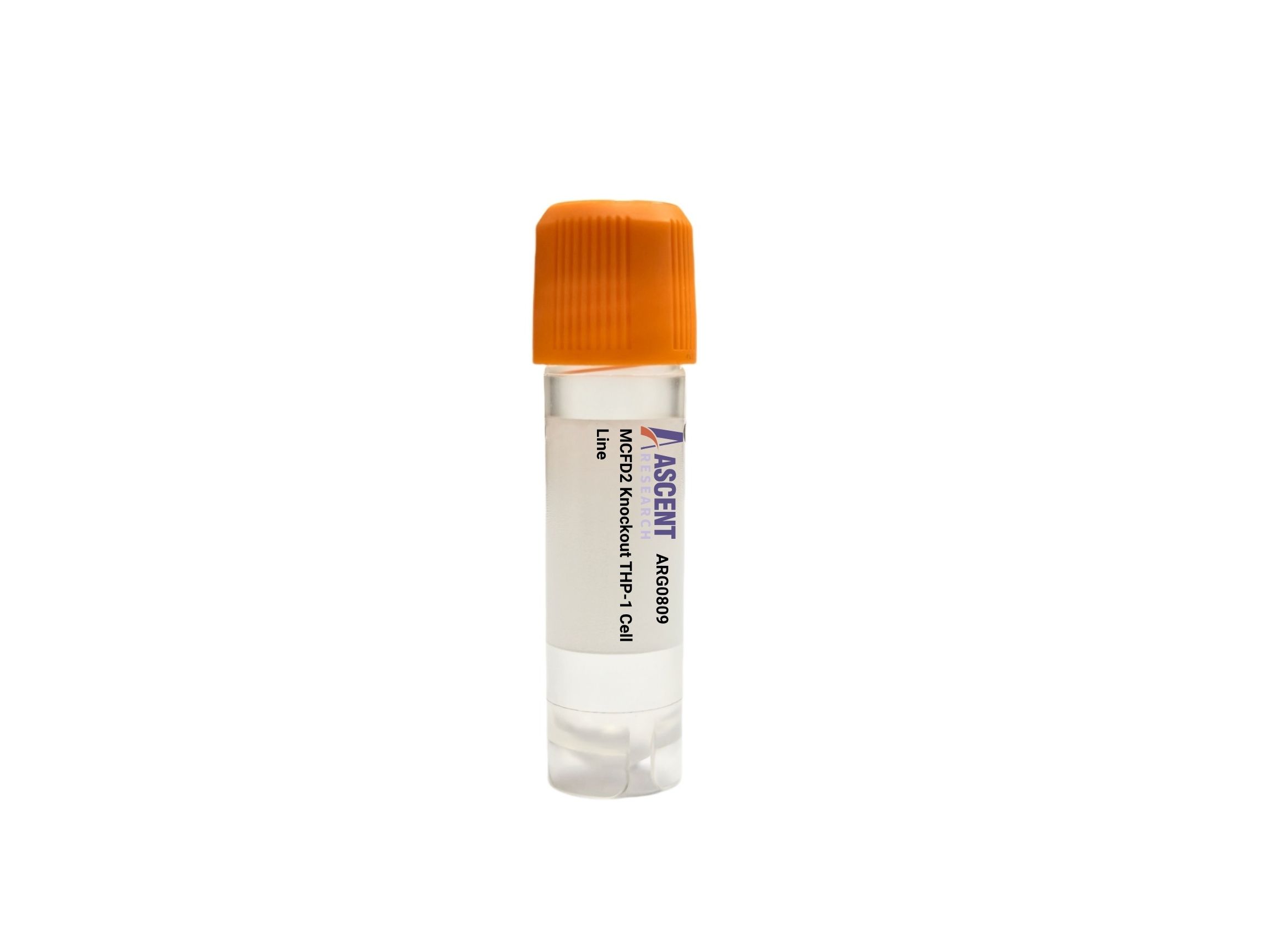
Genome-edited Cells
Blood (peripheral blood)
The MCFD2 Knockout THP-1 Cell Line provides a CRISPR/Cas9-mediated loss-of-function model of the MCFD2 cargo receptor component in the human THP-1 monocytic leukemia cell line. MCFD2 partners with LMAN1/ERGIC-53 to mediate ER-to-Golgi transport of coagulation factors V and VIII in a Ca2?-dependent manner. This knockout line enables focused investigation of MCFD2-dependent secretory trafficking and its impact on monocyte/macrophage biology, including immune signaling, inflammation, and phagocytosis. Applications include functional studies of coagulation factor secretion, ER stress response analysis, and drug screening for secretion modulators. The model supports assays such as co-immunoprecipitation, ELISA, and confocal imaging, and is relevant to research on F5F8D and secretory pathway biology in leukemia.
 CALR Knockout HGC-27 Polyclonal Cells
Cat. No. ARG29799
GATA6 Knockout K562 Polyclonal Cells
Cat. No. ARG19373
FTO Knockout NCI-H1975 Polyclonal Cells
Cat. No. ARG16802
NUDCD2 Knockout NCI-H1299 Polyclonal Cells
Cat. No. ARG17631
HFE Knockout MES-OV Polyclonal Cells
Cat. No. ARG24532
BAG2 Knockout HGC-27 Polyclonal Cells
Cat. No. ARG29692
CALR Knockout HGC-27 Polyclonal Cells
Cat. No. ARG29799
GATA6 Knockout K562 Polyclonal Cells
Cat. No. ARG19373
FTO Knockout NCI-H1975 Polyclonal Cells
Cat. No. ARG16802
NUDCD2 Knockout NCI-H1299 Polyclonal Cells
Cat. No. ARG17631
HFE Knockout MES-OV Polyclonal Cells
Cat. No. ARG24532
BAG2 Knockout HGC-27 Polyclonal Cells
Cat. No. ARG29692
The MCFD2 Knockout THP-1 Cell Line is a genetically engineered cellular model generated through CRISPR/Cas9-mediated gene disruption, designed to facilitate loss-of-function studies of MCFD2 (Multiple Coagulation Factor Deficiency 2) within a human monocytic leukemia background. Derived from the THP-1 host cell line, this knockout product provides a stable, homogeneous population suitable for investigating the functional consequences of MCFD2 ablation in a well-characterized myeloid cell context.
THP-1 cells were originally isolated from the peripheral blood of a 1-year-old male patient with acute monocytic leukemia (AML M5) and have since become a widely employed model for monocyte and macrophage biology. These cells exhibit characteristics such as plastic adherence, phagocytic activity, and responsiveness to differentiation-inducing agents, making them valuable for studying immune signaling pathways, inflammatory responses, and phagocytosis in both undifferentiated and differentiated states.
MCFD2 encodes a calcium-dependent cargo receptor component that partners with LMAN1 (ERGIC-53) to facilitate the endoplasmic reticulum (ER)-to-Golgi transport of specific glycoproteins, most notably coagulation factors V (F5) and VIII (F8). The MCFD2?CLMAN1 complex forms within the ER and interacts with the COPII vesicle machinery, including SEC23, to package these cargo proteins for anterograde trafficking. Accordingly, MCFD2 functions downstream of transcription factors XBP1 and ATF6, which regulate components of the unfolded protein response and secretory pathway. Disruption of MCFD2 impairs ER exit of F5 and F8, leading to reduced secretion and is associated with the rare bleeding disorder combined deficiency of coagulation factors V and VIII (F5F8D).
In the THP-1 context, targeted disruption of MCFD2 offers a unique opportunity to dissect ER-to-Golgi trafficking mechanisms specifically within monocyte and macrophage lineages. Given that myeloid cells engage in extensive secretory activity and ER stress responses during inflammation and immune activation, this knockout cell line serves as a powerful model for exploring how MCFD2-dependent secretory pathways influence monocyte/macrophage function. Furthermore, the leukemia origin of THP-1 enables investigations into the role of protein secretion and ER homeostasis in leukemic cell survival, potentially revealing vulnerabilities in secretory pathway components that could be exploited therapeutically.
Researchers can employ this MCFD2 knockout line in a broad array of experimental applications, including co-immunoprecipitation studies with LMAN1, immunofluorescence analysis of ER and Golgi markers, and ELISA-based assays to quantify secreted coagulation factors. The model is also suited for RT-qPCR and western blotting to confirm MCFD2 depletion, as well as for monitoring ER stress biomarkers such as BiP and CHOP. Confocal microscopy permits tracking of COPII vesicles, while functional phagocytosis assays allow assessment of macrophage effector functions. Together, these approaches support studies of ER-to-Golgi trafficking, drug screening efforts to identify modulators of coagulation factor secretion, and investigations of ER stress responses in leukemia cells. For further details, please contact Ascent Research.