Genome-edited Cells
Ascites
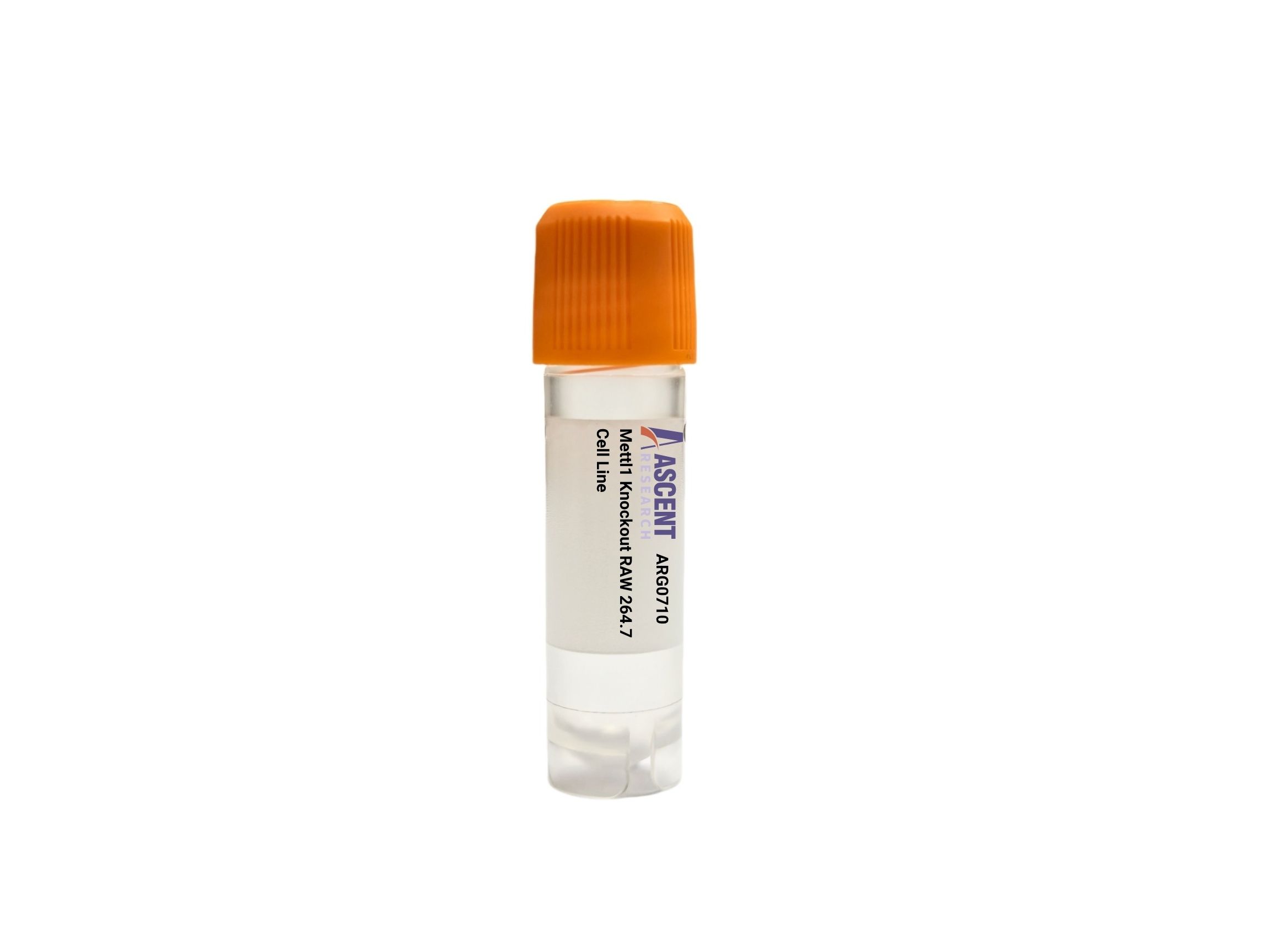
The Mettl1 Knockout RAW 264.7 Cell Line is a CRISPR/Cas9-edited murine macrophage model lacking functional Mettl1, the catalytic subunit of the m7G methyltransferase complex. Mettl1 partners with WDR4 to modify tRNAs and mRNAs, and its deletion disrupts translation of growth- and immune-related transcripts downstream of MYC signaling. This knockout line provides a powerful tool for epitranscriptomics, inflammation, and cancer research. It enables dissection of tRNA modification-dependent translation control in innate immune cells using assays such as cytokine profiling, phagocytosis measurement, and RNA-seq, helping to elucidate roles of Mettl1 in macrophage biology and disease.
 MFGE8 Knockout A2780 Polyclonal Cells
Cat. No. ARG18882
NDUFA5 Knockout Hela Polyclonal Cells
Cat. No. ARG8702
NPEPL1 Knockout Hela Polyclonal Cells
Cat. No. ARG7491
HSPB8 Knockout MES-OV Polyclonal Cells
Cat. No. ARG24587
ACVR1B Knockout A549 Polyclonal Cells
Cat. No. ARG37855
DNER Knockout HT29 Polyclonal Cells
Cat. No. ARG39394
MFGE8 Knockout A2780 Polyclonal Cells
Cat. No. ARG18882
NDUFA5 Knockout Hela Polyclonal Cells
Cat. No. ARG8702
NPEPL1 Knockout Hela Polyclonal Cells
Cat. No. ARG7491
HSPB8 Knockout MES-OV Polyclonal Cells
Cat. No. ARG24587
ACVR1B Knockout A549 Polyclonal Cells
Cat. No. ARG37855
DNER Knockout HT29 Polyclonal Cells
Cat. No. ARG39394
The Mettl1 Knockout RAW 264.7 Cell Line is a genetically disrupted murine macrophage model generated by CRISPR/Cas9-mediated targeting of the Mettl1 gene. This product is supplied as a stable cell line, providing a renewable and tractable system for loss-of-function studies. The editing strategy yields functional ablation of the catalytic subunit of the N7-methylguanosine (m7G) methyltransferase complex, eliminating the installation of m7G on its substrate RNAs. Researchers can employ this model to investigate how the absence of Mettl1-dependent RNA modifications remodels gene expression and cellular behavior without the need for transient silencing approaches.
The host line, RAW 264.7, is a well-established monocyte/macrophage cell line derived from BALB/c mice. These cells retain key innate immune effector functions including robust phagocytic activity, inflammatory cytokine secretion, and antigen presentation capacity. Their responsiveness to bacterial lipopolysaccharide and other immune stimuli makes them a workhorse in macrophage biology and inflammation research. By introducing a Mettl1 knockout into this background, scientists can directly examine the intersection of epitranscriptomic regulation and innate immunity, exploring how RNA modification status influences macrophage activation, polarization, and effector output in a defined and highly manipulable system.
Mettl1 functions as the catalytic core of the METTL1-WDR4 methyltransferase complex, which catalyzes the deposition of m7G at position 46 of specific tRNAs (including tRNA-Arg-TCT and tRNA-Leu-CAG) and on certain mRNAs and miRNAs. This modification enhances RNA stability and promotes efficient translation elongation, particularly for codon-biased transcripts enriched in growth-regulatory and oncogenic pathways. Upstream, Mettl1 expression is positively regulated by MYC and oncogenic signaling cascades. Downstream, loss of Mettl1 activity reduces the pool of m7G-modified tRNAs and impairs translational output of target mRNAs, thereby compromising the translation machinery and eIF4F complex function. These molecular connections position Mettl1 as a critical node linking growth signals to protein synthesis.
In the RAW 264.7 macrophage context, Mettl1 knockout is anticipated to broadly disturb the translation of proteins required for rapid immune responses. Because m7G-modified tRNAs are essential for decoding codons prevalent in transcripts encoding inflammatory mediators, phagocytic receptors, and MHC molecules, their deficiency can attenuate cytokine production, phagocytic clearance, and antigen presentation. This model therefore enables dissection of translational control mechanisms in innate immunity and offers a platform to study how dysregulated tRNA modification contributes to chronic inflammatory diseases and tumor-associated macrophage dysfunction. The intersection of epitranscriptomics and immunology in a tractable cell line makes this product particularly valuable for mechanistic investigations.
This Mettl1 knockout line is ideally suited for epitranscriptomics research, tRNA biology studies, and macrophage functional genomics. Experimental workflows such as RT-qPCR and RNA-seq can be employed to profile transcriptome-wide changes, while western blotting and flow cytometry enable analysis of protein expression and signaling. Functional assays including phagocytosis quantification, multiplex cytokine ELISA, and proliferation measurements allow direct assessment of immune effector capabilities. Additionally, this model supports cancer immunology studies where macrophage behavior is critical. For further details on validation and application protocols, researchers are invited to contact Ascent Research.