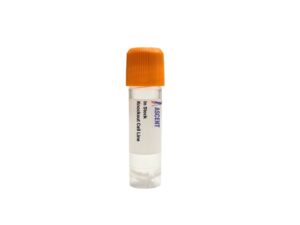
In Stock Cell Lines
Homo sapiens (Human)
Blood (peripheral blood)
Suspension
The METTL3 Knockout Jurkat Cell Line is a CRISPR/Cas9-edited human T-cell leukemia model that eliminates the m6A methyltransferase METTL3. By disrupting this key writer of N6-methyladenosine, the cell line abrogates mRNA modifications critical for leukemia cell proliferation and survival. It provides a well-defined system for studying METTL3-dependent gene regulation and RNA epitranscriptomics in acute lymphoblastic leukemia. METTL3 regulates targets such as c-Myc and BCL2 via m6A deposition. This knockout cell line supports m6A profiling, transcriptomic analysis, and functional assessments of apoptosis, cell cycle, and drug sensitivity, making it a crucial resource for target validation and m6A pathway research in T-cell leukemia.
 CASP2 Knockout HGC-27 Polyclonal Cells
Cat. No. ARG29820
PCCA Knockout A2780 Polyclonal Cells
Cat. No. ARG18285
DHCR7 Knockout TE1 Polyclonal Cells
Cat. No. ARG12150
MAP2K1 Knockout HCT116 Polyclonal Cells
Cat. No. ARG6990
NDFIP1 Knockout AGS Polyclonal Cells
Cat. No. ARG2727
MTMR12 Knockout AGS Polyclonal Cells
Cat. No. ARG2520
CASP2 Knockout HGC-27 Polyclonal Cells
Cat. No. ARG29820
PCCA Knockout A2780 Polyclonal Cells
Cat. No. ARG18285
DHCR7 Knockout TE1 Polyclonal Cells
Cat. No. ARG12150
MAP2K1 Knockout HCT116 Polyclonal Cells
Cat. No. ARG6990
NDFIP1 Knockout AGS Polyclonal Cells
Cat. No. ARG2727
MTMR12 Knockout AGS Polyclonal Cells
Cat. No. ARG2520
The METTL3 Knockout Jurkat Cell Line is a CRISPR/Cas9-edited knockout cell line featuring targeted disruption of the METTL3 gene in the Jurkat human T-lymphocyte line. By eliminating the catalytic subunit of the m6A methyltransferase complex, this model depletes N6-methyladenosine (m6A) marks on mRNA, providing a renewable system to investigate m6A-dependent post-transcriptional regulation in a T-cell leukemia context.
Jurkat cells, derived from an acute T-cell leukemia patient, are a standard suspension model for T-cell receptor signaling, apoptosis, and leukemogenesis. Their well-characterized signaling network and genetic tractability make them ideal for CRISPR/Cas9-mediated gene disruption. This knockout cell line retains the core properties of Jurkat cells, enabling focused functional studies of METTL3 in acute lymphoblastic leukemia biology.
METTL3 is the catalytic subunit of the m6A methyltransferase complex, partnered with METTL14, WTAP, VIRMA, and RBM15. Upstream transcriptional regulators include c-Myc, SP1, and E2F1, while its m6A targets encompass c-Myc, CCND1, BCL2, SOX2, and MYC mRNAs. Reader proteins (YTHDF1/2/3, YTHDC1/2) interpret these marks, and demethylases (FTO, ALKBH5) remove them. This machinery governs RNA stability, splicing, translation, and decay, linking METTL3 to Wnt/??-catenin, PI3K/AKT/mTOR, and p53 signaling. In Jurkat cells, METTL3 disruption dismantles m6A-dependent regulation, offering a window into post-transcriptional leukemogenic mechanisms.
In T-cell leukemia, METTL3-mediated m6A methylation sustains oncogenic transcripts. Jurkat METTL3 knockout cells lose m6A marks on targets like c-Myc and BCL2, leading to impaired proliferation, altered cell cycle, and enhanced apoptosis. This model thus enables dissection of how RNA methylation supports leukemic cell maintenance and drug sensitivity, linking m6A machinery to established oncogenic pathways.
The knockout cell line is suited for diverse applications: Western blotting confirms METTL3 loss; m6A dot blot or LC-MS/MS quantifies methylation; RNA-seq and MeRIP-seq reveal transcriptomic and epitranscriptomic changes. Functional assays??flow cytometry for apoptosis/cell cycle, proliferation assays, and drug sensitivity tests??further characterize the knockout phenotype. This tool is ideal for target validation and for exploring therapeutic modulation of the m6A pathway in leukemia. For further information, please contact Ascent Research.