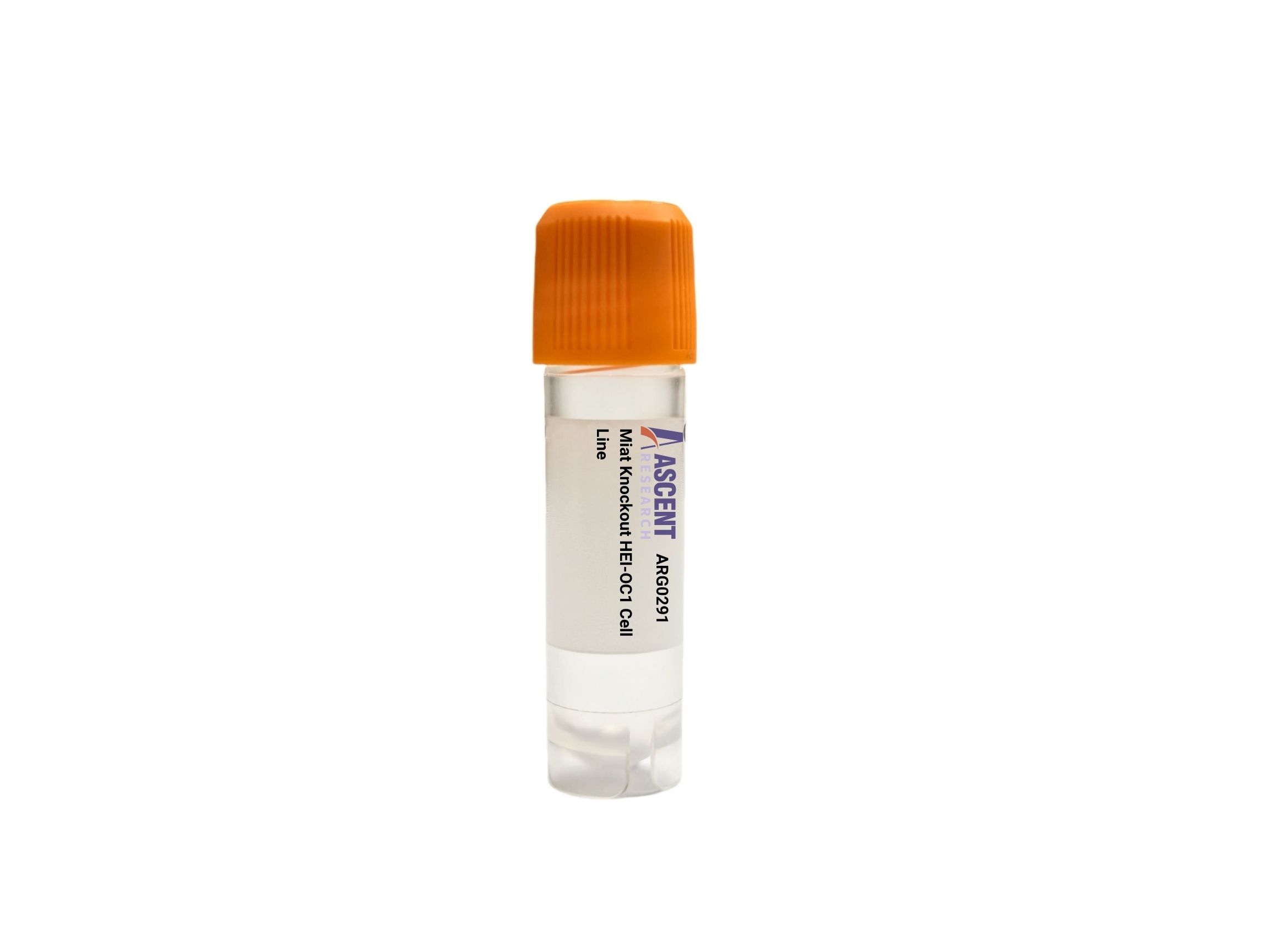
Genome-edited Cells
The Miat Knockout HEI-OC1 Cell Line is a CRISPR/Cas9-edited knockout cell line derived from the immortalized mouse cochlear hair cell-like cell line HEI-OC1. Disruption of the long non-coding RNA Miat, a competitive endogenous RNA that regulates apoptosis and proliferation by sponging miR-150 and miR-22, provides a loss-of-function model for auditory research. Miat is regulated by NF-??B, SP1, p53, and TGF-??, and modulates Wnt/??-catenin and NF-??B signaling pathways, controlling Bcl-2 and Bax expression. This cell line is designed for investigating hearing loss mechanisms, ototoxicity screening, and lncRNA functional analysis. Applications include RT-qPCR, western blotting, RNA-seq, flow cytometry, and cell viability assays to study hair cell survival and apoptosis. Contact Ascent Research for further information.
 ABCB8 Knockout Hela Polyclonal Cells
Cat. No. ARG20121
CTNNB1 Knockout 143B Polyclonal Cells
Cat. No. ARG11799
KIF1C Knockout Hela Polyclonal Cells
Cat. No. ARG26365
ADA Knockout jurkat Polyclonal Cells
Cat. No. ARG33743
GSN Knockout HAP1 Polyclonal Cells
Cat. No. ARG34885
EDIL3 Knockout MES-OV Polyclonal Cells
Cat. No. ARG40483
ABCB8 Knockout Hela Polyclonal Cells
Cat. No. ARG20121
CTNNB1 Knockout 143B Polyclonal Cells
Cat. No. ARG11799
KIF1C Knockout Hela Polyclonal Cells
Cat. No. ARG26365
ADA Knockout jurkat Polyclonal Cells
Cat. No. ARG33743
GSN Knockout HAP1 Polyclonal Cells
Cat. No. ARG34885
EDIL3 Knockout MES-OV Polyclonal Cells
Cat. No. ARG40483
The Miat Knockout HEI-OC1 Cell Line is a CRISPR/Cas9-edited knockout cell line in which the long non-coding RNA gene Miat has been disrupted using CRISPR/Cas9-mediated gene disruption. Derived from the HEI-OC1 immortalized mouse cochlear hair cell-like cell line, this product provides a powerful loss-of-function model for dissecting the biological functions of Miat in auditory sensory hair cells. The knockout cell line serves as a valuable tool for investigating the role of this lncRNA in cell proliferation, apoptosis, and gene expression regulation within the context of cochlear biology.
The host HEI-OC1 cell line is an immortalized mouse organ of Corti cell line established from H-2Kb-tsA58 transgenic mice (Immortomouse). These cells retain many phenotypic characteristics of auditory sensory hair cells and are widely used as an in vitro model system for studying hair cell biology, ototoxicity, and age-related hearing loss. HEI-OC1 cells respond to ototoxic stimuli such as aminoglycosides and cisplatin, making them a relevant platform for evaluating the cellular and molecular mechanisms underlying hair cell damage and survival.
Miat is a long non-coding RNA that functions as a competitive endogenous RNA (ceRNA), sequestering microRNAs such as miR-150 and miR-22 to regulate apoptosis- and proliferation-related gene expression. Transcription of Miat is activated by NF-??B, SP1, p53, and TGF-?? signaling pathways. The lncRNA interacts with epigenetic modifiers EZH2, SUZ12, and DNMT1, and it modulates components of the Wnt/??-catenin cascade including Wnt3a, ??-catenin, and TCF4, as well as NF-??B pathway members NF-??B p65 and I??B??. Through these interactions, Miat controls the expression of Bcl-2 and Bax, key determinants of cell survival and death.
In HEI-OC1 cells, Miat disruption likely compromises cell survival and apoptotic programs, directly impacting cochlear hair cell function. This loss-of-function model allows researchers to dissect the ceRNA network underlying ototoxic responses and hearing loss, and to evaluate whether restoring Miat-mediated microRNA sponging can protect against hair cell damage.
Applications encompass hearing loss mechanism studies, ototoxicity screening, lncRNA functional analysis, and auditory cell line engineering. Compatible techniques include RT-qPCR, western blotting, RNA-seq, immunofluorescence, flow cytometry, apoptosis and viability assays, luciferase reporter assays, and RNA immunoprecipitation. For further information, please contact Ascent Research.