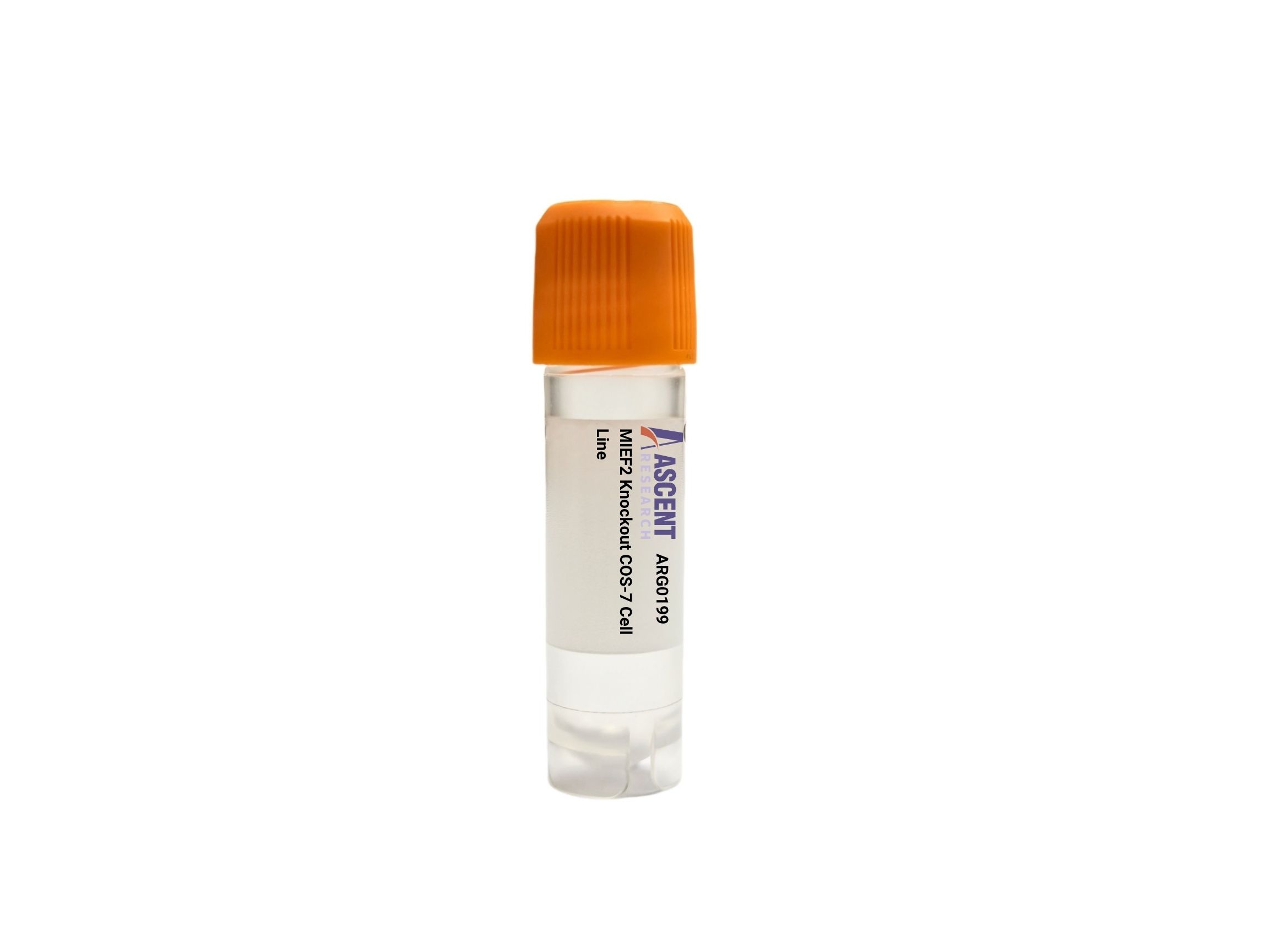
Genome-edited Cells
Kidney
MIEF2 Knockout COS-7 is a CRISPR/Cas9-edited African green monkey kidney fibroblast-like cell line with disruption of the mitochondrial outer membrane regulator MIEF2. In COS-7 cells, loss of MIEF2 enables analysis of DNM1L/DRP1 recruitment, mitochondrial fission-fusion balance, network morphology, and organelle quality-control pathways involving factors such as MFF, MFN1/2, OPA1, PINK1, and PRKN/Parkin. This adherent, imaging-compatible model is well suited for mitochondrial dynamics studies, mitophagy and apoptosis research, bioenergetics profiling, protein interaction analysis, and CRISPR loss-of-function validation using microscopy, western blotting, Seahorse assays, and related molecular assays.
 FGFR1 Knockout A549 Polyclonal Cells
Cat. No. ARG11046
FGFR1 Knockout A549 Polyclonal Cells
Cat. No. ARG11046
 Nrep Knockout 4T1 Cell Line
Cat. No. ARG44016
Nrep Knockout 4T1 Cell Line
Cat. No. ARG44016
 Human Bronchial Epithelial Cells (DF508/DF508 Cystic Fibrosis)
Cat. No. ARP1161
ANKRD13A Knockout K562 Polyclonal Cells
Cat. No. ARG20100
GMEB1 Knockout jurkat Polyclonal Cells
Cat. No. ARG13092
CSDE1 Knockout MCF7 Polyclonal Cells
Cat. No. ARG11473
Human Bronchial Epithelial Cells (DF508/DF508 Cystic Fibrosis)
Cat. No. ARP1161
ANKRD13A Knockout K562 Polyclonal Cells
Cat. No. ARG20100
GMEB1 Knockout jurkat Polyclonal Cells
Cat. No. ARG13092
CSDE1 Knockout MCF7 Polyclonal Cells
Cat. No. ARG11473
The MIEF2 Knockout COS-7 Cell Line is a CRISPR/Cas9-engineered African green monkey cell model in which the endogenous MIEF2 locus has been disrupted to abolish functional gene expression. This stable knockout line is generated in COS-7 cells, an adherent SV40-transformed kidney fibroblast-like background widely used for mechanistic studies in mammalian cell biology. The model is designed for investigation of mitochondrial outer membrane regulatory mechanisms, particularly those governing mitochondrial fission, fusion, and stress-responsive remodeling.
COS-7 cells are derived from African green monkey kidney tissue and exhibit robust adherence, high transfectability, and compatibility with microscopy-based and biochemical workflows. Their SV40 large T antigen-transformed background has made them a standard host for transient protein expression, organelle imaging, and signaling analysis. In mitochondrial research, COS-7 cells are especially useful because their flat morphology facilitates high-content visualization of mitochondrial network architecture, subcellular localization studies, and live-cell assessment of organelle dynamics under basal and stress conditions.
MIEF2 encodes a mitochondrial outer membrane protein that functions as a receptor-like regulator of the dynamin-related GTPase DNM1L/DRP1. By interacting with DNM1L and coordinating its recruitment at mitochondria, MIEF2 acts within the core mitochondrial dynamics machinery that also includes MFF, FIS1, MIEF1, MFN1, MFN2, and OPA1. Its activity is regulated by cellular stress, mitochondrial depolarization, nutrient status, AMPK-linked metabolic stress, and the phosphorylation state of DNM1L, positioning MIEF2 within broader organelle quality-control pathways. Loss of MIEF2 can therefore alter mitochondrial morphology, network connectivity, fragmentation behavior, mitophagy susceptibility, ATP output, reactive oxygen species homeostasis, and apoptotic sensitivity, with relevance to mitochondrial disease, neurodegeneration, optic neuropathy, cardiomyopathy, metabolic dysfunction, and cancer cell metabolism.
In the COS-7 background, MIEF2 deletion provides a practical system for examining how mitochondrial fission control interfaces with a highly tractable imaging and expression platform. Because COS-7 cells are routinely used for mitochondrial localization studies and protein interaction experiments, this model supports analysis of how loss of MIEF2 modifies DNM1L recruitment, shifts the balance between fission and fusion, and changes responses to mitochondrial quality-control signals such as those linked to PINK1 and PRKN/Parkin.
This knockout cell line is suitable for western blotting and RT-qPCR confirmation of gene disruption, immunofluorescence and live-cell mitochondrial imaging to quantify network morphology, and confocal morphometric analysis to assess fragmentation versus elongation phenotypes. It can also be applied in co-immunoprecipitation studies of DNM1L-centered protein complexes, mitochondrial membrane potential assays, Seahorse metabolic profiling, reactive oxygen species measurements, apoptosis assays, electron microscopy, and RNA-seq-based analysis of stress-responsive transcriptional changes. Researchers may contact Ascent Research for additional technical information, product details, or related gene-edited cell models.