Genome-edited Cells
Stomach
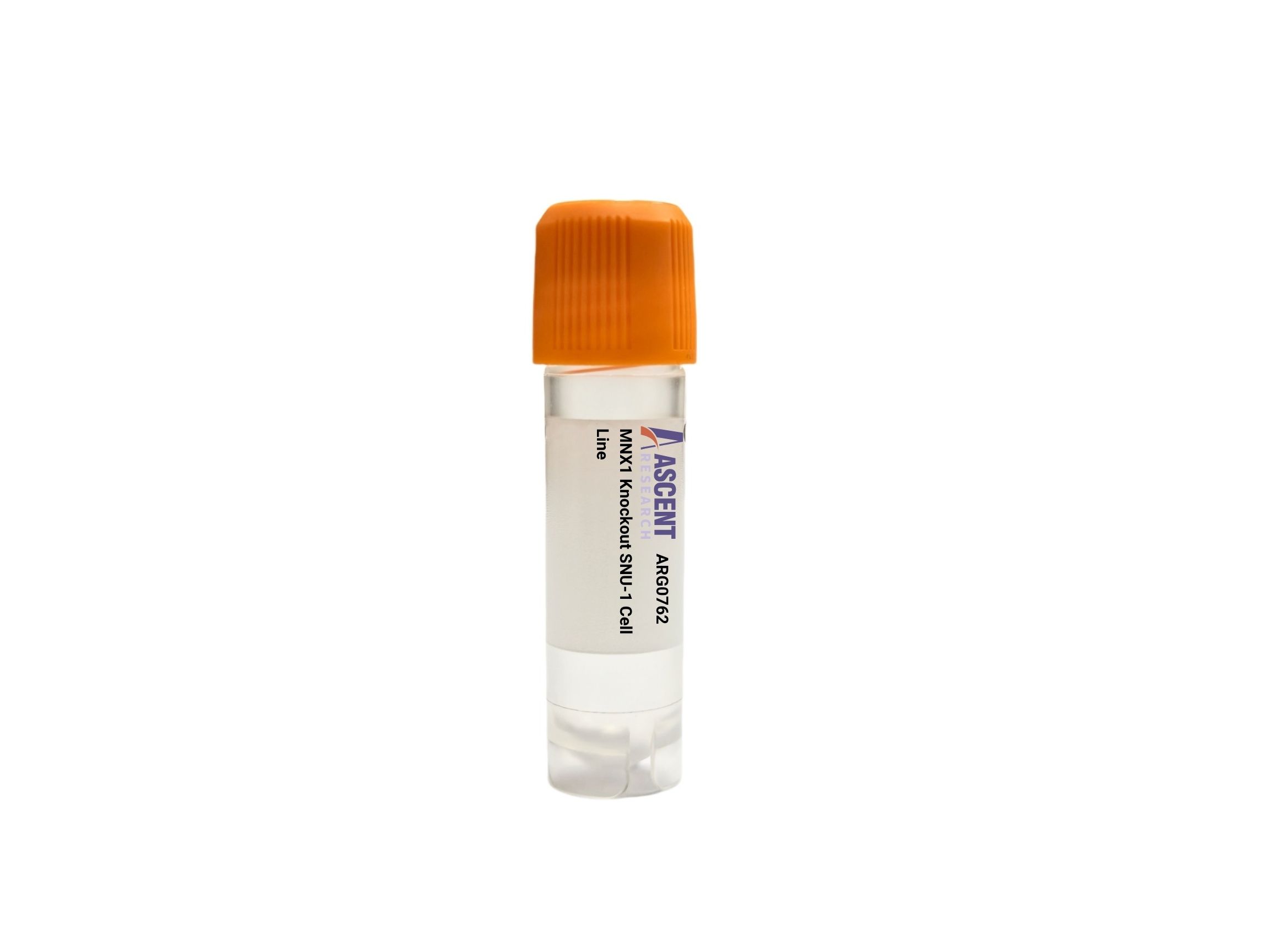
The MNX1 Knockout SNU-1 Cell Line is a CRISPR/Cas9-edited knockout cell line based on the SNU-1 human gastric adenocarcinoma cell line, designed to disrupt MNX1 function. MNX1 encodes a homeobox transcription factor essential for motor neuron and pancreatic ??-cell development, controlling targets like INS and CHAT via interactions with PDX1 and ISL1. This model aids in studying MNX1's roles in gastric cancer tumorigenesis, including proliferation and invasion, and its integration into developmental signaling pathways. Applications such as RNA-seq, colony formation, and xenograft assays support cancer and developmental biology research.
 ARL13B Knockout K562 Polyclonal Cells
Cat. No. ARG20211
GIGYF1 Knockout A2780 Polyclonal Cells
Cat. No. ARG18477
NAGS Knockout A549 Polyclonal Cells
Cat. No. ARG10309
ACP1 Knockout AGS Polyclonal Cells
Cat. No. ARG26444
GZF1 Knockout HT29 Polyclonal Cells
Cat. No. ARG33312
DCUN1D4 Knockout MES-OV Polyclonal Cells
Cat. No. ARG6600
ARL13B Knockout K562 Polyclonal Cells
Cat. No. ARG20211
GIGYF1 Knockout A2780 Polyclonal Cells
Cat. No. ARG18477
NAGS Knockout A549 Polyclonal Cells
Cat. No. ARG10309
ACP1 Knockout AGS Polyclonal Cells
Cat. No. ARG26444
GZF1 Knockout HT29 Polyclonal Cells
Cat. No. ARG33312
DCUN1D4 Knockout MES-OV Polyclonal Cells
Cat. No. ARG6600
The MNX1 Knockout SNU-1 Cell Line is a CRISPR/Cas9-edited knockout cell line derived from the SNU-1 human gastric carcinoma cell line, designed to disrupt MNX1 gene function. This loss-of-function model enables systematic investigation of MNX1-dependent transcriptional networks and their role in gastric cancer pathology. Created using CRISPR/Cas9-mediated gene disruption, the cell line offers a versatile platform for functional studies, including gene expression analysis and phenotypic assays.
The SNU-1 cell line originates from a poorly differentiated gastric adenocarcinoma established from the ascites of a Korean patient. It represents an aggressive gastric cancer model characterized by rapid proliferation and invasive potential. Widely employed in oncology research, SNU-1 cells provide a clinically relevant background to study the molecular mechanisms driving gastric tumor progression and therapeutic resistance.
MNX1 encodes a homeobox transcription factor essential for motor neuron specification and pancreatic ??-cell development. It operates within a signaling hierarchy, regulated by upstream factors BMP4, SHH, NOTCH1, and PDX1. MNX1 interacts with cofactors PDX1, ISL1, LHX3, PBX1, and MEIS1 to control downstream targets INS, ISL1, CHAT, and NEUROD1. Downstream of PDX1 and NEUROG3, it collaborates with PAX6 and NKX2-2 in ??-cell differentiation, and with ISL1 and LHX3 in cholinergic neuron specification. Disruption of MNX1 thus perturbs critical developmental and cell fate decisions.
In the SNU-1 gastric cancer context, MNX1 knockout provides a unique model to dissect its contribution to oncogenic phenotypes. MNX1 may influence proliferation, survival, and invasiveness through cross-talk with Wnt, Notch, and BMP pathways, which are frequently dysregulated in gastric adenocarcinoma. By eliminating MNX1, researchers can interrogate its role in maintaining the poorly differentiated state and assess how its loss impacts tumorigenic properties such as colony formation and migration. This model is particularly valuable for exploring transcriptional dependencies in gastric cancer and for validating MNX1 as a potential therapeutic target.
Researchers can utilize this cell line for a wide range of applications, including transcriptomic profiling by RNA-seq and RT-qPCR, protein detection via Western blotting, and functional assays such as proliferation, colony formation, and Transwell migration/invasion. Flow cytometry enables analysis of cell cycle and apoptosis, while tumor xenograft models allow assessment of in vivo growth and metastasis. These tools facilitate studies in developmental biology, pancreatic differentiation, and gastric cancer biology. For further technical information, please contact Ascent Research.