Genome-edited Cells
Breast (mammary gland)
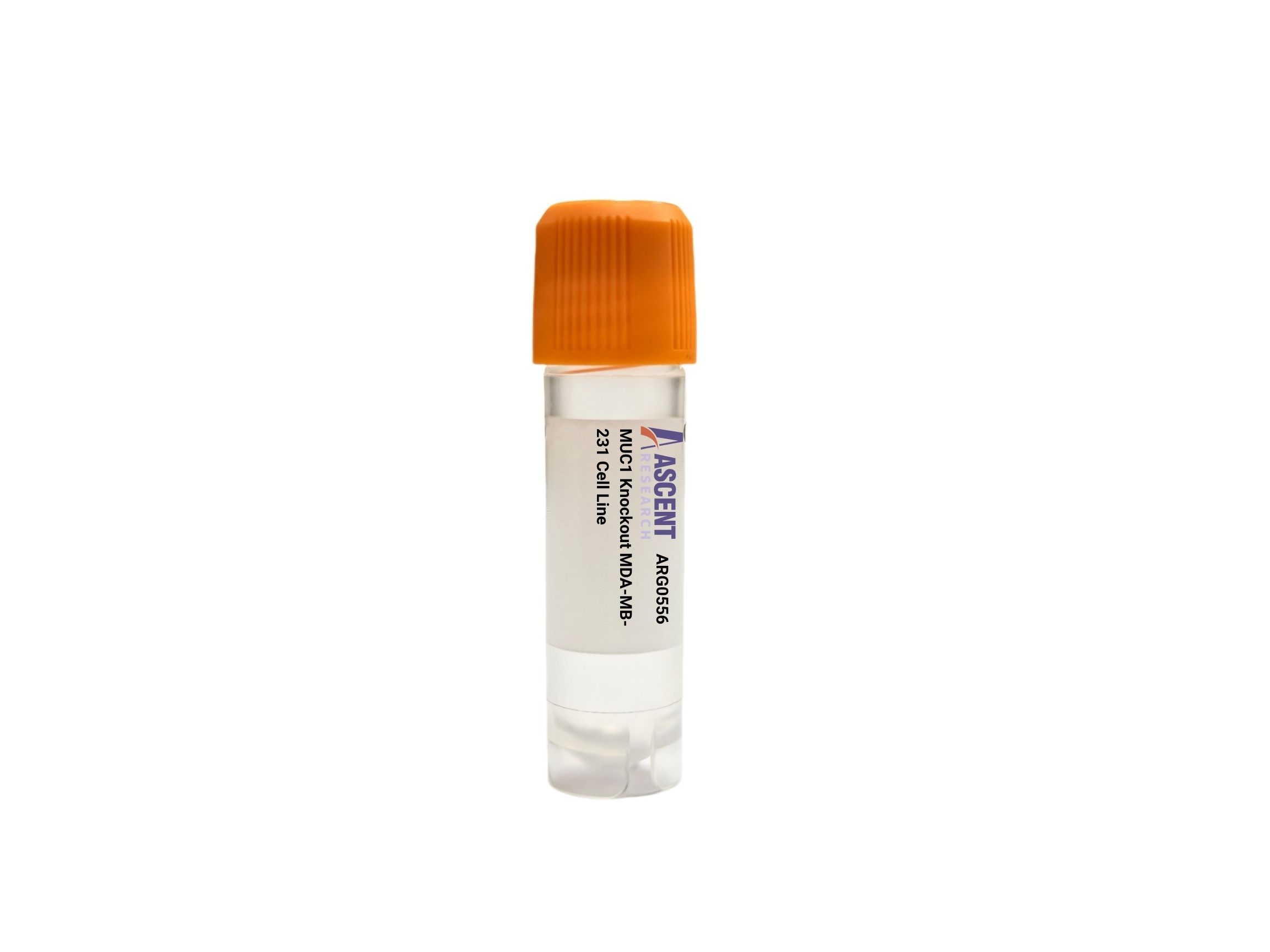
The MUC1 Knockout MDA-MB-231 Cell Line is a CRISPR/Cas9-edited human triple-negative breast cancer line with targeted disruption of the MUC1 gene. MUC1 encodes a transmembrane mucin oncoprotein that drives tumor progression by stabilizing ??-catenin and activating PI3K/AKT, NF-??B, and ERK signaling, promoting proliferation, survival, and metastasis. This knockout model enables dissection of MUC1-dependent pathways in an aggressive, mesenchymal-like TNBC background. Applications include Western blotting for phospho-signaling, proliferation, migration/invasion assays, and xenograft tumor studies, supporting drug target validation and cancer biology research.
 ACAT1 Knockout Hela Polyclonal Cells
Cat. No. ARG20405
KLF3 Knockout huh-7 Polyclonal Cells
Cat. No. ARG28498
DVL3 Knockout Hela Polyclonal Cells
Cat. No. ARG40116
CRY1 Knockout PATU8988T Polyclonal Cells
Cat. No. ARG11374
LIPA Knockout AGS Polyclonal Cells
Cat. No. ARG2952
PBLD Knockout AGS Polyclonal Cells
Cat. No. ARG2949
ACAT1 Knockout Hela Polyclonal Cells
Cat. No. ARG20405
KLF3 Knockout huh-7 Polyclonal Cells
Cat. No. ARG28498
DVL3 Knockout Hela Polyclonal Cells
Cat. No. ARG40116
CRY1 Knockout PATU8988T Polyclonal Cells
Cat. No. ARG11374
LIPA Knockout AGS Polyclonal Cells
Cat. No. ARG2952
PBLD Knockout AGS Polyclonal Cells
Cat. No. ARG2949
The MUC1 Knockout MDA-MB-231 Cell Line is a CRISPR/Cas9-edited human breast adenocarcinoma cell line featuring targeted disruption of the mucin 1 (MUC1) gene. This knockout model provides a powerful loss-of-function platform to dissect MUC1??s oncogenic functions in a triple-negative breast cancer (TNBC) background. By eliminating MUC1 expression, researchers can investigate its contributions to tumor cell signaling, proliferation, survival, and metastatic behavior without confounding effects from receptor-based oncogenic drivers.
The parental MDA-MB-231 cell line is a well-established model of highly aggressive, mesenchymal-like TNBC lacking estrogen receptor, progesterone receptor, and HER2 amplification. It harbors oncogenic mutations in TP53 (R280K) and KRAS (G13D), and exhibits pronounced invasive and metastatic properties both in vitro and in vivo. This genetic background makes it an ideal host for studying MUC1-dependent mechanisms in a clinically relevant context where therapeutic options are limited.
MUC1 encodes a heterodimeric transmembrane mucin glycoprotein that is overexpressed and aberrantly glycosylated in carcinomas, exposing its cytoplasmic tail to intracellular signaling networks. In cancer, MUC1 is activated by growth factors and cytokines such as EGF, TNF-??, and IFN-??, and physically interacts with EGFR, ??-catenin, Src, and PI3K. It stabilizes CTNNB1 (??-catenin) to potentiate TCF/LEF?Cmediated transcription of proliferation and survival genes including CCND1 (cyclin D1) and BCL2L1 (Bcl-xL). Concurrently, MUC1 facilitates NF-??B activation through TNF-??/I??B signaling, promoting RELA (p65)?Cdependent expression of anti-apoptotic and invasive factors. It also recruits Grb2/SOS to activate RAS/RAF/MEK/ERK cascade and engages PI3K/AKT/mTOR signaling, collectively enhancing cell growth, migration, and resistance to apoptosis.
In the MDA-MB-231 background, MUC1 overexpression contributes to the aggressive phenotype by driving constitutive activation of these oncogenic pathways. Ablation of MUC1 using CRISPR/Cas9 enables precise interrogation of its role in maintaining the mesenchymal, invasive, and metastatic characteristics of TNBC cells. This model allows researchers to distinguish MUC1-specific effects from other signaling inputs, thereby clarifying its utility as a therapeutic target. Loss-of-function studies in this cell line can reveal dependencies on MUC1 for tumor growth and dissemination, offering insights into potential strategies for targeting MUC1-driven cancers.
Typical applications include biochemical analysis of MUC1 downstream signaling via Western blotting for phospho-AKT, phospho-ERK, and total ??-catenin, co-immunoprecipitation to assess MUC1?C??-catenin complexes, and RT-qPCR to quantify target gene expression. Functional assays such as MTT or BrdU proliferation, transwell migration, Matrigel invasion, and Annexin V apoptosis assays are directly implemented. The knockout line is also suitable for RNA-seq transcriptomic profiling, flow cytometry for surface MUC1, and in vivo xenograft tumor growth evaluation to study metastasis and therapeutic response. For additional information or customized support, please contact Ascent Research.