Genome-edited Cells
Lung
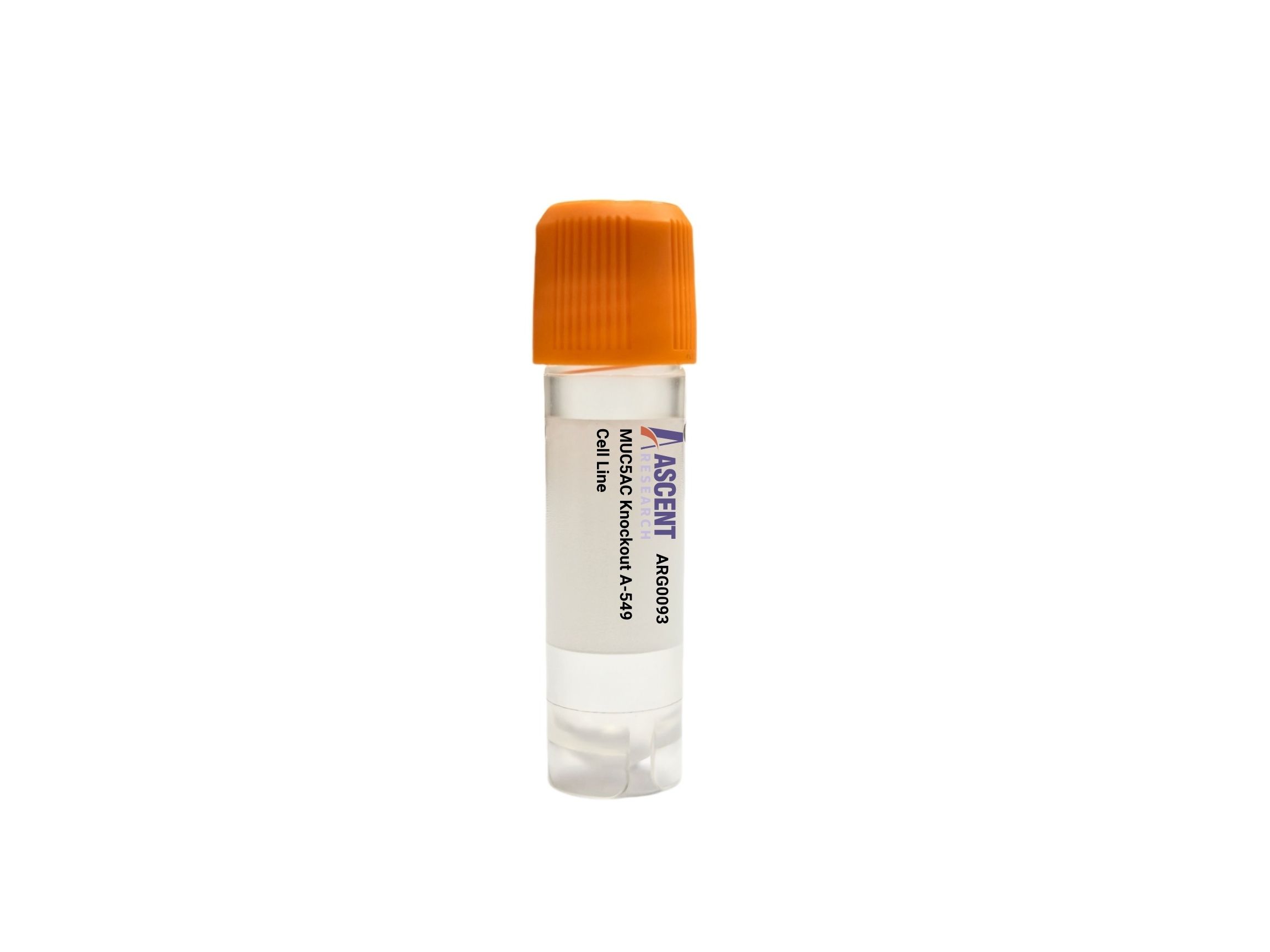
The MUC5AC Knockout A-549 Cell Line is a human CRISPR/Cas9-edited alveolar epithelial adenocarcinoma model with disruption of the secreted gel-forming mucin gene MUC5AC. In A-549 cells, this knockout supports analysis of airway mucus biology, epithelial secretion, host-pathogen interactions, and lung cancer-associated phenotypes. MUC5AC is regulated by EGFR-MAPK signaling and IL13/STAT6, with links to factors including SPDEF and AGR2 that support mucin biosynthesis and secretory differentiation. Applications include RT-qPCR, western blotting, ELISA, immunofluorescence, cytokine stimulation, phospho-ERK or phospho-STAT6 analysis, mucin secretion studies, infection assays, and drug response profiling.
 COQ6 Knockout NCI-H1299 Polyclonal Cells
Cat. No. ARG18053
AKAP11 Knockout HEK293T Polyclonal Cells
Cat. No. ARG37916
DNAJC16 Knockout NCI-H1975 Polyclonal Cells
Cat. No. ARG39229
HP1BP3 Knockout huh-7 Polyclonal Cells
Cat. No. ARG28326
FHL3 Knockout A549 Polyclonal Cells
Cat. No. ARG10077
NTN1 Knockout CaSki Polyclonal Cells
Cat. No. ARG9917
COQ6 Knockout NCI-H1299 Polyclonal Cells
Cat. No. ARG18053
AKAP11 Knockout HEK293T Polyclonal Cells
Cat. No. ARG37916
DNAJC16 Knockout NCI-H1975 Polyclonal Cells
Cat. No. ARG39229
HP1BP3 Knockout huh-7 Polyclonal Cells
Cat. No. ARG28326
FHL3 Knockout A549 Polyclonal Cells
Cat. No. ARG10077
NTN1 Knockout CaSki Polyclonal Cells
Cat. No. ARG9917
The MUC5AC Knockout A-549 Cell Line is a human CRISPR/Cas9-engineered cell model in which the MUC5AC gene has been disrupted to eliminate functional gene expression. This stable knockout was generated in the A-549 background, a human alveolar epithelial adenocarcinoma cell line frequently used to study pulmonary epithelial secretion, signal transduction, and tumor-associated biology. The model provides a defined in vitro system for examining the consequences of MUC5AC loss in respiratory epithelial cells with secretory and cancer-relevant characteristics.
A-549 cells are derived from human lung adenocarcinoma and are widely used as an airway/alveolar epithelial model in studies of respiratory epithelial biology, mucin regulation, host-pathogen interactions, and lung cancer-associated signaling. Their utility stems from their relevance to epithelial barrier function, inflammatory responsiveness, growth factor signaling, and secretory phenotyping. In this context, A-549 cells support experimental investigation of pathways linked to airway mucus production, epithelial innate defense, and disease processes such as asthma, chronic obstructive pulmonary disease, chronic bronchitis, cystic fibrosis airway disease, respiratory infection, and mucin-associated lung cancer phenotypes.
MUC5AC encodes a secreted gel-forming mucin that is a major structural component of the mucus layer and contributes to epithelial surface protection, extracellular mucin gel formation, and particle and pathogen trapping. Its expression is induced downstream of EGFR ligands such as EGF and TGFA, with signaling propagated through EGFR, ERBB2, KRAS, RAF1, MAP2K1, and MAPK1/3. MUC5AC is also transcriptionally regulated by IL13 and IL4 through STAT6 and is influenced by inflammatory mediators including TNF, IL1B, and NF-kB/RELA. Secretory differentiation factors such as SPDEF and FOXA3 further promote mucin-associated programs. At the biosynthetic and secretory level, MUC5AC function is linked to AGR2, FCGBP, CLCA1, BPIFB1, ERN2, B4GALT5, and GALNT family glycosyltransferases, which collectively support mucin folding, glycosylation, and epithelial secretory phenotype readouts. Loss of MUC5AC therefore reduces a principal component of the secreted mucus gel and enables direct analysis of mucin-dependent airway biology.
Within the A-549 host-cell context, MUC5AC knockout is particularly useful for separating mucin-dependent phenotypes from broader epithelial signaling responses. The model can be applied to determine whether responses to EGFR-MAPK, IL-13-STAT6, or NF-kB-mediated inflammatory stimulation require MUC5AC expression or instead proceed through parallel secretory and transcriptional programs. It also provides a relevant system for comparing MUC5AC-dependent versus MUC5B-associated functions in epithelial mucus biology and for evaluating how mucin loss affects barrier-related outputs, pathogen interaction, and tumor-associated secretory states.
This cell line is suitable for mechanistic studies using RT-qPCR, western blotting, ELISA for secreted MUC5AC, immunofluorescence microscopy, immunocytochemistry, and RNA-seq to quantify transcriptional and proteomic consequences of gene disruption. Researchers can combine cytokine stimulation assays with phospho-ERK and phospho-STAT6 analysis to map signaling inputs from EGFR, IL13, IL4, TNF, or IL1B to mucin-related outputs. The model is also applicable to mucin secretion assays, host-pathogen adhesion or infection studies, epithelial secretory phenotyping, and drug sensitivity experiments designed to test mucin-dependent treatment response in lung adenocarcinoma and inflammatory airway research. Comparative studies examining airway mucus hypersecretion, mucociliary clearance-related phenotypes, and mucinous differentiation programs are also supported. Researchers may contact Ascent Research for additional technical information, product details, or related gene-edited cell models.