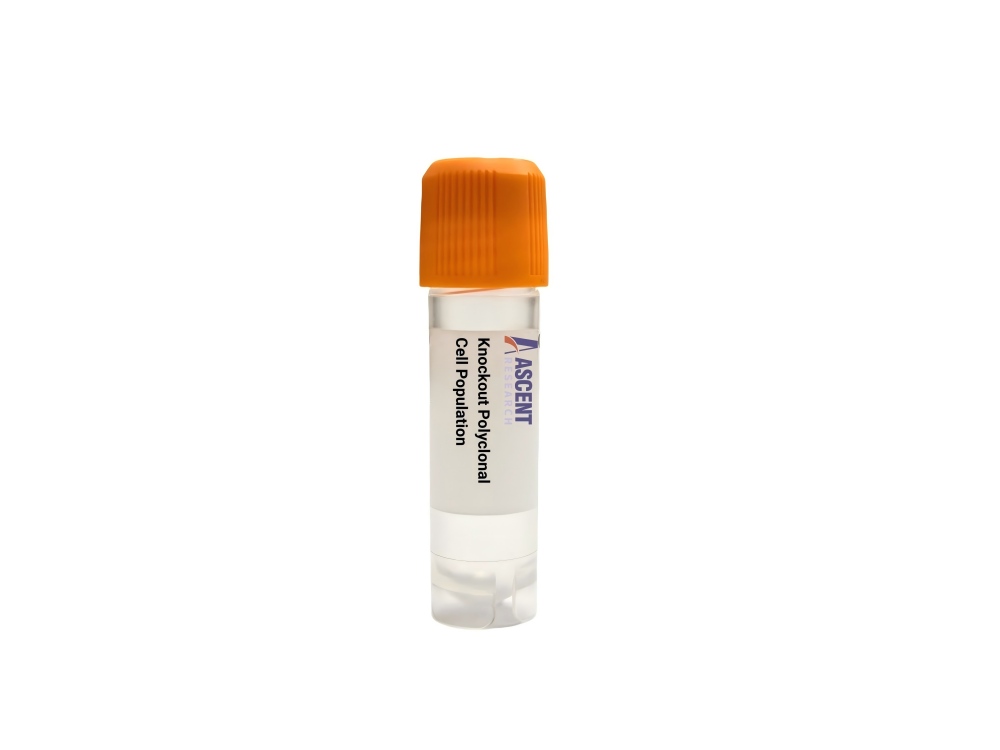
Polyclonal Cell Population
Homo sapiens (Human)
Bone
Suspension
MYO19 Knockout Raji Polyclonal Cells provide a loss-of-function model system for studying mitochondrial dynamics and actin-based organelle transport in a B lymphocyte background. MYO19 is an unconventional myosin that couples mitochondria to the actin cytoskeleton via Miro1/RHOT1 and Miro2/RHOT2 adaptor proteins, influencing network organization and metabolic output. This CRISPR/Cas9-edited polyclonal Raji cell population is ideal for investigating mitochondrial positioning, cancer cell metabolism, and apoptosis. Applications include mitochondrial morphology assays, ATP production analysis, and drug sensitivity testing, enabling dissection of MYO19-dependent pathways in Burkitt lymphoma biology.
 AIF1L Knockout 786-O Polyclonal Cells
Cat. No. ARG24859
GPHN Knockout jurkat Polyclonal Cells
Cat. No. ARG34184
ATF6 Knockout DLD-1 Polyclonal Cells
Cat. No. ARG35514
EGFR Knockout CaSki Polyclonal Cells
Cat. No. ARG40732
MCFD2 Knockout MES-OV Polyclonal Cells
Cat. No. ARG5910
MLLT10 Knockout AGS Polyclonal Cells
Cat. No. ARG3122
AIF1L Knockout 786-O Polyclonal Cells
Cat. No. ARG24859
GPHN Knockout jurkat Polyclonal Cells
Cat. No. ARG34184
ATF6 Knockout DLD-1 Polyclonal Cells
Cat. No. ARG35514
EGFR Knockout CaSki Polyclonal Cells
Cat. No. ARG40732
MCFD2 Knockout MES-OV Polyclonal Cells
Cat. No. ARG5910
MLLT10 Knockout AGS Polyclonal Cells
Cat. No. ARG3122
MYO19 Knockout Raji Polyclonal Cells are a CRISPR/Cas9-edited polyclonal knockout cell population designed to disrupt MYO19 gene expression in the Raji host background. This product provides a heterogeneous pool of gene-edited cells, avoiding clonal selection artifacts and preserving population-level biological variability for robust functional studies. The CRISPR/Cas9-mediated targeting introduces a loss-of-function perturbation, enabling researchers to interrogate mitochondrial dynamics and actin-based organelle transport without the constraints of single-cell-derived clones. The polyclonal format is particularly suited for transient or pooled screening applications where maintaining a broad representation of knockout phenotypes is advantageous.
The Raji cell line is an Epstein-Barr virus (EBV)-positive Burkitt lymphoma-derived lymphoblastoid B lymphocyte model. These suspension cells exhibit high proliferative capacity and are widely employed in immunology, oncology, and apoptosis research. Their cancerous origin and EBV-transformed state confer distinct metabolic and survival dependencies, making them an ideal platform for examining the intersection of viral oncogenesis, mitochondrial function, and chemoresistance. The use of Raji cells in a knockout context allows for the investigation of gene function within a well-characterized malignant B-cell environment.
MYO19 is an unconventional myosin motor protein that links mitochondria to the actin cytoskeleton through direct interaction with the outer mitochondrial membrane adaptors Miro1/RHOT1 and Miro2/RHOT2. This motor transports mitochondria along cortical actin filaments, thereby regulating organelle positioning, network morphology, and local ATP supply. MYO19 activity is modulated by upstream signals including AMPK and PINK1, and it functionally associates with key mitochondrial dynamics machinery such as DRP1, MFN1, MFN2, and OPA1. Disruption of MYO19 disrupts the Miro-mediated tethering mechanism, leading to perinuclear mitochondrial clustering, altered calcium buffering, and impaired ATP production, ultimately influencing downstream apoptotic sensitivity.
In the context of Raji B lymphocytes, MYO19-dependent mitochondrial distribution is critical for sustaining the elevated bioenergetic demands of proliferation and for spatial coordination of energy-intensive processes at the plasma membrane. EBV-driven oncogenic programs often rewire mitochondrial metabolism, and MYO19 may serve as a node connecting actin cytoskeletal rearrangements to mitochondrial function in lymphoma survival. Knockout of MYO19 in this background is expected to compromise mitochondrial delivery to cortical regions, perturb calcium homeostasis, and enhance susceptibility to pro-apoptotic stimuli, thus providing a relevant model for studying mitochondrial contribution to cancer cell fitness and drug response.
Researchers can apply MYO19 Knockout Raji Polyclonal Cells to explore mitochondrial dynamics, cancer cell metabolism, and apoptosis regulation, using assays such as MitoTracker staining, JC-1 mitochondrial membrane potential measurement, ATP quantification, and Annexin V apoptosis detection. The model also facilitates biochemical analyses including co-immunoprecipitation of the MYO19?CMiro complex, Western blotting for DRP1 and mitofusins, and actin co-sedimentation experiments. These applications support investigations into mitochondrial positioning mechanisms, energy stress responses, and therapeutic vulnerability profiling. For further information, please contact Ascent Research.