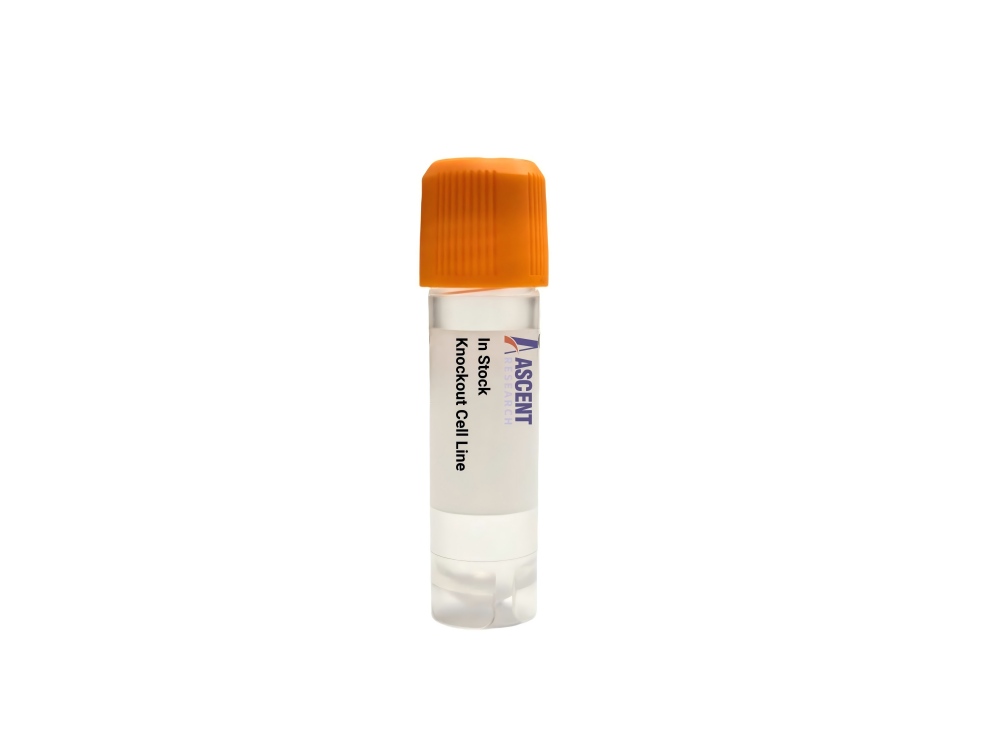
In Stock Cell Lines
Homo sapiens (Human)
Kidney
Adherent
The NALF2 Knockout HEK293T Cell Line is a CRISPR/Cas9-edited human cell line providing a loss-of-function model for the NALF2 gene, which encodes a putative N-acetyltransferase. Derived from the HEK293T host, this stable knockout line enables mechanistic studies of protein acetylation and downstream signaling events. NALF2 catalyzes acetyl-CoA-dependent acetylation of lysine residues on target proteins, with deacetylation reversed by HDAC and SIRT enzymes. Key applications include acetyltransferase activity assays, acetyl-proteomics, and inhibitor screening, supporting research into metabolic control of the acetylome.
 DTWD2 Knockout HEK293T Polyclonal Cells
Cat. No. ARG39936
CTNNB1 Knockout CaSki Polyclonal Cells
Cat. No. ARG9786
NDST3 Knockout HEK293T Polyclonal Cells
Cat. No. ARG3753
DTWD2 Knockout HEK293T Polyclonal Cells
Cat. No. ARG39936
CTNNB1 Knockout CaSki Polyclonal Cells
Cat. No. ARG9786
NDST3 Knockout HEK293T Polyclonal Cells
Cat. No. ARG3753
 Mouse Colonic Stromal Cell Medium
Cat. No. ARM0481
Mouse Colonic Stromal Cell Medium
Cat. No. ARM0481
 VSC4.1
Cat. No. ARI0219
VSC4.1
Cat. No. ARI0219
![EGFR [NM_005228.5] Knockout A-549 Cell Line](https://www.ovaryresearch.com/wp-content/uploads/2025/09/egfr-nm_005228-5-knockout-a-549-cell-line-150x150.jpg) EGFR [NM_005228.5] Knockout A-549 Cell Line
Cat. No. ARG0079
EGFR [NM_005228.5] Knockout A-549 Cell Line
Cat. No. ARG0079
The NALF2 Knockout HEK293T Cell Line is a CRISPR/Cas9-edited knockout cell line derived from human embryonic kidney HEK293T cells, providing a stable loss-of-function model for the NALF2 gene. NALF2 encodes a putative N-acetyltransferase, and its disruption enables investigation of protein acetylation dynamics. This cell line is supplied as a ready-to-use research tool, bypassing the variability of transient silencing methods. The CRISPR-mediated gene disruption ensures consistent, heritable knockout of the target locus, making it suitable for reproducible functional assays.
HEK293T is a widely utilized host cell line, originally derived from HEK293 cells by stable expression of the SV40 large T antigen. This modification permits episomal replication of plasmids containing the SV40 origin, significantly boosting transient protein expression and viral vector production. The cell line??s epithelial morphology, human origin, and high transfectability render it an ideal platform for studying human gene function. The NALF2 knockout variant retains all these advantageous properties, providing a robust cellular context for examining acetyltransferase biology.
The NALF2 protein is a putative N-acetyltransferase that catalyzes acetyl group transfer from acetyl-coenzyme A (acetyl-CoA) to lysine residues on substrate proteins. This post-translational modification influences protein stability, activity, localization, and interactions, forming a key node in lysine acetylation signaling. NALF2 activity is dependent on acetyl-CoA availability, which is governed by cellular metabolic state. Deacetylase enzymes, such as histone deacetylases (HDACs) and sirtuins (SIRTs), reverse this modification, creating a dynamic regulatory network. NALF2 thus links metabolic status to the acetyl-proteome.
In the HEK293T background, knockout of NALF2 allows unambiguous dissection of its role in acetylation-dependent signaling. The host cells possess active acetylation machinery and responsive metabolic pathways, making them physiologically relevant for mechanistic studies. By comparing the knockout line to wild-type controls, researchers can identify NALF2-specific substrates and downstream effects on processes such as signal transduction or metabolic regulation. The absence of NALF2 may reveal compensatory changes in deacetylase activity or alternative acetylation pathways.
This NALF2 knockout cell line supports a wide array of experimental applications, including functional characterization of acetyltransferase activity, acetyl-proteomics, and inhibitor screening. Representative assays include anti-acetyl-lysine western blotting to monitor global acetylation changes, RT-qPCR for verifying NALF2 knockout, in vitro acetyltransferase activity assays with recombinant NALF2, and co-immunoprecipitation to capture acetylated protein partners. LC-MS/MS acetyl-proteomics can comprehensively profile altered acetylation sites, while cell viability assays gauge functional outcomes. For technical details and customization, contact Ascent Research.