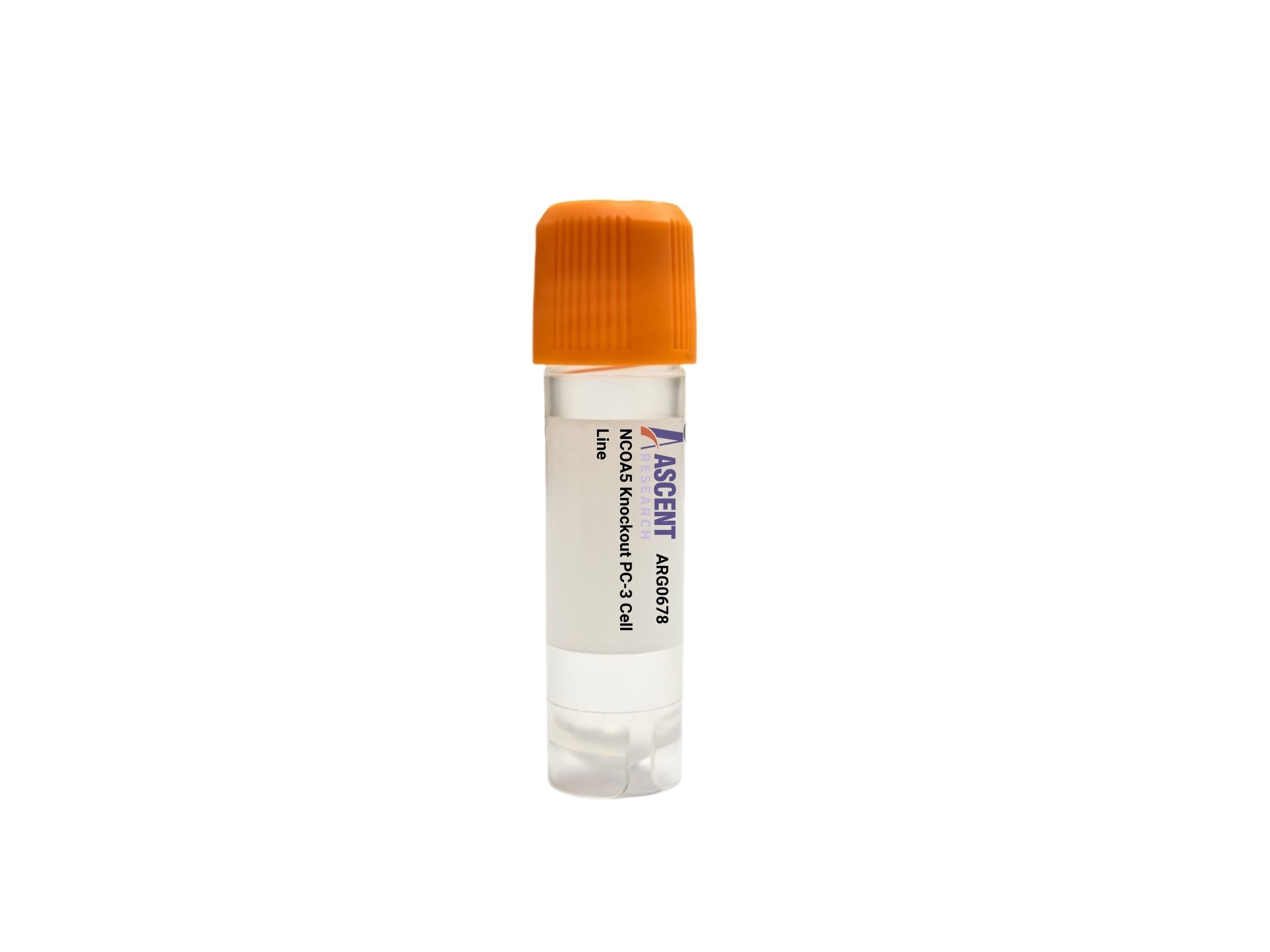
Genome-edited Cells
Prostate
The NCOA5 Knockout PC-3 Cell Line is a CRISPR/Cas9-edited knockout cell line with targeted disruption of the NCOA5 gene in human PC-3 prostate adenocarcinoma epithelial cells. NCOA5 functions as a nuclear receptor coactivator that enhances ER?? (ESR1) and PR (PGR) transcriptional activity and interacts with NF-??B (RELA) and STAT3 to regulate genes involved in proliferation, apoptosis, and inflammation. This model leverages the androgen-independent, p53-deficient PC-3 background to study NCOA5-dependent signaling in advanced prostate cancer. Applications include investigating nuclear receptor coactivation, NF-??B and JAK-STAT pathway crosstalk, gene expression regulation, drug screening, and metastatic cancer modeling.
 Map4k2 Knockout RAW 264.7 Polyclonal Cells
Cat. No. ARG12495
APEX1 Knockout Raji Polyclonal Cells
Cat. No. ARG21201
CCDC88C Knockout Hela Polyclonal Cells
Cat. No. ARG43099
CBR1 Knockout K562 Polyclonal Cells
Cat. No. ARG42693
DDAH1 Knockout NCI-H1299 Polyclonal Cells
Cat. No. ARG17815
Map4k2 Knockout RAW 264.7 Polyclonal Cells
Cat. No. ARG12495
APEX1 Knockout Raji Polyclonal Cells
Cat. No. ARG21201
CCDC88C Knockout Hela Polyclonal Cells
Cat. No. ARG43099
CBR1 Knockout K562 Polyclonal Cells
Cat. No. ARG42693
DDAH1 Knockout NCI-H1299 Polyclonal Cells
Cat. No. ARG17815
 Pig Cardiac Fibroblasts
Cat. No. ARP0909
Pig Cardiac Fibroblasts
Cat. No. ARP0909
The NCOA5 Knockout PC-3 Cell Line is a CRISPR/Cas9-edited knockout cell line engineered to disrupt the NCOA5 gene in the PC-3 human prostate adenocarcinoma epithelial cell line. This cell line provides a robust loss-of-function model for studying NCOA5, a nuclear receptor coactivator that enhances the transcriptional activity of estrogen receptor ?? (ER??) and progesterone receptor (PR), and also interacts with NF-??B and STAT3 to regulate genes involved in proliferation, apoptosis, and inflammation. By introducing targeted gene disruption through CRISPR/Cas9 technology, this knockout cell line enables precise interrogation of NCOA5-dependent signaling networks in an androgen-independent prostate cancer background.
The PC-3 cell line, derived from a bone metastasis of a grade IV prostatic adenocarcinoma, is a model of androgen-independent prostate cancer. These cells are androgen receptor-negative and p53-deficient, recapitulating key features of metastatic castration-resistant prostate cancer (mCRPC). PC-3 cells rely on NF-??B and STAT3 signaling for sustained proliferation and survival, making them a relevant host for studying NCOA5 function in the absence of androgen receptor signaling.
NCOA5 functions as a transcriptional coactivator for nuclear receptors, notably ER?? (ESR1) and PR (PGR), and also modulates NF-??B and JAK-STAT signaling pathways. It directly interacts with the NF-??B p65 subunit (RELA) and STAT3, thereby regulating the expression of target genes such as cyclin D1 (CCND1), BCL2, survivin (BIRC5), PCNA, and MMP9. Upstream regulators including interleukin-6 (IL-6), TNF-??, estrogen, and EGF control NCOA5 expression or activity. Within these pathways, NCOA5 cooperates with coactivators SRC-1 and P300 and is found in complexes containing IL6R, JAK2, and the IKK complex. Through these interactions, NCOA5 coordinates gene programs governing cell cycle progression, apoptosis, and inflammatory responses. Knockout of NCOA5 is anticipated to perturb these transcriptional networks, potentially impairing the expression of pro-proliferative and anti-apoptotic factors.
In PC-3 cells lacking androgen receptor and p53, NCOA5-mediated regulation of NF-??B and STAT3 signaling is particularly relevant. PC-3 cells exhibit basal NF-??B and STAT3 activation, driving androgen-independent growth and metastasis. Disruption of NCOA5 here offers a valuable tool to dissect its contributions to these oncogenic programs, enabling assessment of effects on proliferation, survival, and migration, and identification of NCOA5-dependent target genes in a clinically relevant prostate cancer model.
This knockout cell line supports research applications such as functional analyses of nuclear receptor coactivation in prostate cancer, investigation of NCOA5 crosstalk with NF-??B and STAT3 pathways, and gene expression profiling. It is suitable for cell proliferation assays (MTT/XTT), apoptosis detection by Annexin V staining, NF-??B luciferase reporter assays, ChIP-qPCR, and migration/invasion assays using Boyden chambers. This model can also be used for drug screening of coactivator-targeted therapies and metastatic prostate cancer studies. For further information, please contact Ascent Research.