Genome-edited Cells
Uterus (cervix)
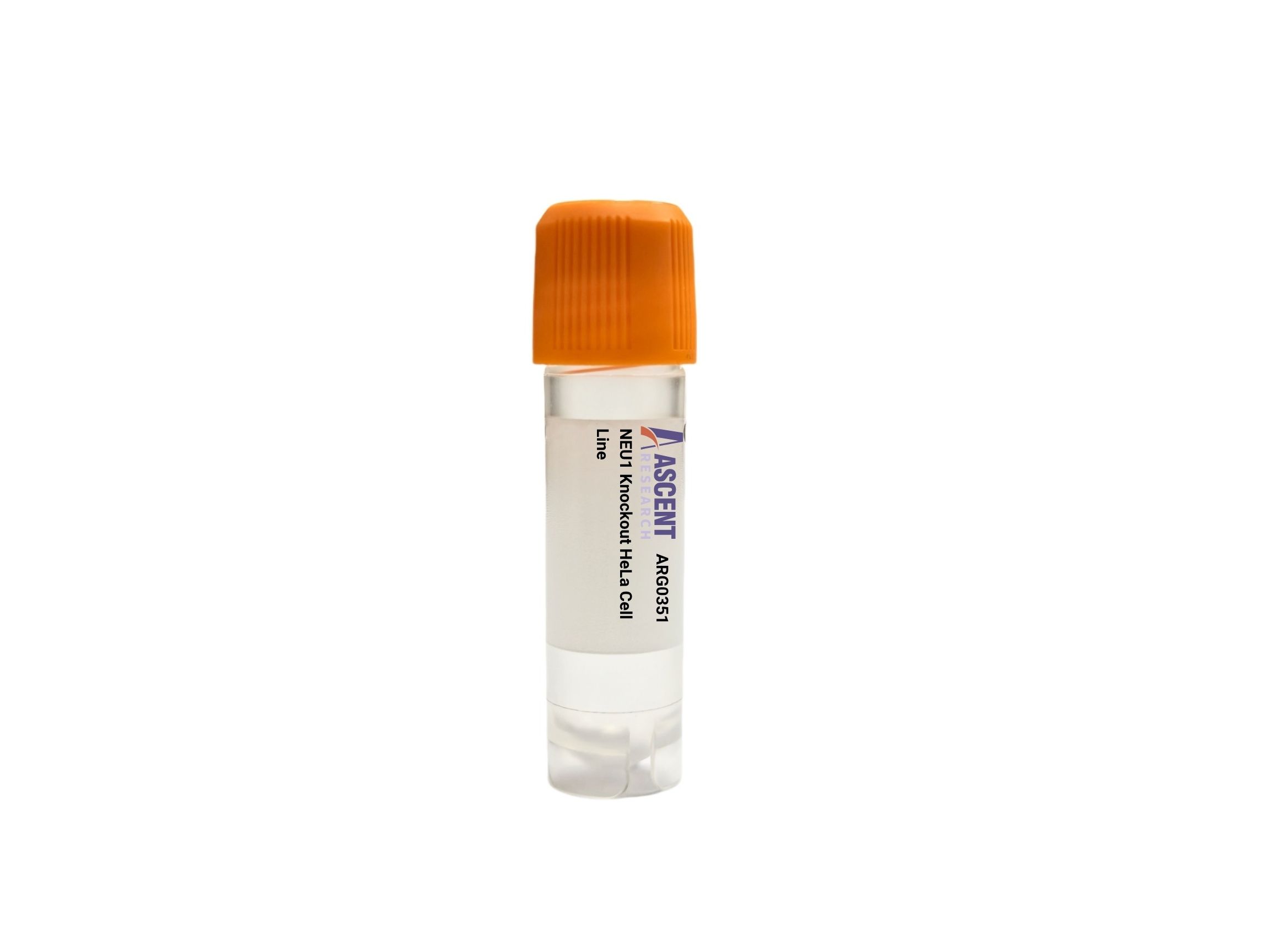
The NEU1 Knockout HeLa Cell Line is a CRISPR/Cas9-edited model derived from an HPV18-positive cervical adenocarcinoma line, deficient in lysosomal sialidase. NEU1 removes terminal sialic acids from receptors such as EGFR and integrin ??1, regulating MAPK/ERK and PI3K/AKT pathways. Loss of sialidase results in hypersialylation and altered cell signaling. This product supports research into cancer glycobiology, sialidosis drug screening, and lysosomal storage disease mechanisms. Typical assays include sialidase activity measurements, lectin blotting, flow cytometry, and migration studies.
 NR3C1 Knockout HEK293 Polyclonal Cells
Cat. No. ARG12736
EXOC2 Knockout Hela Polyclonal Cells
Cat. No. ARG8939
HABP4 Knockout 786-O Polyclonal Cells
Cat. No. ARG25228
ANKRD28 Knockout A2780 Polyclonal Cells
Cat. No. ARG28697
CLPP Knockout Raji Polyclonal Cells
Cat. No. ARG1580
NR3C1 Knockout HEK293 Polyclonal Cells
Cat. No. ARG12736
EXOC2 Knockout Hela Polyclonal Cells
Cat. No. ARG8939
HABP4 Knockout 786-O Polyclonal Cells
Cat. No. ARG25228
ANKRD28 Knockout A2780 Polyclonal Cells
Cat. No. ARG28697
CLPP Knockout Raji Polyclonal Cells
Cat. No. ARG1580
 Rabbit Skeletal Muscle Cells
Cat. No. ARP0803
Rabbit Skeletal Muscle Cells
Cat. No. ARP0803
The NEU1 Knockout HeLa Cell Line is a CRISPR/Cas9-edited human cell model with a targeted disruption of the NEU1 gene, resulting in loss of lysosomal sialidase function. This tool enables investigation of desialylation-dependent cellular processes in a well-characterized cervical adenocarcinoma background. The knockout cell line is provided as a ready-to-use live product for functional genomics and biochemical assays.
The host HeLa cell line originates from an HPV18-positive cervical adenocarcinoma and serves as a fundamental model in cancer biology. Its immortalized nature, rapid proliferation, and extensively annotated genome facilitate gene-editing studies. The presence of HPV oncoproteins E6 and E7, which inactivate p53 and Rb, creates a permissive environment for examining how glycosylation perturbations affect oncogenic signaling.
NEU1 encodes a lysosomal sialidase that removes terminal sialic acids from glycoconjugates, thereby regulating receptor activity and lysosomal degradation. It is regulated by Cathepsin A and TFEB and interacts with cathepsin A, ??-galactosidase, and elastin-binding protein within a multienzyme complex. Downstream substrates include EGFR, PDGFR, integrin ??1, and TLR4, whose desialylation influences MAPK/ERK, PI3K/AKT, and NF-??B pathways. In the lysosome, NEU1 acts on sialylated glycoproteins, with LAMP1 as a representative component of the pathway.
In HeLa cells, NEU1 knockout leads to hypersialylation of surface receptors such as EGFR and integrin ??1, altering their stability and signaling output. This promotes sustained proliferative and migratory signals, making the model valuable for dissecting sialidase-dependent regulation of cancer cell behavior. The interaction between HPV-driven oncogenesis and altered sialylation provides a platform to study glycan-mediated modulation of tumor progression pathways.
Applications include sialidase activity assays, lectin blotting, flow cytometry for surface sialylation, cell migration assays, and drug screening for sialidosis. The model supports RNA-seq and Western blot analysis of downstream effectors like ERK and AKT, enabling detailed mechanistic studies. For further information, contact Ascent Research.