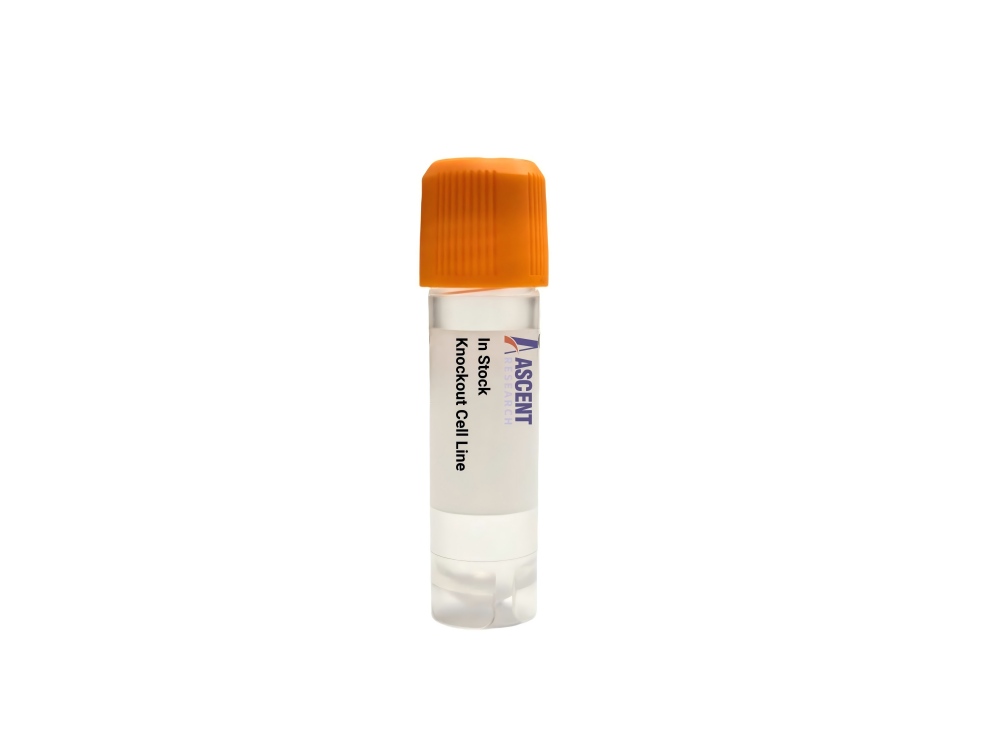
In Stock Cell Lines
The Ninj1 Knockout iBMDM Cell Line is a CRISPR/Cas9-edited mouse macrophage cell line with targeted disruption of the Ninj1 gene. Derived from immortalized bone marrow-derived macrophages, this model enables investigation of Ninj1-dependent cell adhesion, migration, and inflammatory signaling pathways. Ninj1 mediates homophilic adhesion and activates NF-??B and MAPK cascades, promoting expression of MMP9, MMP2, IL-6, and TNF-??. This knockout cell line is ideal for studies on inflammation, multiple sclerosis, and cancer metastasis, and is compatible with adhesion, migration, phagocytosis, and cytokine assays.
 NQO2 Knockout A549 Polyclonal Cells
Cat. No. ARG10690
FBXL2 Knockout Hela Polyclonal Cells
Cat. No. ARG8247
ACOT2 Knockout Raji Polyclonal Cells
Cat. No. ARG21036
CCDC90B Knockout jurkat Polyclonal Cells
Cat. No. ARG43113
DGCR2 Knockout MES-OV Polyclonal Cells
Cat. No. ARG6814
NPBWR1 Knockout HEK293T Polyclonal Cells
Cat. No. ARG3453
NQO2 Knockout A549 Polyclonal Cells
Cat. No. ARG10690
FBXL2 Knockout Hela Polyclonal Cells
Cat. No. ARG8247
ACOT2 Knockout Raji Polyclonal Cells
Cat. No. ARG21036
CCDC90B Knockout jurkat Polyclonal Cells
Cat. No. ARG43113
DGCR2 Knockout MES-OV Polyclonal Cells
Cat. No. ARG6814
NPBWR1 Knockout HEK293T Polyclonal Cells
Cat. No. ARG3453
The Ninj1 Knockout iBMDM Cell Line is a CRISPR/Cas9-edited mouse macrophage cell line with targeted disruption of the Ninj1 gene. This loss-of-function model is generated in the iBMDM (immortalized bone marrow-derived macrophage) background, providing a consistent system to study Ninj1 roles in adhesion, migration, and inflammatory signaling. The knockout eliminates Ninj1 protein expression, enabling precise dissection of its functions in innate immune responses.
iBMDM cells are a well-established murine macrophage line that retain primary macrophage properties, including phagocytosis and cytokine production. They are commonly used for investigating Toll-like receptor (TLR) signaling, NF-??B pathway activation, and innate immune effector mechanisms. Their immortalized phenotype supports stable genetic manipulation, making them suitable for knockout cell line generation.
Ninj1 encodes a homophilic cell adhesion molecule that promotes macrophage adhesion and migration. It interacts with ??1 integrin and signals through NF-??B and MAPK pathways. Upstream, Ninj1 is activated by IFN-??, IFN-??, LPS, and TNF-??, and downstream it induces MMP2, MMP9, IL-6, and TNF-?? expression via transcription factors NFKB1/RELA and kinases MAPK1/3. It also intersects with TLR4/MYD88 signaling, amplifying inflammatory responses.
Ninj1 knockout in iBMDM cells impairs adhesion-dependent functions and reduces activation of NF-??B and MAPK cascades upon stimulation. This model is relevant for multiple sclerosis and other inflammatory diseases, as well as cancer metastasis, where macrophage migration and cytokine production drive pathology. The knockout line thus provides a defined tool to study these processes.
Researchers can employ this line in cell adhesion assays, transwell migration assays, phagocytosis assays, and cytokine profiling by ELISA or flow cytometry. Gene expression analysis by RT-qPCR and western blotting can confirm pathway modulation. It supports inflammation research, macrophage biology studies, and therapeutic screening. For more information, please contact Ascent Research.