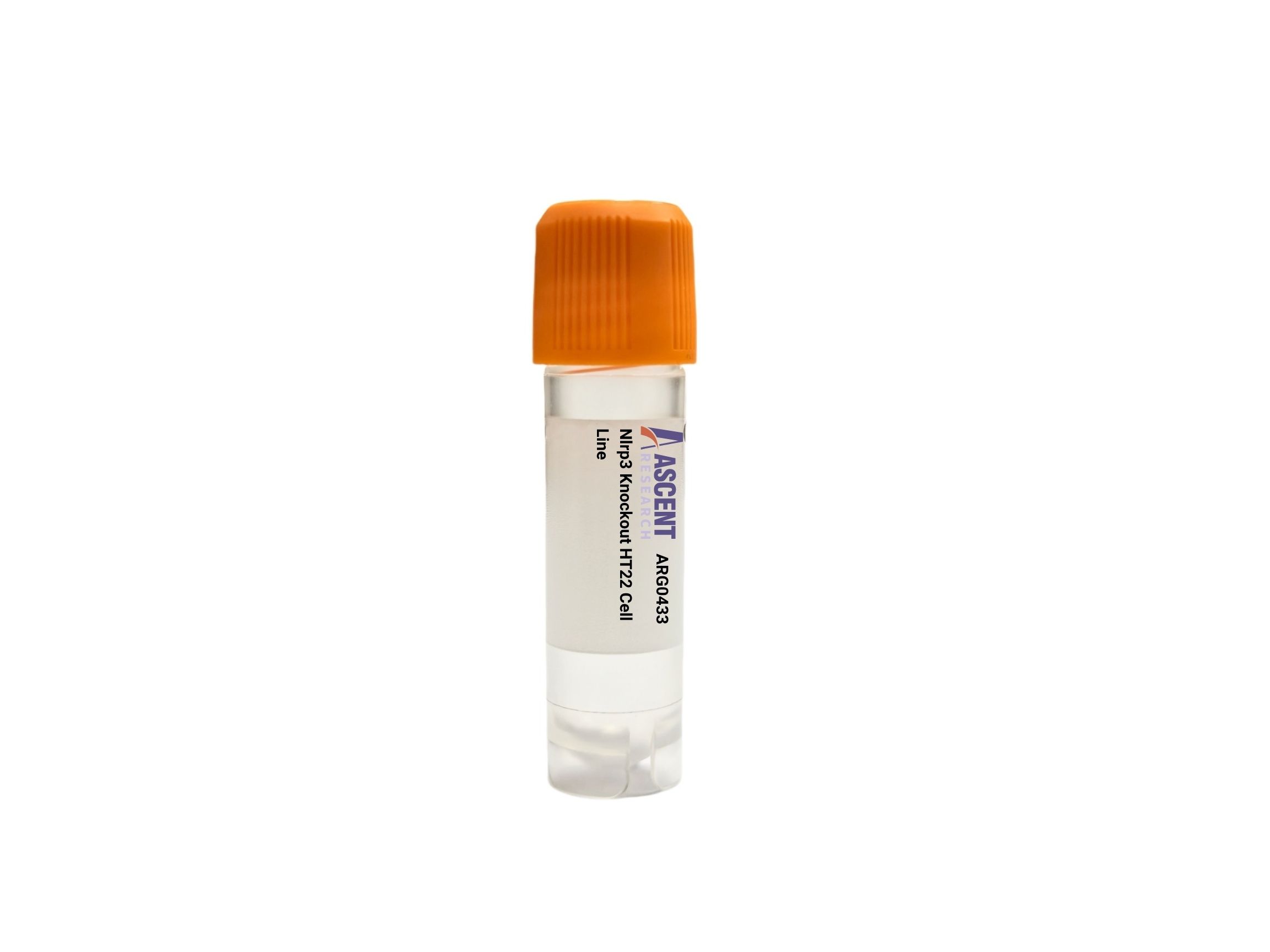
Genome-edited Cells
CRISPR/Cas9-edited Nlrp3 knockout HT22 cell line engineered for loss of NLRP3 function in a mouse hippocampal neuronal background. This model enables precise interrogation of NLRP3 inflammasome signaling, including ASC/caspase-1-dependent IL-1?? secretion and pyroptosis, without wild-type protein interference. Ideal for neuroinflammation research, neurodegenerative disease modeling, and NLRP3 inhibitor screening. Key assays include Western blot and ELISA for caspase-1 and IL-1??, LDH release, and ASC speck imaging.
 MRPL34 Knockout Huh-7 Cell Line
Cat. No. ARG43987
MRPL34 Knockout Huh-7 Cell Line
Cat. No. ARG43987
 DAXX Knockout TE1 Polyclonal Cells
Cat. No. ARG12141
MBD6 Knockout Lovo Polyclonal Cells
Cat. No. ARG11685
ASPHD1 Knockout Hela Polyclonal Cells
Cat. No. ARG20930
KCTD1 Knockout K562 Polyclonal Cells
Cat. No. ARG20746
DOCK11 Knockout A2780 Polyclonal Cells
Cat. No. ARG39539
DAXX Knockout TE1 Polyclonal Cells
Cat. No. ARG12141
MBD6 Knockout Lovo Polyclonal Cells
Cat. No. ARG11685
ASPHD1 Knockout Hela Polyclonal Cells
Cat. No. ARG20930
KCTD1 Knockout K562 Polyclonal Cells
Cat. No. ARG20746
DOCK11 Knockout A2780 Polyclonal Cells
Cat. No. ARG39539
The Nlrp3 Knockout HT22 Cell Line is a CRISPR/Cas9-edited knockout cell line derived from the HT22 mouse hippocampal neuronal cell line, engineered for targeted disruption of the Nlrp3 gene. This loss-of-function model provides a stable, renewable resource for investigating NLRP3-dependent signaling without the confounding effects of wild-type protein expression. The knockout is generated through CRISPR/Cas9-mediated gene disruption, eliminating functional NLRP3 sensor protein and enabling rigorous dissection of inflammasome pathways in a neuronal context.
The HT22 cell line is an immortalized mouse hippocampal neuronal line, originally subcloned from the HT4 line, and widely used as a model for studying synaptic plasticity, oxidative stress, and neurotoxicity. These cells retain key neuronal characteristics and are highly tractable for genetic manipulation, making them a relevant platform for examining the intersection between innate immune signaling and neuronal function. Their hippocampal origin positions them particularly well for studies of cognitive and neurodegenerative processes.
NLRP3 functions as a critical innate immune sensor that assembles the NLRP3 inflammasome complex in response to diverse danger signals, including ATP, uric acid crystals, reactive oxygen species, and potassium efflux. Upon activation, NLRP3 recruits the adaptor protein ASC (PYCARD) and pro-caspase-1, forming a multiprotein complex that catalyzes the cleavage and activation of caspase-1. Active caspase-1 subsequently processes pro-IL-1?? and pro-IL-18 into their mature secreted forms and cleaves gasdermin D (GSDMD) to trigger pyroptosis. NLRP3 activity is regulated upstream by signals through TLR4, TNFR, and IL-1R, often involving NF-??B-mediated transcriptional priming, and downstream it promotes expression of IL-6 and IL-8. The inflammasome assembly is also modulated by NEK7, a direct interacting partner of NLRP3.
In the hippocampal neuronal context, NLRP3 inflammasome signaling is increasingly recognized as a driver of neuroinflammation and synaptic dysfunction. HT22 cells expressing wild-type NLRP3 respond to classical inflammasome stimuli, making this knockout line a powerful tool for dissecting neuron-intrinsic roles of NLRP3 in the absence of glial contributions. By ablating Nlrp3, researchers can specifically attribute phenotypic changes to NLRP3 activity, study compensatory mechanisms, and evaluate downstream consequences on cytokine production and cell death pathways in a disease-relevant cell type.
This Nlrp3 Knockout HT22 Cell Line supports a broad range of research applications, including neuroinflammation studies, mechanistic investigations of inflammasome signaling, neurodegenerative disease modeling for conditions such as Alzheimer’s and Parkinson’s, and drug screening for NLRP3 inhibitors. Researchers can employ quantitative assays such as Western blotting for NLRP3, caspase-1, and IL-1??, ELISA for IL-1?? and IL-18, LDH release assays to measure pyroptosis, immunofluorescence detection of ASC specks, and RT-qPCR analysis of inflammasome-related transcripts. For further information or to request a quote, please contact Ascent Research.