Genome-edited Cells
Kidney
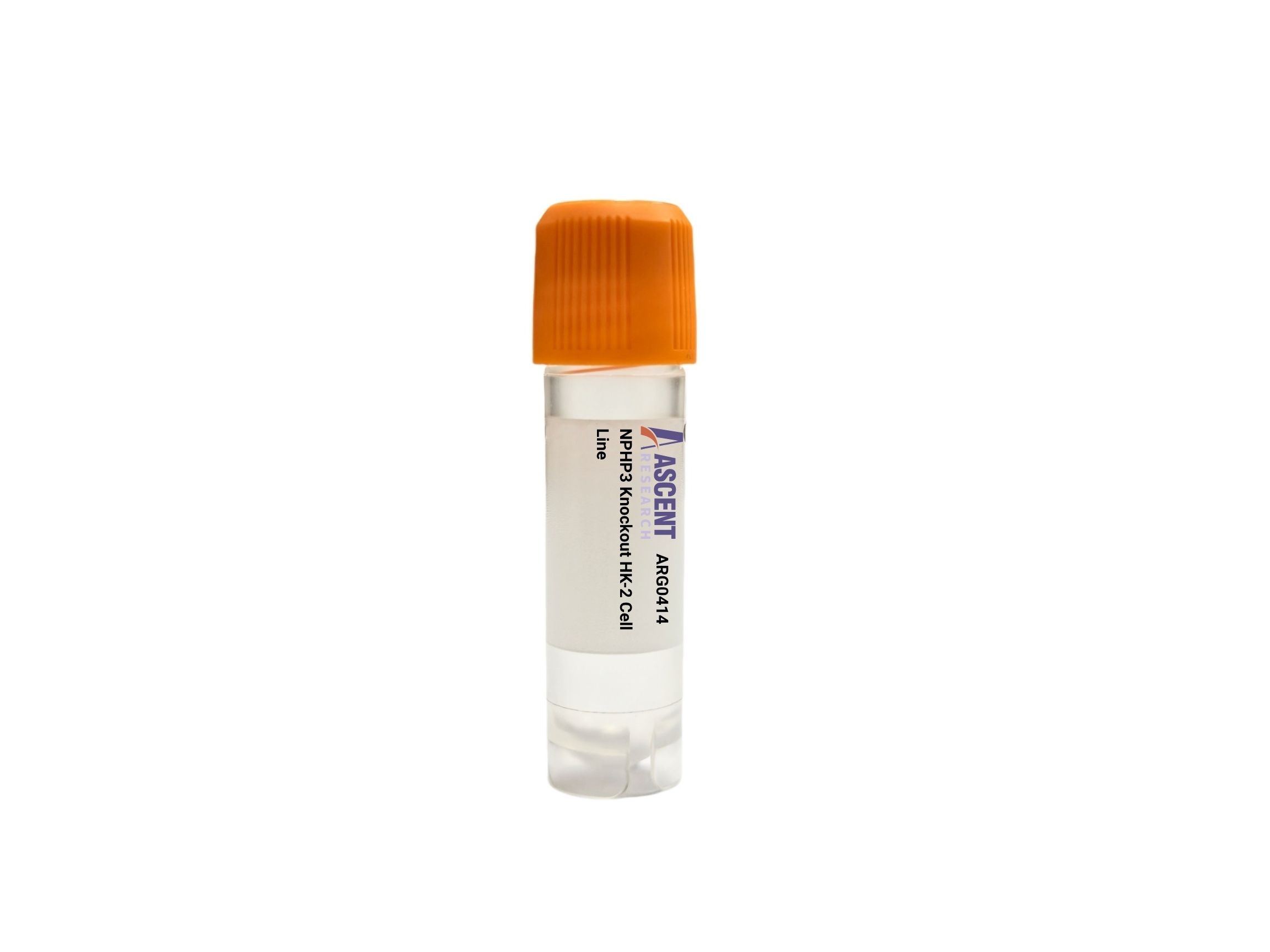
The NPHP3 Knockout HK-2 Cell Line is a CRISPR/Cas9-edited human proximal tubule epithelial cell model featuring targeted disruption of the NPHP3 gene. NPHP3 encodes nephrocystin-3, a ciliary transition zone protein that coordinates Wnt/planar cell polarity and Hippo signaling through interactions with NPHP1, NPHP4, and other ciliopathy-associated proteins. Loss of NPHP3 dysregulates ??-catenin and YAP/TAZ, providing a relevant system for studying nephronophthisis and renal cystic disease mechanisms. This cell line supports investigations into primary cilium biology, ciliary signaling, and drug screening for ciliopathies. Common assays include immunofluorescence for ciliary markers (acetylated tubulin, ARL13B), western blotting for downstream effectors, and RT-qPCR for Wnt target genes.
 BBX Knockout A549 Polyclonal Cells
Cat. No. ARG31921
ARHGEF40 Knockout HT29 Polyclonal Cells
Cat. No. ARG33031
HMGN3 Knockout SK-HEP-1 Polyclonal Cells
Cat. No. ARG32585
DGKE Knockout NCI-H1299 Polyclonal Cells
Cat. No. ARG17814
CPT1A Knockout HCT116 Polyclonal Cells
Cat. No. ARG7193
BBX Knockout A549 Polyclonal Cells
Cat. No. ARG31921
ARHGEF40 Knockout HT29 Polyclonal Cells
Cat. No. ARG33031
HMGN3 Knockout SK-HEP-1 Polyclonal Cells
Cat. No. ARG32585
DGKE Knockout NCI-H1299 Polyclonal Cells
Cat. No. ARG17814
CPT1A Knockout HCT116 Polyclonal Cells
Cat. No. ARG7193
 Ishikawa Luciferase Stable Cell Line
Cat. No. ARG0470
Ishikawa Luciferase Stable Cell Line
Cat. No. ARG0470
The NPHP3 Knockout HK-2 Cell Line is a CRISPR/Cas9-edited human proximal tubule epithelial cell line with targeted disruption of the NPHP3 gene. This loss-of-function model provides a controlled system for investigating NPHP3-dependent signaling and ciliary biology in a kidney-derived cellular context.
HK-2 cells are immortalized proximal tubule epithelial cells derived from normal adult human kidney, retaining key characteristics of renal proximal tubule epithelium, including polarized morphology and transport functions. They serve as a well-established in vitro model for studying renal reabsorption and secretion, and are particularly suited for examining ciliary signaling pathways relevant to tubule homeostasis.
Nephrocystin-3, encoded by NPHP3, localizes to the ciliary transition zone and is essential for proper ciliogenesis and cilia-dependent signal transduction. It functions within a multiprotein complex that includes NPHP1, NPHP4, RPGRIP1L, INVS, CC2D2A, B9D1, and B9D2. NPHP3 modulates Wnt/planar cell polarity and Hippo pathway activity, with upstream regulation by HNF1B and ciliary flow-induced calcium signaling. Disruption of NPHP3 leads to altered ??-catenin stability, dysregulated YAP/TAZ localization, and impaired GLI transcription factor activity downstream of Hedgehog signaling.
In the proximal tubule epithelial context, NPHP3 knockout mimics the ciliary defects observed in nephronophthisis and related ciliopathies, such as Meckel syndrome and Joubert syndrome. Loss of NPHP3 in HK-2 cells disrupts the transition zone integrity, impairing the regulation of downstream effectors like ??-catenin and YAP/TAZ, and ultimately compromising epithelial cell polarity and tubular maintenance. This model recapitulates key aspects of renal cystic disease pathogenesis, making it a valuable tool for exploring the molecular mechanisms underlying ciliopathy-associated kidney degeneration.
Researchers can employ this NPHP3 knockout cell line for a broad range of functional studies, including immunofluorescence analysis of ciliary markers such as acetylated ??-tubulin and ARL13B to assess cilia morphology, western blotting and co-immunoprecipitation to probe NPHP3 interactions with its complex partners, and RT-qPCR or RNA-seq to profile Wnt and Hippo target gene expression. Calcium signaling assays and cilia length measurements further enable dissection of ciliary flow-mediated pathways. The model is well-suited for drug screening campaigns aimed at identifying compounds that rescue nephronophthisis-associated cellular defects. For additional information or technical support, please contact Ascent Research.