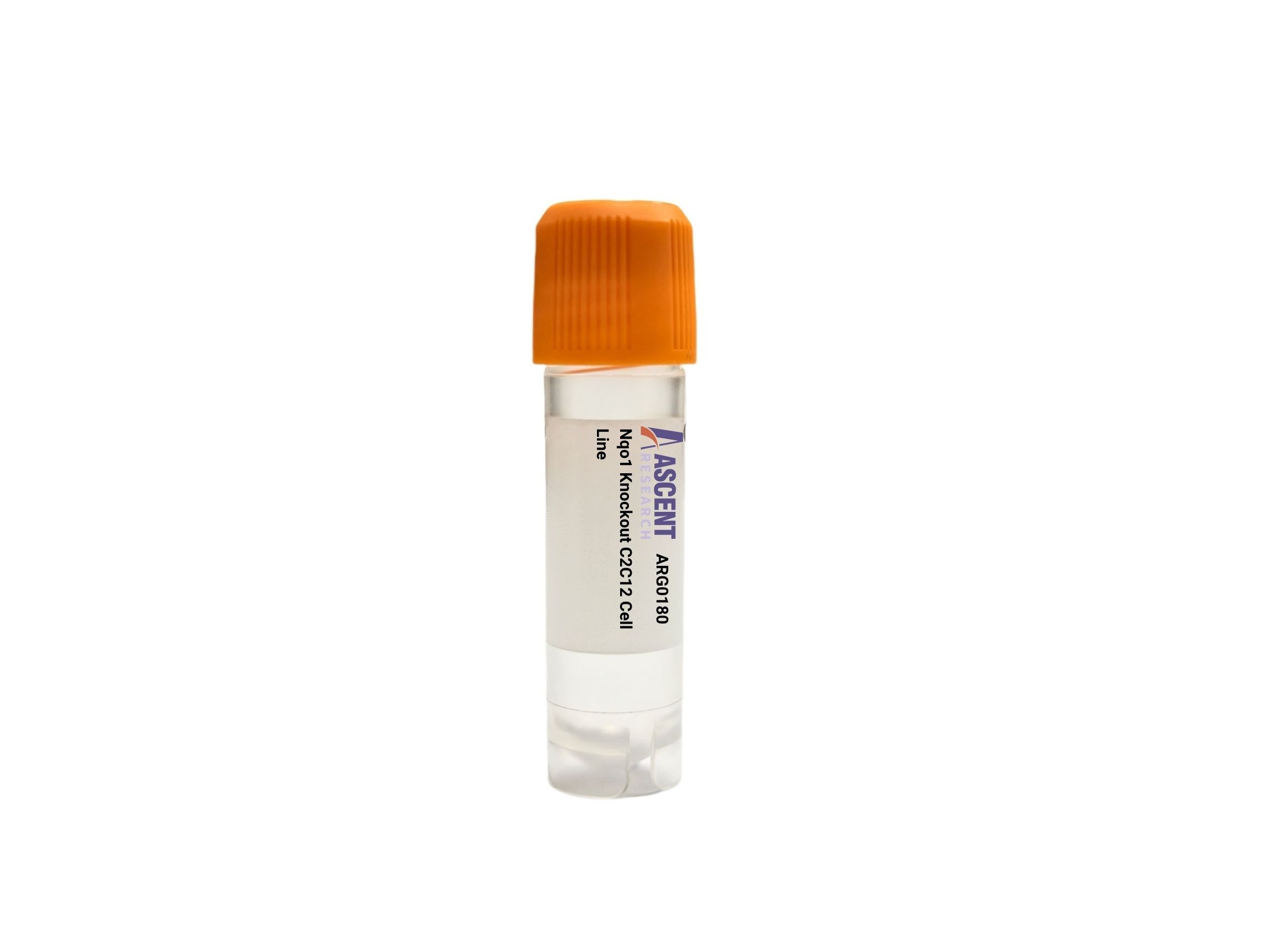
Genome-edited Cells
Nqo1 Knockout C2C12 is a CRISPR/Cas9-engineered mouse myoblast cell line with disruption of the Nqo1 gene, generating a stable model for studying quinone detoxification and oxidative stress regulation in skeletal muscle precursor cells. In C2C12 myoblasts and differentiating myotubes, NQO1 functions downstream of NFE2L2/NRF2 and KEAP1 to catalyze FAD-dependent two-electron quinone reduction using NADH or NADPH. This model is useful for analyzing ROS control, glutathione redox balance, lipid peroxidation, quinone sensitivity, myogenic differentiation, NRF2 pathway biology, ferroptosis-related stress responses, and toxicology using assays such as RT-qPCR, western blotting, quinone reductase activity, and viability profiling.
 MFAP3 Knockout HT29 Polyclonal Cells
Cat. No. ARG15039
IMPACT Knockout SK-HEP-1 Polyclonal Cells
Cat. No. ARG32669
CASP7 Knockout Raji Polyclonal Cells
Cat. No. ARG42517
ARFGAP1 Knockout AGS Polyclonal Cells
Cat. No. ARG26616
GAMT Knockout 786-O Polyclonal Cells
Cat. No. ARG5295
PEPD Knockout HEK293T Polyclonal Cells
Cat. No. ARG4289
MFAP3 Knockout HT29 Polyclonal Cells
Cat. No. ARG15039
IMPACT Knockout SK-HEP-1 Polyclonal Cells
Cat. No. ARG32669
CASP7 Knockout Raji Polyclonal Cells
Cat. No. ARG42517
ARFGAP1 Knockout AGS Polyclonal Cells
Cat. No. ARG26616
GAMT Knockout 786-O Polyclonal Cells
Cat. No. ARG5295
PEPD Knockout HEK293T Polyclonal Cells
Cat. No. ARG4289
The Nqo1 Knockout C2C12 Cell Line is a CRISPR/Cas9-engineered mouse myoblast model in which the Nqo1 gene has been disrupted to eliminate functional NQO1 expression. This stable in vitro cell line provides a targeted system for investigating the consequences of Nqo1 loss in proliferating and differentiating skeletal muscle precursor cells. Because C2C12 cells retain the capacity to exit the cell cycle and form multinucleated myotubes under differentiation conditions, this model is suited for studies examining redox regulation across multiple states of myogenic maturation.
C2C12 is a murine myoblast cell line derived from regenerating skeletal muscle and is extensively used to study myogenesis, muscle metabolism, oxidative stress signaling, and injury-associated responses. Its well-characterized transition from proliferative myoblasts to differentiated myotubes makes it a relevant platform for analyzing how gene perturbation influences muscle-lineage biology. In addition to differentiation programs, C2C12 cells are widely applied in studies of mitochondrial function, metabolic adaptation, and toxicant-induced stress, providing a biologically relevant host background for evaluating antioxidant defense mechanisms in skeletal muscle precursor cells.
NQO1 is a cytosolic FAD-dependent flavoprotein oxidoreductase that catalyzes the two-electron reduction of quinones using NADH or NADPH as electron donors, thereby limiting semiquinone formation and suppressing redox cycling-derived reactive oxygen species. Nqo1 is transcriptionally regulated downstream of NFE2L2/NRF2 and its repressor axis involving KEAP1 and CUL3, and is also connected to AHR-dependent xenobiotic response programs with participation of small Maf proteins including MAFF and MAFG. Through its enzymatic function, NQO1 acts upstream of cellular quinone reduction capacity, ROS accumulation, NAD(P)H utilization, glutathione redox balance, and lipid peroxidation. Its pathway context overlaps with representative oxidative stress response components including HMOX1, GCLC, GCLM, TXNRD1, SOD1, CAT, and GPX4, linking Nqo1 status to ferroptosis-related redox control, electrophile handling, and toxic responses to quinones such as menadione and benzoquinone.
Loss of Nqo1 in C2C12 cells is therefore a useful model for examining how impaired quinone detoxification influences muscle-cell stress adaptation, differentiation-associated redox remodeling, and susceptibility to oxidative or xenobiotic injury. In skeletal muscle precursor cells, where redox state can influence both proliferation and myotube formation, disruption of this enzyme enables controlled interrogation of pathway dependency within the KEAP1-NRF2-NQO1 axis and related antioxidant gene expression programs.
This knockout cell line can be applied in mechanistic studies using western blotting, RT-qPCR, and RNA-seq to profile NRF2-responsive transcriptional networks; quinone reductase activity assays to confirm functional loss of enzymatic detoxification; and ROS, glutathione, and lipid peroxidation assays to quantify redox imbalance. It is also suitable for cytotoxicity and drug sensitivity experiments with quinones, electrophiles, and ferroptosis-relevant stressors, as well as apoptosis assays, flow cytometry, and metabolic assays to assess downstream viability and stress phenotypes. In the context of muscle biology, researchers may combine immunofluorescence for myogenic markers with myotube differentiation assays to determine whether Nqo1 deficiency alters myogenic progression under basal or oxidant-challenged conditions. Researchers may contact Ascent Research for additional technical information, product details, or related gene-edited cell models.