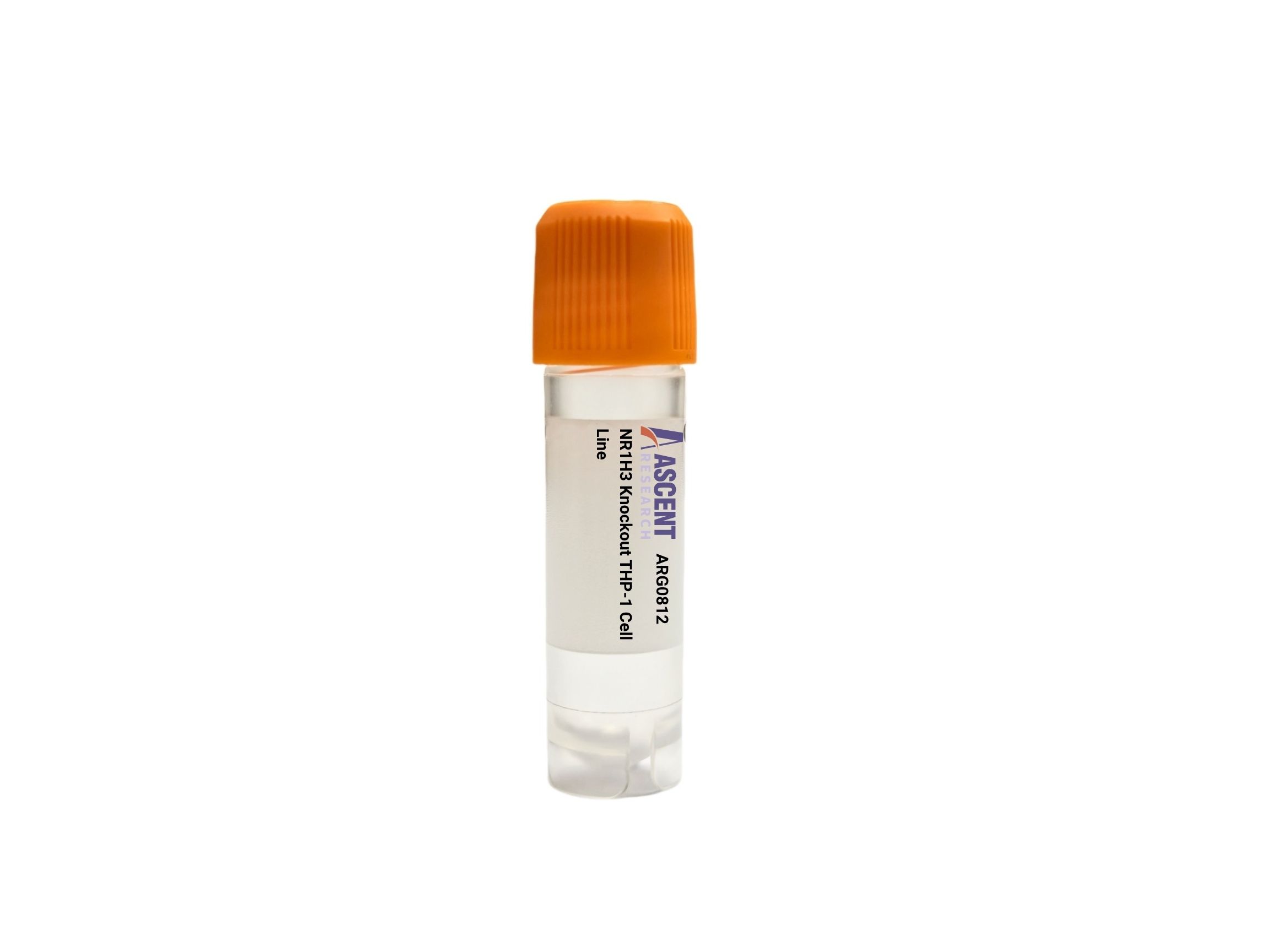
Genome-edited Cells
Blood (peripheral blood)
The NR1H3 Knockout THP-1 Cell Line is a CRISPR/Cas9-edited human monocytic cell line with targeted disruption of the liver X receptor alpha (LXR??) nuclear receptor. THP-1 cells, derived from acute monocytic leukemia, differentiate into macrophage-like cells upon PMA stimulation, providing a model for immunometabolism studies. Loss of NR1H3 impairs oxysterol-mediated transcriptional activation of cholesterol efflux genes ABCA1 and ABCG1 and disrupts transrepression of pro-inflammatory cytokines such as TNF-?? and IL-6. This knockout model enables atherosclerosis research, LXR agonist profiling, and investigation of macrophage cholesterol metabolism disorders.
 G6PC3 Knockout K562 Polyclonal Cells
Cat. No. ARG19374
DENND4C Knockout HT29 Polyclonal Cells
Cat. No. ARG14469
NRK Knockout Hela Polyclonal Cells
Cat. No. ARG8769
HS3ST1 Knockout TE1 Polyclonal Cells
Cat. No. ARG36861
CLINT1 Knockout MES-OV Polyclonal Cells
Cat. No. ARG6561
LRP10 Knockout AGS Polyclonal Cells
Cat. No. ARG2141
G6PC3 Knockout K562 Polyclonal Cells
Cat. No. ARG19374
DENND4C Knockout HT29 Polyclonal Cells
Cat. No. ARG14469
NRK Knockout Hela Polyclonal Cells
Cat. No. ARG8769
HS3ST1 Knockout TE1 Polyclonal Cells
Cat. No. ARG36861
CLINT1 Knockout MES-OV Polyclonal Cells
Cat. No. ARG6561
LRP10 Knockout AGS Polyclonal Cells
Cat. No. ARG2141
The NR1H3 Knockout THP-1 Cell Line is a CRISPR/Cas9-edited human monocytic knockout cell line engineered to disrupt the NR1H3 gene, which encodes the liver X receptor alpha (LXR??). This cell line provides a loss-of-function model for studying LXR??-mediated transcriptional regulation in a myeloid background. By targeting the NR1H3 locus, the product enables investigation of LXR??-dependent gene programs and their roles in cholesterol metabolism and inflammation. The knockout cell line is supplied as a ready-to-use cell culture product for advanced biomedical research applications.
The THP-1 cell line, derived from the peripheral blood of a one-year-old male with acute monocytic leukemia, serves as a widely used human monocytic leukemia model. These myeloid progenitor cells can be differentiated into macrophage-like cells upon stimulation with phorbol esters such as PMA, recapitulating key features of monocyte-derived macrophages. This differentiation capacity makes THP-1 cells particularly valuable for investigating macrophage biology, including inflammatory responses and lipid metabolism.
NR1H3 (LXR??) functions as a nuclear receptor transcription factor by heterodimerizing with retinoid X receptor (RXR) and binding to LXREs in target gene promoters upon activation by oxysterol ligands such as 22R-hydroxycholesterol, 24S-hydroxycholesterol, and 27-hydroxycholesterol. This activation induces expression of cholesterol efflux mediators ABCA1 and ABCG1 and fatty acid synthesis regulator SREBP-1c. Additionally, LXR?? transrepresses pro-inflammatory genes, including TNF-??, IL-6, and iNOS, through mechanisms involving corepressors NCoR and SMRT. Its activity is further modulated by insulin and synthetic agonists like T0901317 and GW3965, and it interacts with coactivators SRC-1 and PGC-1?? as well as PPAR??.
In the THP-1 macrophage context, NR1H3 is a central regulator of cholesterol homeostasis and inflammatory balance. Disruption of NR1H3 impairs LXR-mediated cholesterol efflux and anti-inflammatory programs, enabling detailed dissection of these pathways. This knockout model is particularly relevant for studying foam cell formation in atherosclerosis, where imbalance in cholesterol uptake and efflux leads to lipid-laden macrophages. The cell line provides a human myeloid platform to examine NR1H3-dependent mechanisms in metabolic syndrome, type 2 diabetes, and Alzheimer’s disease.
Typical research applications include investigating macrophage cholesterol metabolism through cholesterol efflux assays, evaluating LXR agonist efficacy in modulating target gene expression via RT-qPCR and Western blotting, and analyzing lipid accumulation by Oil Red O staining. The NR1H3 Knockout THP-1 Cell Line also supports LXRE reporter assays and cytokine profiling to probe anti-inflammatory mechanisms. For further technical specifications, please contact Ascent Research.