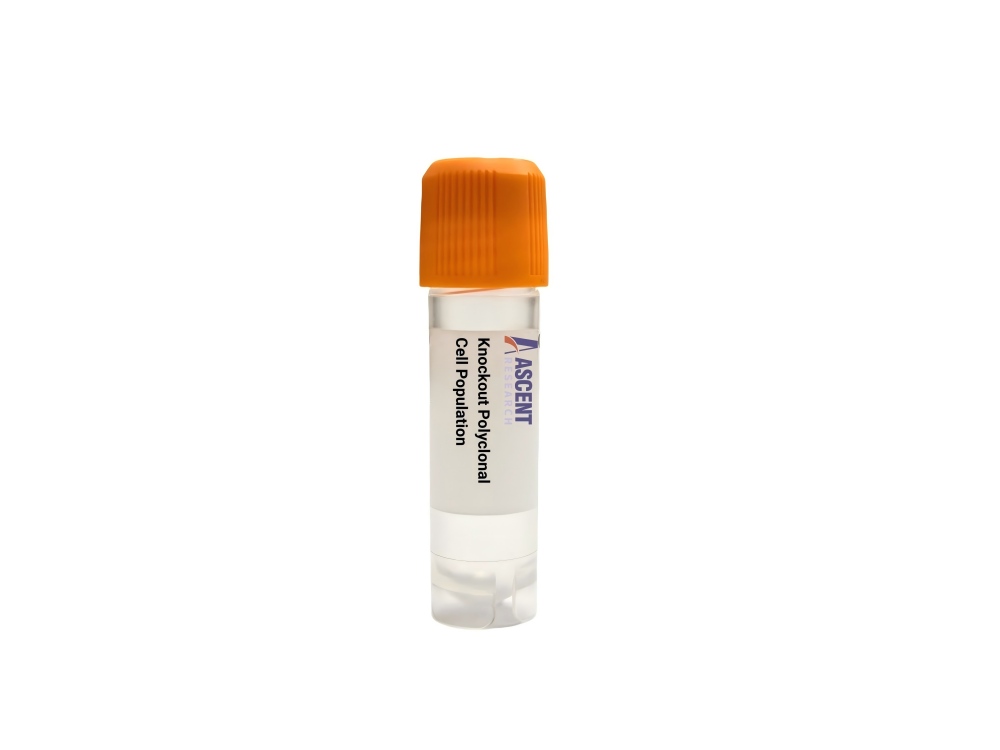
Polyclonal Cell Population
Homo sapiens (Human)
Bone
Suspension
NUDT3 Knockout Raji Polyclonal Cells are a CRISPR/Cas9-edited B lymphocyte population with targeted disruption of the NUDT3 gene, which encodes a diphosphoinositol polyphosphate phosphohydrolase. This enzyme normally hydrolyzes IP7 to IP6, keeping IP7 levels low; its inactivation elevates IP7, impacting Akt/mTOR signaling and genomic stability. This polyclonal knockout model, derived from EBV-positive Burkitt's lymphoma Raji cells, is optimized for studying inositol phosphate signaling in B cell malignancies. Applications include investigating IP7-mediated effects on proliferation, apoptosis, and drug sensitivity using techniques such as phospho-flow cytometry and mass spectrometry.
 NOMO2 Knockout SK-HEP-1 Polyclonal Cells
Cat. No. ARG15212
ERC1 Knockout NCI-H1975 Polyclonal Cells
Cat. No. ARG17255
MARK4 Knockout Jurkat Polyclonal Cells
Cat. No. ARG13813
DUSP23 Knockout HAP1 Polyclonal Cells
Cat. No. ARG40057
DSC2 Knockout Raji Polyclonal Cells
Cat. No. ARG39807
INPPL1 Knockout huh-7 Polyclonal Cells
Cat. No. ARG28401
NOMO2 Knockout SK-HEP-1 Polyclonal Cells
Cat. No. ARG15212
ERC1 Knockout NCI-H1975 Polyclonal Cells
Cat. No. ARG17255
MARK4 Knockout Jurkat Polyclonal Cells
Cat. No. ARG13813
DUSP23 Knockout HAP1 Polyclonal Cells
Cat. No. ARG40057
DSC2 Knockout Raji Polyclonal Cells
Cat. No. ARG39807
INPPL1 Knockout huh-7 Polyclonal Cells
Cat. No. ARG28401
NUDT3 Knockout Raji Polyclonal Cells comprise a CRISPR/Cas9-mediated gene-disrupted polyclonal population derived from the Raji B lymphocyte line, engineered for loss-of-function studies of the NUDT3 gene. This knockout model enables investigation of NUDT3-dependent processes without the isolation of a single clonal derivative, providing a heterogeneous yet targeted depletion of NUDT3 protein expression.
The Raji host cell line originates from an EBV-positive Burkitt’s lymphoma patient and grows in suspension as lymphoblastoid cells. Raji cells are widely utilized as a model for B cell malignancies and EBV latency programs, offering a well-characterized platform for studying lymphomagenesis and viral oncogenesis. Their transformed nature and rapid proliferation facilitate high-throughput functional assays.
NUDT3 encodes a nudix hydrolase that specifically dephosphorylates diphosphoinositol polyphosphates, converting 5-diphosphoinositol pentakisphosphate (5-IP7) to inositol hexakisphosphate (IP6) and thereby reducing intracellular IP7 levels. IP7 acts as a high-energy signaling metabolite that modulates the Akt/mTOR pathway and influences DNA damage responses. NUDT3 activity is transcriptionally regulated by MYC, SP1, and NF-??B, and it interacts with the IP7-synthesizing kinases IP6K1 and IP6K2. Disruption of NUDT3 elevates cellular IP7 concentrations, potentially enhancing Akt phosphorylation and altering genomic stability, with downstream effects on mTOR signaling and chromatin remodeling.
In the context of Raji B lymphocytes, NUDT3 knockout provides a unique tool to dissect how IP7 dynamics shape malignant B cell behavior. Elevated IP7 resulting from NUDT3 loss may hyperactivate Akt signaling, promoting proliferation and survival, while also affecting the DNA damage repair machinery. This interplay is particularly relevant for Burkitt’s lymphoma, where MYC-driven growth and genomic instability are central. Consequently, this model facilitates the study of metabolic signaling nodes that connect inositol phosphate metabolism to oncogenic pathways.
Researchers can employ these polyclonal knockout cells to explore the role of inositol pyrophosphate signaling in B cell lymphoma proliferation, apoptosis, and therapeutic response. Representative assays include Western blotting for Akt and mTOR phosphorylation, phospho-flow cytometry for p-Akt, IP7 quantification by mass spectrometry, RT-qPCR to confirm NUDT3 disruption, immunofluorescence staining of DNA damage foci, and cell viability or Annexin V apoptosis assays. Additionally, they are suitable for drug sensitivity screening against PI3K/Akt/mTOR inhibitors or DNA-damaging agents. For further technical inquiries, please contact Ascent Research.