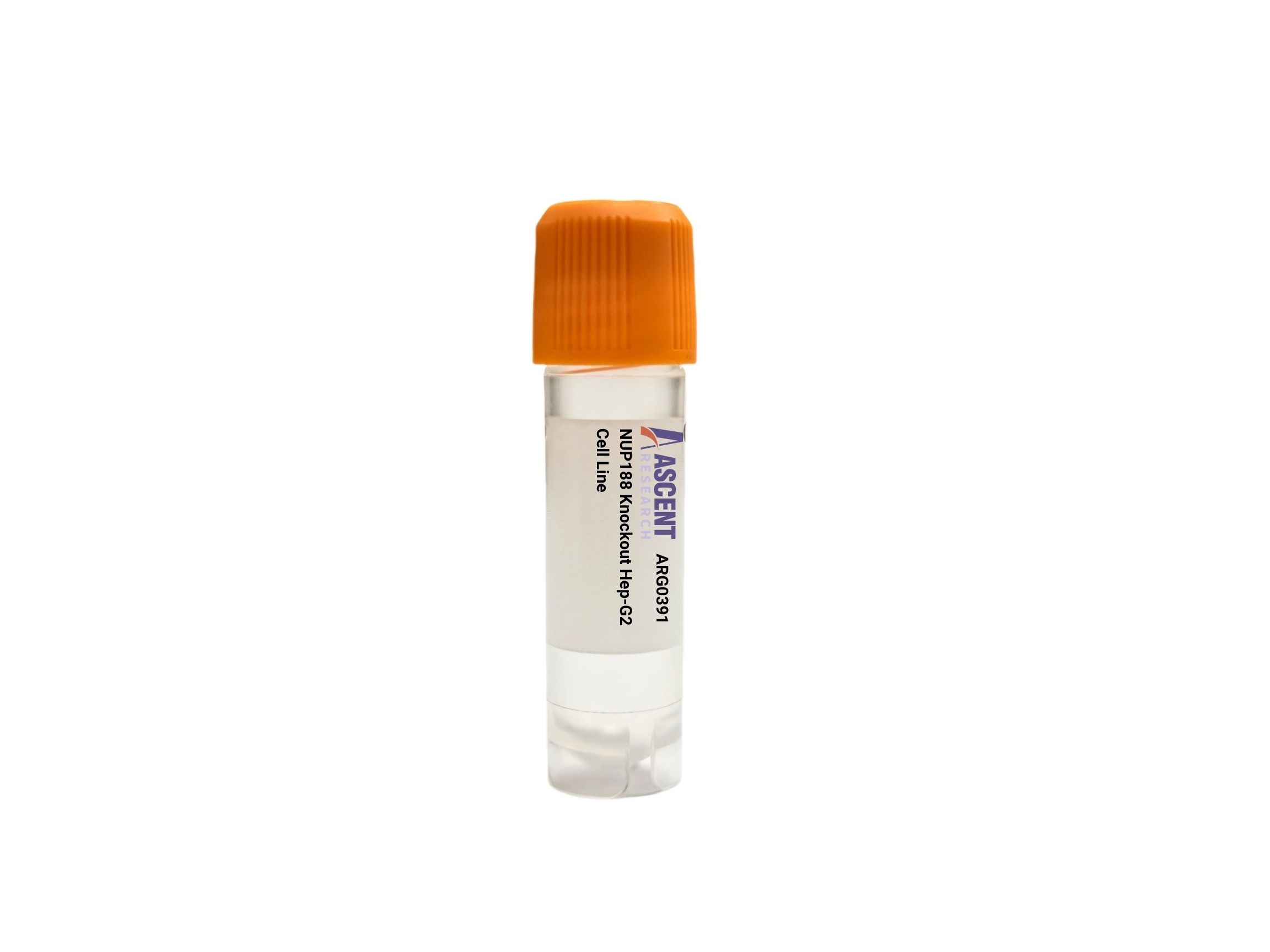
Genome-edited Cells
Liver
The NUP188 Knockout Hep-G2 Cell Line is a CRISPR/Cas9-edited Hep-G2 hepatocarcinoma cell line with targeted disruption of the NUP188 gene, encoding a key scaffold nucleoporin of the nuclear pore complex. This model facilitates research on nucleocytoplasmic transport, nuclear envelope integrity, and mitotic progression. NUP188 is regulated by Cyclin B/CDK1 and Aurora A kinases and interacts with nucleoporins Nup93 and Nup155, as well as Lamin B, to control nuclear import of cargoes like ??-catenin and STAT3. The line is suited for studying nuclear transport dysfunction in hepatocellular carcinoma, cell cycle checkpoints, and screening nucleocytoplasmic transport inhibitors.
 KDM5C Knockout UMUC-3 Polyclonal Cells
Cat. No. ARG36951
KCNJ2 Knockout UMUC-3 Polyclonal Cells
Cat. No. ARG36948
CCNB2 Knockout A549 Polyclonal Cells
Cat. No. ARG43232
Dcps Knockout RAW 264.7 Polyclonal Cells
Cat. No. ARG40235
NUDCD1 Knockout AGS Polyclonal Cells
Cat. No. ARG2825
KDM5C Knockout UMUC-3 Polyclonal Cells
Cat. No. ARG36951
KCNJ2 Knockout UMUC-3 Polyclonal Cells
Cat. No. ARG36948
CCNB2 Knockout A549 Polyclonal Cells
Cat. No. ARG43232
Dcps Knockout RAW 264.7 Polyclonal Cells
Cat. No. ARG40235
NUDCD1 Knockout AGS Polyclonal Cells
Cat. No. ARG2825
 Rabbit Periodontal Ligament Fibroblast Medium
Cat. No. ARM0881
Rabbit Periodontal Ligament Fibroblast Medium
Cat. No. ARM0881
The NUP188 Knockout Hep-G2 Cell Line is a CRISPR/Cas9-edited knockout cell line derived from the Hep-G2 human hepatocellular carcinoma line, engineered for loss-of-function studies of the NUP188 gene. This product provides a genetically defined model in which CRISPR/Cas9-mediated gene disruption eliminates NUP188 expression, enabling dissection of this scaffold nucleoporin’s roles in a liver cancer context. The edited cell population provides a stable loss-of-function model for rigorous investigation of nuclear pore complex integrity, nucleocytoplasmic transport, and cell cycle progression.
Hep-G2 is a human hepatocellular carcinoma cell line with epithelial morphology, widely used in liver metabolism, toxicity testing, and hepatocarcinoma research. It retains hepatocyte-like metabolic functions and offers a consistent genetic background for comparing wild-type and NUP188-deficient states, making it an appropriate host for studying nuclear transport in cancer.
NUP188 encodes a scaffold nucleoporin integral to the nuclear pore complex (NPC), interacting with Nup93, Nup205, Nup155, Ndc1, and Lamin B. It functions downstream of Cyclin B/CDK1 and Aurora A kinases, regulated by Ran GTPase. NUP188 facilitates nuclear import of signal transducers such as STAT3 and ??-catenin and is essential for mitotic spindle assembly and nuclear envelope reorganization. These molecular interactions are critical for maintaining the selective permeability barrier and orchestrating cargo translocation. Knockout of NUP188 disrupts these processes, impairing nucleocytoplasmic trafficking and mitotic progression.
In hepatocellular carcinoma, efficient nucleocytoplasmic transport is vital for oncogenic signaling and proliferation. Loss of NUP188 in Hep-G2 cells allows investigation of how NPC dysfunction impacts ??-catenin-driven transcription and cell cycle checkpoints, potentially uncovering vulnerabilities in NPC-dependent pathways for liver cancer. This model probes the intersection of nuclear transport, mitosis, and cancer cell fitness.
Applications include Western blot and immunofluorescence to verify NUP188 ablation and assess NPC composition, nuclear import assays using fluorescent reporters, cell cycle analysis by flow cytometry, and proliferation assays (MTT/BrdU). Transcriptomic profiling via RNA-seq and co-immunoprecipitation reveal downstream pathways and altered protein interactions. The line is suited for studying nucleoporin roles in hepatocellular carcinoma, drug screening for transport inhibitors, and mitotic regulation research. Contact Ascent Research for more information.