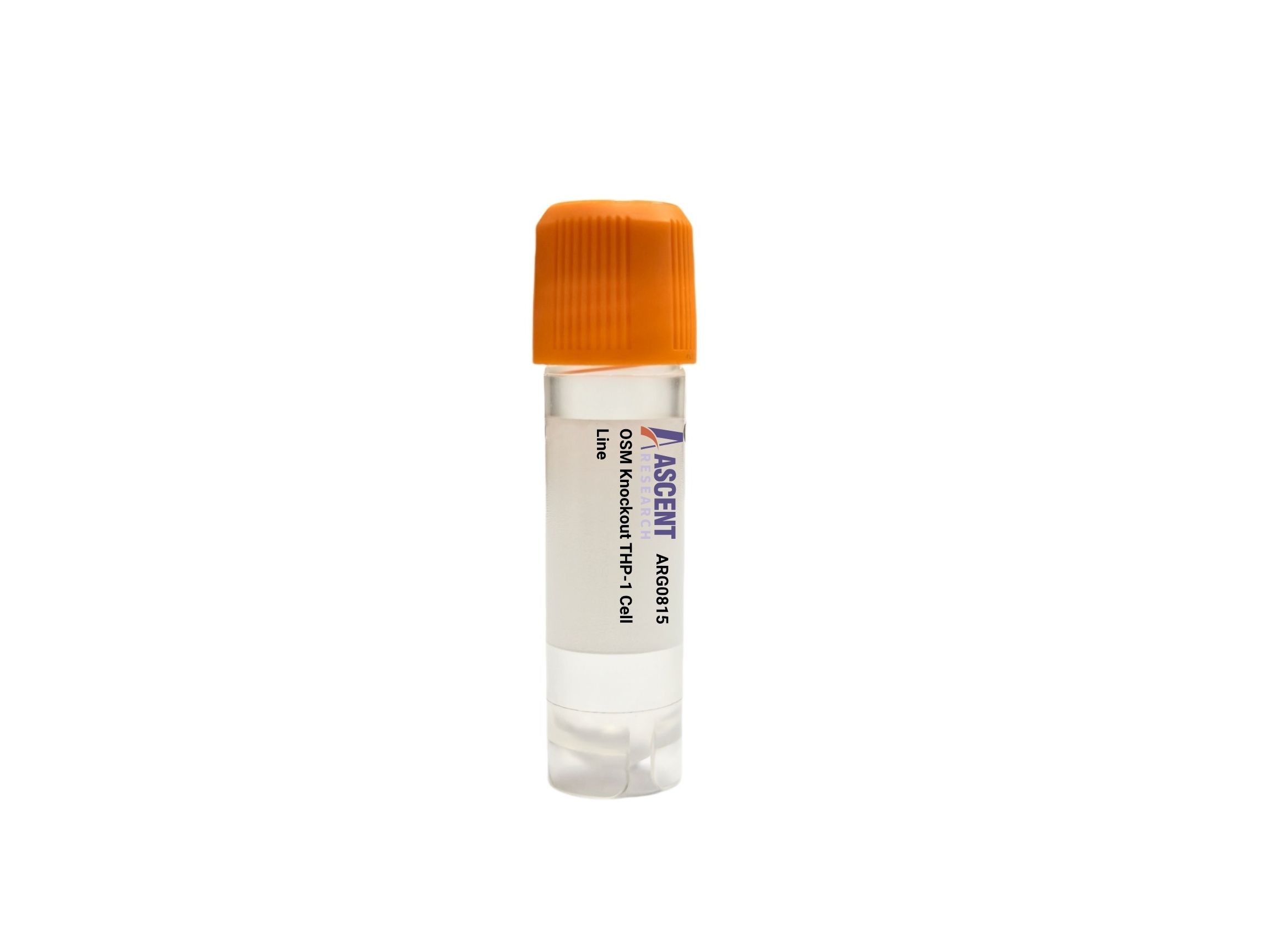
Genome-edited Cells
Blood (peripheral blood)
The OSM Knockout THP-1 Cell Line is a CRISPR/Cas9-edited human acute monocytic leukemia cell line with targeted disruption of the oncostatin M (OSM) gene. This loss-of-function model eliminates OSM-mediated signaling through the OSMR/gp130 receptor complex and downstream JAK/STAT, MAPK, and PI3K-AKT pathways. It is designed for studies of OSM-dependent inflammation, macrophage polarization, and tissue remodeling, with applications in rheumatoid arthritis, cancer, and fibrosis research. Key readouts include STAT3 phosphorylation and target gene expression (e.g., TIMP-1, MMP-1). The knockout line supports inhibitor screening and transcriptomic analysis to dissect OSM-specific pathways.
 FYN Knockout A2780 Polyclonal Cells
Cat. No. ARG19208
FYN Knockout A2780 Polyclonal Cells
Cat. No. ARG19208
 Human Type I Alveolar Epithelial Cells
Cat. No. ARP1173
Cdk8 Knockout RAW 264.7 Polyclonal Cells
Cat. No. ARG12472
FGD5 Knockout CAL27 Polyclonal Cells
Cat. No. ARG11538
LAMP2 Knockout CaSki Polyclonal Cells
Cat. No. ARG9926
Human Type I Alveolar Epithelial Cells
Cat. No. ARP1173
Cdk8 Knockout RAW 264.7 Polyclonal Cells
Cat. No. ARG12472
FGD5 Knockout CAL27 Polyclonal Cells
Cat. No. ARG11538
LAMP2 Knockout CaSki Polyclonal Cells
Cat. No. ARG9926
 HCC4006
Cat. No. ARC0263
HCC4006
Cat. No. ARC0263
The OSM Knockout THP-1 Cell Line is a CRISPR/Cas9-edited knockout cell line derived from the human THP-1 monocytic leukemia cell line. It provides a stable loss-of-function model for the OSM gene, eliminating oncostatin M expression and downstream signaling. This cell line enables detailed investigation of OSM-dependent pathways in a defined monocytic background, suitable for studies of inflammation, macrophage biology, and leukemia.
The parental THP-1 cell line originates from peripheral blood of an acute monocytic leukemia patient. Widely used to study monocyte and macrophage functions, innate immune responses, and inflammatory processes, THP-1 cells can differentiate into macrophage-like cells upon phorbol ester stimulation. This host provides a physiologically relevant context for examining cytokine signaling in both normal immune regulation and leukemogenesis.
OSM is a pleiotropic IL-6 family cytokine with pro-inflammatory and tissue-remodeling roles. It signals through OSMR/gp130 or OSMR/LIFR receptor complexes, activating JAK1/JAK2/TYK2 to phosphorylate STAT1/3/5, and also engaging MAPK/ERK and PI3K-AKT pathways. Upstream inducers TNF-??, IL-1??, and LPS drive OSM transcription via NF-??B, C/EBP, and AP-1. Downstream effector genes include TIMP-1, MMP-1, VEGF, IL-6, CXCL8, CCL2, SOCS3, and SAA1, coordinating cell proliferation, differentiation, and matrix remodeling.
OSM knockout in THP-1 cells abolishes OSM-specific autocrine/paracrine signaling, enabling precise analysis of its role in macrophage polarization, inflammatory gene expression, and tissue remodeling. This model is pertinent to rheumatoid arthritis, multiple sclerosis, cancer, fibrosis, IBD, and atherosclerosis. The knockout line offers a clean system to discriminate OSM-dependent responses from other IL-6 family cytokines in monocytic and macrophage-like states, and is valuable for studying OSM-driven survival signals in acute myeloid leukemia.
Applications include western blotting for phospho-STAT3, RT-qPCR profiling of OSM target genes, and ELISA-based cytokine quantification. Cell-based assays such as macrophage differentiation, flow cytometry for receptor expression, migration, and tumor co-culture can be employed. RNA-seq provides transcriptome-wide insights, and the line is suitable for screening OSM pathway inhibitors. For additional details, please contact Ascent Research.