Genome-edited Cells
Breast (mammary gland)
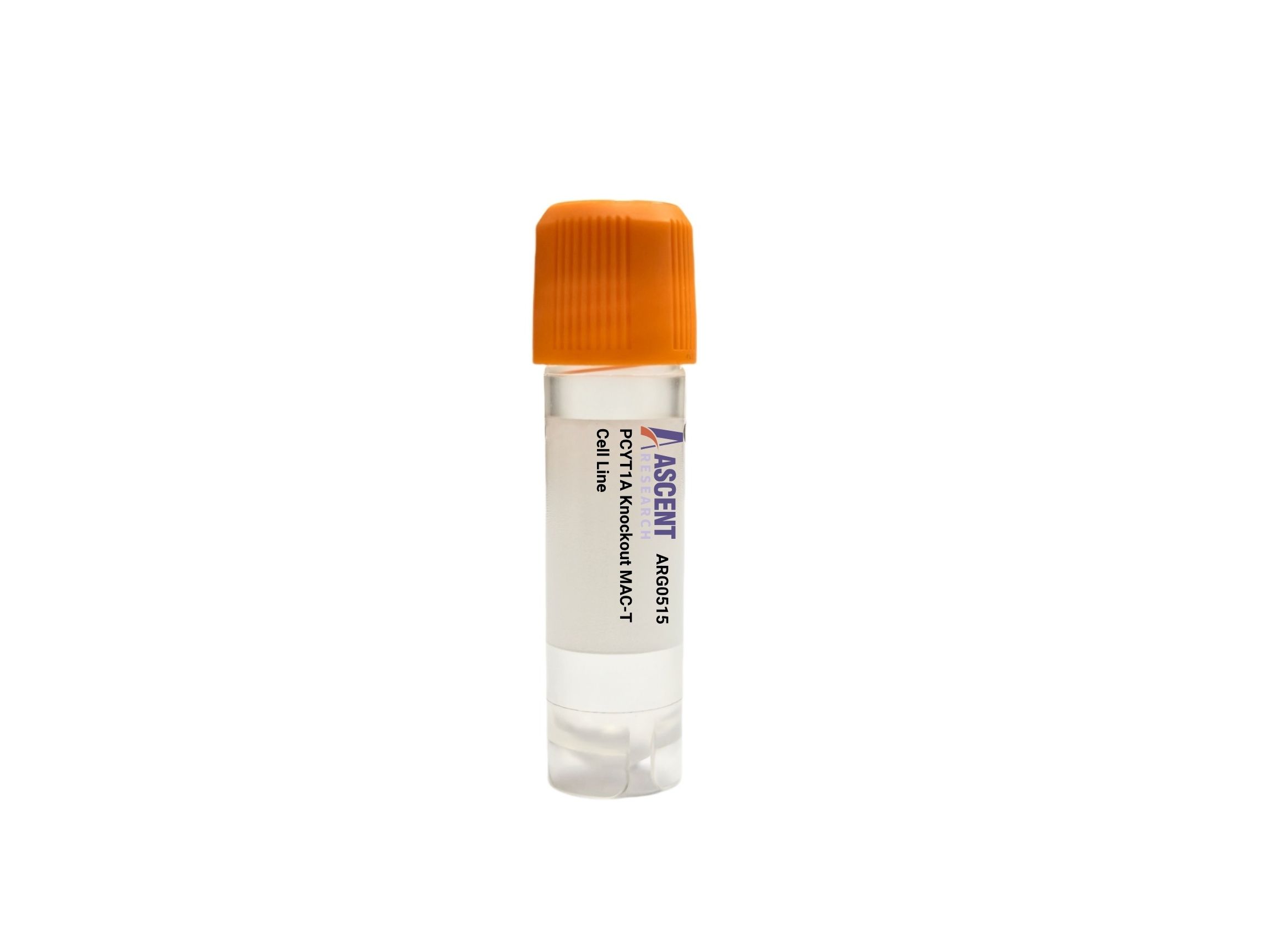
The PCYT1A Knockout MAC-T Cell Line is a CRISPR/Cas9-edited bovine mammary epithelial cell line with targeted disruption of PCYT1A, the gene encoding the rate-limiting enzyme of phosphatidylcholine biosynthesis. This knockout impairs the CDP-choline pathway, making it a valuable model for studying membrane biogenesis, lipid metabolism, and milk lipid secretion in a lactation-relevant context. Applications include choline incorporation assays, lipidomics, and milk lipid secretion analyses, suitable for research in metabolic disorders, bovine lactation biology, and drug discovery. The model incorporates key molecular interactions with regulators such as SREBP-1c and PPAR??, and interacting factors including PCYT1B and Lipin proteins.
 OGFOD2 Knockout NCI-H1975 Polyclonal Cells
Cat. No. ARG17077
Map3k7 Knockout RAW 264.7 Polyclonal Cells
Cat. No. ARG12484
AMN Knockout HAP1 Polyclonal Cells
Cat. No. ARG21803
ACO1 Knockout SK-HEP-1 Polyclonal Cells
Cat. No. ARG32071
JAK1 Knockout 143B Polyclonal Cells
Cat. No. ARG35066
OGFOD2 Knockout NCI-H1975 Polyclonal Cells
Cat. No. ARG17077
Map3k7 Knockout RAW 264.7 Polyclonal Cells
Cat. No. ARG12484
AMN Knockout HAP1 Polyclonal Cells
Cat. No. ARG21803
ACO1 Knockout SK-HEP-1 Polyclonal Cells
Cat. No. ARG32071
JAK1 Knockout 143B Polyclonal Cells
Cat. No. ARG35066
 Human Nucleus Pulposus Cells
Cat. No. ARP0158
Human Nucleus Pulposus Cells
Cat. No. ARP0158
The PCYT1A Knockout MAC-T Cell Line is a CRISPR/Cas9-edited knockout cell line derived from the immortalized bovine mammary alveolar epithelial MAC-T cell line, providing a loss-of-function model for the PCYT1A gene. This product enables targeted disruption of PCYT1A, a critical regulator of phosphatidylcholine biosynthesis, within a cell type central to lipid metabolism and secretion.
The MAC-T host cell line is an established immortalized bovine mammary alveolar epithelial model widely used to study milk synthesis and secretion. These cells retain polarized secretory functions and express key enzymes for lipid droplet formation and milk fat secretion, offering a physiologically relevant system for investigating phospholipid-dependent processes in lactation.
PCYT1A encodes the rate-limiting enzyme of the CDP-choline pathway, catalyzing the conversion of choline phosphate and CTP into CDP-choline, the direct precursor of phosphatidylcholine. Its activity is governed by upstream regulators including the lipogenic transcription factor SREBP-1c, the nuclear receptor PPAR??, and the availability of substrates choline phosphate (produced by choline kinase) and CTP. PCYT1A interacts with PCYT1B, Lipin family proteins, and diacylglycerol acyltransferase, integrating into the glycerophospholipid metabolic network. Disruption of PCYT1A impairs de novo phosphatidylcholine synthesis, leading to compromised membrane biogenesis and altered lipid droplet dynamics.
In MAC-T cells, PCYT1A knockout directly impacts the synthesis of phosphatidylcholine required for milk fat globule membrane formation and secretory vesicle trafficking. This model is therefore essential for dissecting the role of phospholipid metabolism in mammary epithelial cell function, lactation biology, and the mechanisms underlying lipid metabolism disorders such as spondylometaphyseal dysplasia with cone-rod dystrophy.
Researchers can utilize this cell line for choline incorporation assays, lipidomic profiling, membrane integrity assessments, and milk lipid secretion assays to quantify phosphatidylcholine metabolism. Standard validation includes Western blotting, RT-qPCR, and immunofluorescence. The model supports applications in lipid metabolism research, bovine lactation studies, drug screening for phospholipid disorders, and investigation of membrane biogenesis. For additional details, please contact Ascent Research.