Genome-edited Cells
Large intestine (colon)
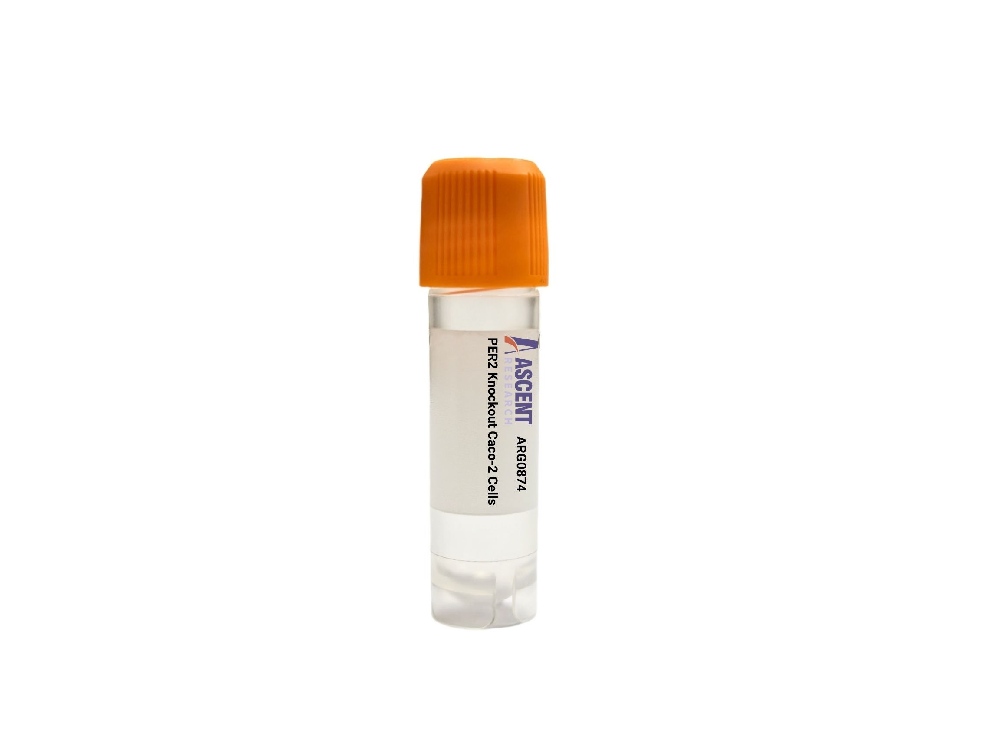
PER2 Knockout Caco-2 Cells are a CRISPR/Cas9-edited knockout cell line derived from the human colorectal adenocarcinoma Caco-2 cell line. This model targets the PER2 gene, a core circadian clock component and transcriptional repressor, providing a stable loss-of-function system in a physiologically relevant intestinal epithelial background. PER2 interacts with cryptochrome proteins (CRY1/2) to repress CLOCK-BMAL1-mediated transcription, linking circadian rhythms to cell cycle regulation via p53 and ??-catenin. The knockout cell line supports research in circadian biology, colorectal cancer, intestinal barrier function, and chronopharmacology, and is compatible with assays such as bioluminescence reporter monitoring, cell cycle analysis, and TEER measurement.
 CEP170B Knockout SK-HEP-1 Polyclonal Cells
Cat. No. ARG16114
CLK4 Knockout Hela Polyclonal Cells
Cat. No. ARG8927
HSD17B12 Knockout HEK293T Polyclonal Cells
Cat. No. ARG26087
CCM2 Knockout K562 Polyclonal Cells
Cat. No. ARG43214
CAV2 Knockout Raji Polyclonal Cells
Cat. No. ARG42640
EDIL3 Knockout MES-OV Polyclonal Cells
Cat. No. ARG40483
CEP170B Knockout SK-HEP-1 Polyclonal Cells
Cat. No. ARG16114
CLK4 Knockout Hela Polyclonal Cells
Cat. No. ARG8927
HSD17B12 Knockout HEK293T Polyclonal Cells
Cat. No. ARG26087
CCM2 Knockout K562 Polyclonal Cells
Cat. No. ARG43214
CAV2 Knockout Raji Polyclonal Cells
Cat. No. ARG42640
EDIL3 Knockout MES-OV Polyclonal Cells
Cat. No. ARG40483
The PER2 Knockout Caco-2 Cells are a CRISPR/Cas9-edited knockout cell line derived from the human colorectal adenocarcinoma Caco-2 cell line. This model provides a stable loss-of-function system for the PER2 gene, a core circadian clock component and transcriptional repressor. Available as a ready-to-use knockout cell population, it eliminates the need for transient gene silencing. The knockout line is particularly suited for circadian rhythm studies in intestinal epithelia and cancer biology applications.
The parental Caco-2 cells were originally isolated from a 72-year-old Caucasian male colorectal adenocarcinoma. Upon reaching confluence, these cells differentiate into polarized, enterocyte-like monolayers with tight junctions and brush borders, recapitulating intestinal absorptive epithelium. Caco-2 is a gold-standard in vitro model for intestinal permeability, drug transport, and barrier function studies, making it an ideal host for examining circadian influences on epithelial homeostasis.
PER2 functions as a central transcriptional repressor in the circadian clock. It forms a complex with cryptochrome proteins CRY1/2 to translocate into the nucleus and inhibit CLOCK-BMAL1-mediated transcription of clock-controlled genes. PER2 stability is regulated by CK1?? phosphorylation and FBXL3-mediated ubiquitination, generating 24-hour oscillations. Beyond the clock, PER2 interacts with p53 and ??-catenin, linking circadian timing to cell cycle control and tumor suppression. Knockout of PER2 thus dysregulates multiple targets, including c-Myc, cyclin D1, and Wee1.
In Caco-2 cells, PER2 knockout offers a powerful model for colorectal cancer research. Loss of PER2 disrupts circadian regulation of proliferation and apoptosis, promoting tumorigenesis via p53 and Wnt/??-catenin pathway dysregulation. This knockout line enables dissection of clock-driven intestinal epithelial homeostasis, including barrier integrity, metabolic rhythms, and drug transporter expression. Given the link between circadian disruption and colorectal cancer, it serves as a critical tool for oncogenesis studies.
The PER2 Knockout Caco-2 Cell Line supports assays such as RT-qPCR and RNA-seq for circadian gene profiling, bioluminescent reporter monitoring of rhythms, ChIP for CLOCK-BMAL1 binding, and flow cytometry for cell cycle. TEER measurements assess barrier function, and migration/invasion assays evaluate metastatic potential. The model is also applicable to chronopharmacology studies of time-dependent drug responses. For ordering and technical support, contact Ascent Research.