Genome-edited Cells
Brain
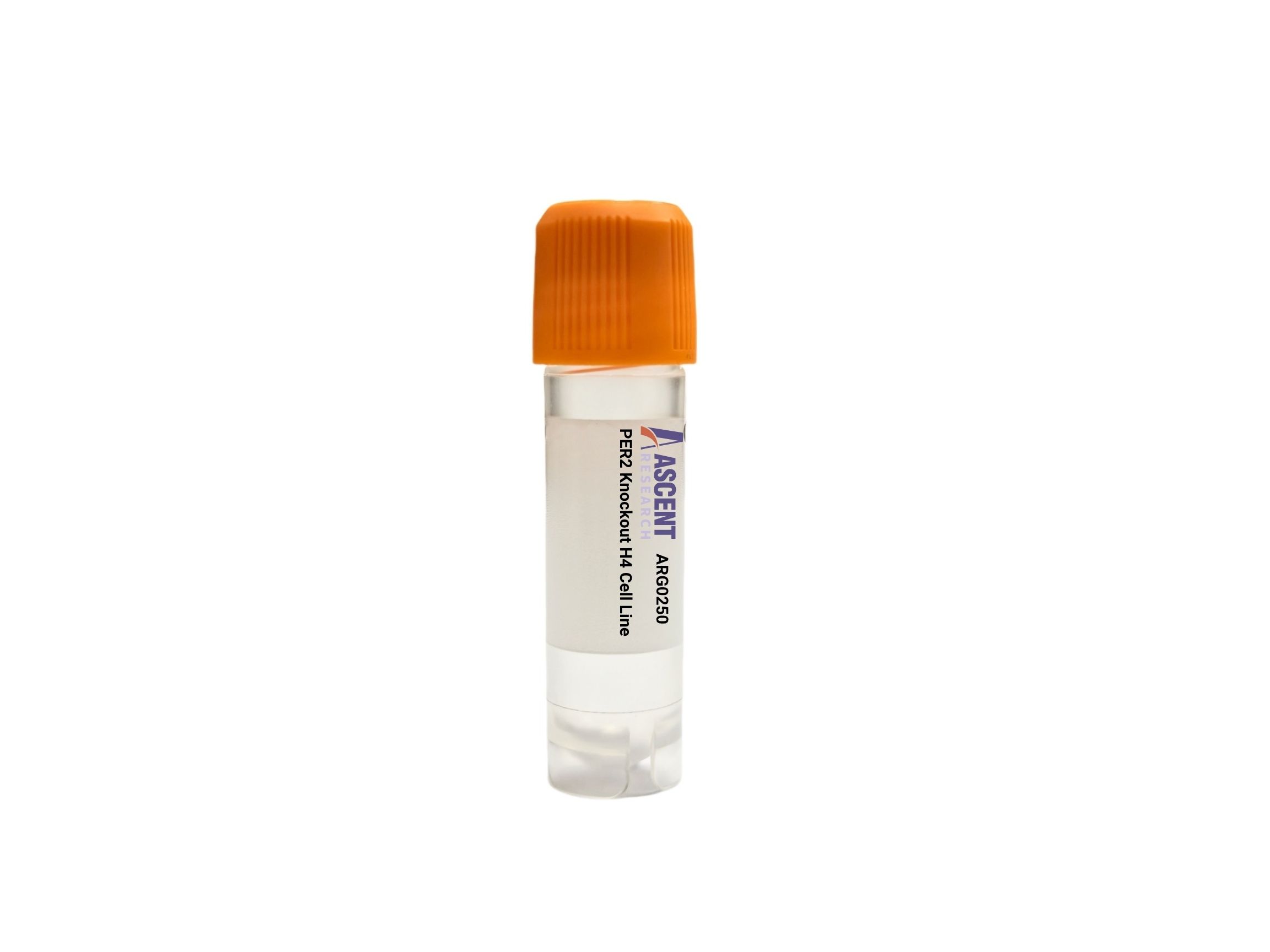
The PER2 Knockout H4 Cell Line is a CRISPR/Cas9-edited human neuroglioma cell line with targeted disruption of PER2, a core circadian clock gene encoding a transcriptional repressor. PER2 operates in the negative feedback loop, forming inhibitory complexes with CRY1 and CRY2 to repress CLOCK-BMAL1-driven transcription. This knockout model is designed for circadian research in a glial cell context, enabling studies on clock-regulated gene expression, glial biology, chronotherapy, and circadian disruption in cancer. Typical applications include luciferase reporter assays, RT-qPCR, western blotting, immunofluorescence, and drug sensitivity analyses.
 C9orf64 Knockout NCI-H1299 Polyclonal Cells
Cat. No. ARG30593
C9orf64 Knockout NCI-H1299 Polyclonal Cells
Cat. No. ARG30593
 RRAGC Knockout THP-1 Cell Line
Cat. No. ARG44095
ALPK2 Knockout A549 Polyclonal Cells
Cat. No. ARG19922
BAG1 Knockout A2780 Polyclonal Cells
Cat. No. ARG28865
RRAGC Knockout THP-1 Cell Line
Cat. No. ARG44095
ALPK2 Knockout A549 Polyclonal Cells
Cat. No. ARG19922
BAG1 Knockout A2780 Polyclonal Cells
Cat. No. ARG28865
 Rabbit Renal Artery Smooth Muscle Cell Medium
Cat. No. ARM0702
Rabbit Renal Artery Smooth Muscle Cell Medium
Cat. No. ARM0702
 BRCA2 Knockout HCT 15 Cell Line
Cat. No. ARG0284
BRCA2 Knockout HCT 15 Cell Line
Cat. No. ARG0284
The PER2 Knockout H4 Cell Line is a CRISPR/Cas9-edited knockout cell line based on H4 human neuroglioma cells. It features a targeted disruption of PER2, generating a stable loss-of-function model for circadian clock studies. This CRISPR/Cas9-mediated gene disruption eliminates PER2 protein expression, enabling functional dissection without off-target effects of transient methods. The line is optimized for complementation assays and signaling pathway analysis.
The H4 cell line was established from a human brain glioma and retains glial cell characteristics, including support and insulation functions for neurons. H4 cells are widely used for glial biology and brain tumor research due partly to their robust growth and genetic manipulability, making them ideal for CRISPR-based circadian gene knockout.
PER2 acts as a transcriptional repressor in the circadian negative feedback loop. It is transcriptionally induced by CLOCK-BMAL1 heterodimers, phosphorylated by CK1??/?? and GSK3??, and then forms complexes with CRY1/CRY2. These PER-CRY complexes translocate to the nucleus to inhibit CLOCK-BMAL1-mediated transcription of clock genes (PER1, CRY, DBP) and cell cycle regulators. Additional interacting factors include TIMELESS and CK1??/??, linking PER2 to diverse physiological rhythms.
The H4 neuroglioma background makes this line particularly valuable for dissecting glial circadian biology. Astrocytic clocks regulate synaptic activity, metabolic coupling, and neuroinflammation. PER2 disruption in H4 cells thus enables exploration of glial clock dysfunction in glioma progression, sleep disorders, and metabolic imbalances. Moreover, glial circadian disruption may influence drug metabolism and chronotherapeutic outcomes, expanding application to neuropharmacology.
This knockout line supports diverse assays: real-time bioluminescent recording of circadian dynamics via luciferase reporters, RT-qPCR profiling of rhythmic gene expression, western blotting for PER2 and phosphorylation variants, and immunofluorescence for subcellular localization. Co-immunoprecipitation can be performed to study PER2-CRY1/2 complexes, and flow cytometry enables cell cycle analysis. Drug sensitivity testing facilitates chronotherapeutic investigations, and overexpressing mutant PER2 models sleep phase syndromes. For further information, please contact Ascent Research.