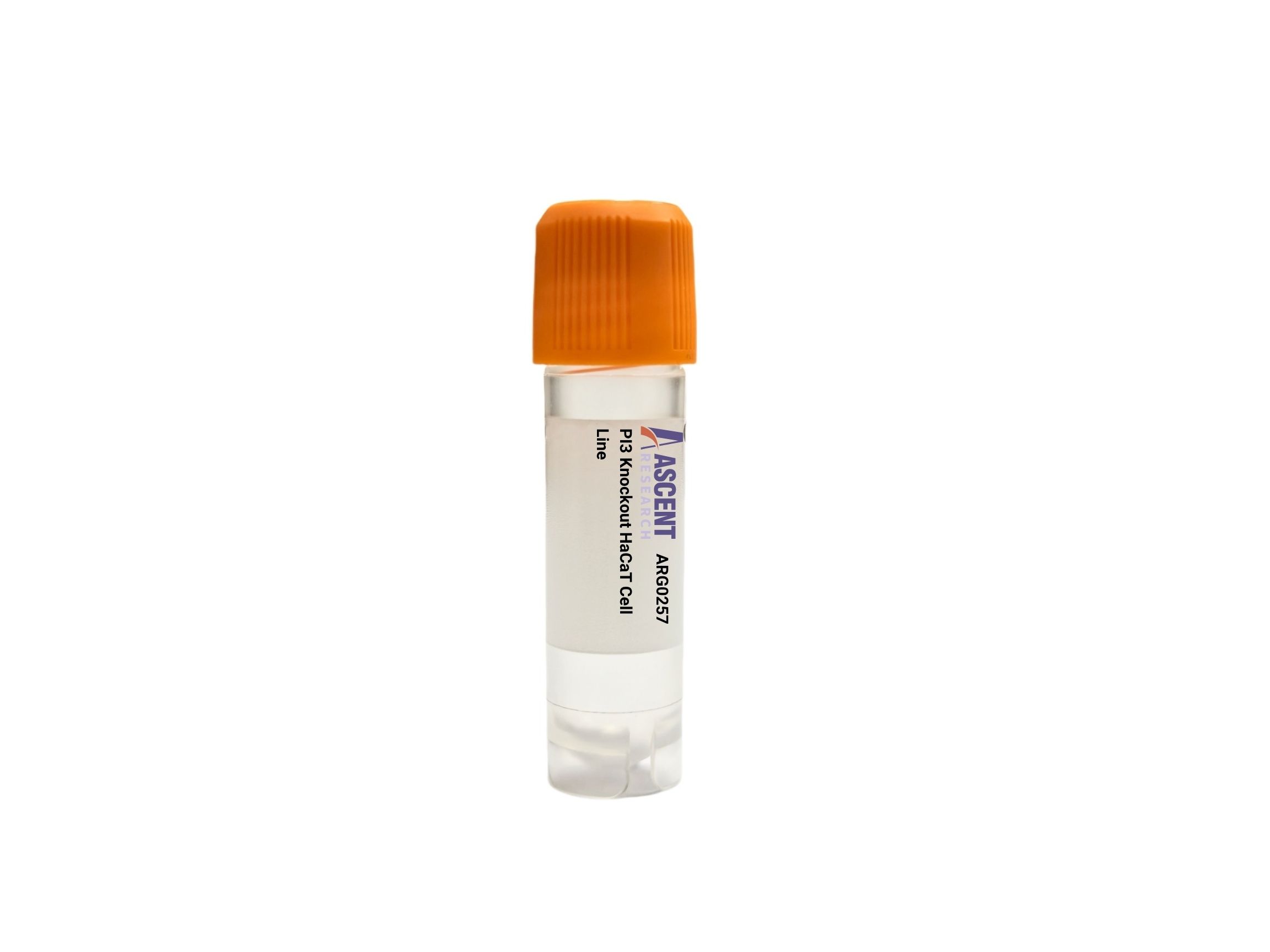
Genome-edited Cells
Skin
The PI3 Knockout HaCaT Cell Line is a CRISPR/Cas9-edited cell line derived from HaCaT human keratinocytes, engineered to disrupt the PI3 gene which encodes the PI3K catalytic subunit. This non-tumorigenic epithelial model retains normal differentiation capacity and is ideal for investigating PI3K/AKT/mTOR signaling in skin biology. PI3K generates PIP3 to activate PDK1 and AKT, which phosphorylates mTOR, S6, and FOXO1 downstream. Knockout of PI3 abrogates growth factor and insulin signaling, impairing proliferation and migration. Applications include phospho-AKT western blotting, scratch wound assays, and inhibitor profiling for dermatological and oncological research.
 GIPC1 Knockout SK-HEP-1 Polyclonal Cells
Cat. No. ARG15854
OSM Knockout TE1 Polyclonal Cells
Cat. No. ARG12210
FBRSL1 Knockout Hela Polyclonal Cells
Cat. No. ARG8936
CNOT6 Knockout Hela Polyclonal Cells
Cat. No. ARG8925
AIDA Knockout HAP1 Polyclonal Cells
Cat. No. ARG27235
CCDC127 Knockout HEK293T Polyclonal Cells
Cat. No. ARG42917
GIPC1 Knockout SK-HEP-1 Polyclonal Cells
Cat. No. ARG15854
OSM Knockout TE1 Polyclonal Cells
Cat. No. ARG12210
FBRSL1 Knockout Hela Polyclonal Cells
Cat. No. ARG8936
CNOT6 Knockout Hela Polyclonal Cells
Cat. No. ARG8925
AIDA Knockout HAP1 Polyclonal Cells
Cat. No. ARG27235
CCDC127 Knockout HEK293T Polyclonal Cells
Cat. No. ARG42917
The PI3 Knockout HaCaT Cell Line is a CRISPR/Cas9-edited knockout cell line engineered for targeted disruption of the PI3 gene in the HaCaT human keratinocyte background. This loss-of-function model enables the study of phosphatidylinositol 3-kinase (PI3K) signaling in a non-tumorigenic epithelial context. The cell line is supplied as a pooled population, and CRISPR/Cas9-mediated gene disruption abolishes expression of the PI3K catalytic subunit, providing a robust platform for investigating PI3K-dependent processes.
The HaCaT cell line is a spontaneously immortalized human keratinocyte line derived from adult skin, retaining many features of normal epidermal differentiation. It is widely employed in dermatological research for studies of keratinocyte biology, skin barrier function, and epidermal homeostasis. Unlike tumor-derived lines, HaCaT cells are non-tumorigenic and exhibit normal stratification and differentiation programs in vitro, making them particularly suited for dissecting signaling pathways involved in skin physiology and disease.
The PI3 gene encodes the catalytic subunit of class I PI3K, which phosphorylates PIP2 to generate PIP3 at the plasma membrane. PIP3 recruits PH domain-containing proteins such as PDK1 and AKT, triggering signaling cascades that regulate survival, proliferation, and metabolism. AKT phosphorylates downstream targets including mTOR, S6, FOXO1, and GSK3B, integrating inputs from EGF, insulin, PDGF, and RAS. It interacts with PIK3R1 (p85) and is counteracted by PTEN, while IRS1 couples receptor activation to PI3K signaling.
In keratinocytes, PI3K/AKT/mTOR signaling is critical for proliferation, migration, and differentiation, processes essential for epidermal barrier formation and wound healing. Disruption of PI3 in HaCaT cells impairs signal transduction from growth factor receptors and insulin, leading to altered cell cycle progression, reduced migration, and aberrant differentiation. This knockout cell line thus provides a physiologically relevant model to elucidate the roles of PI3K in skin homeostasis and to assess pathway dependencies in non-malignant epithelial cells.
The PI3 Knockout HaCaT Cell Line is invaluable for cancer research, drug development, and signal transduction studies, particularly in the context of skin biology and inflammatory skin diseases. It can be employed in phospho-AKT (Ser473) western blotting to assess pathway activation, MTT proliferation assays to measure cell growth, scratch wound healing assays to evaluate migration, and immunofluorescence for keratinocyte differentiation markers. Additionally, PI3K inhibitor dose-response assays facilitate the evaluation of compound specificity and efficacy. For further information, please contact Ascent Research.