Genome-edited Cells
Stomach
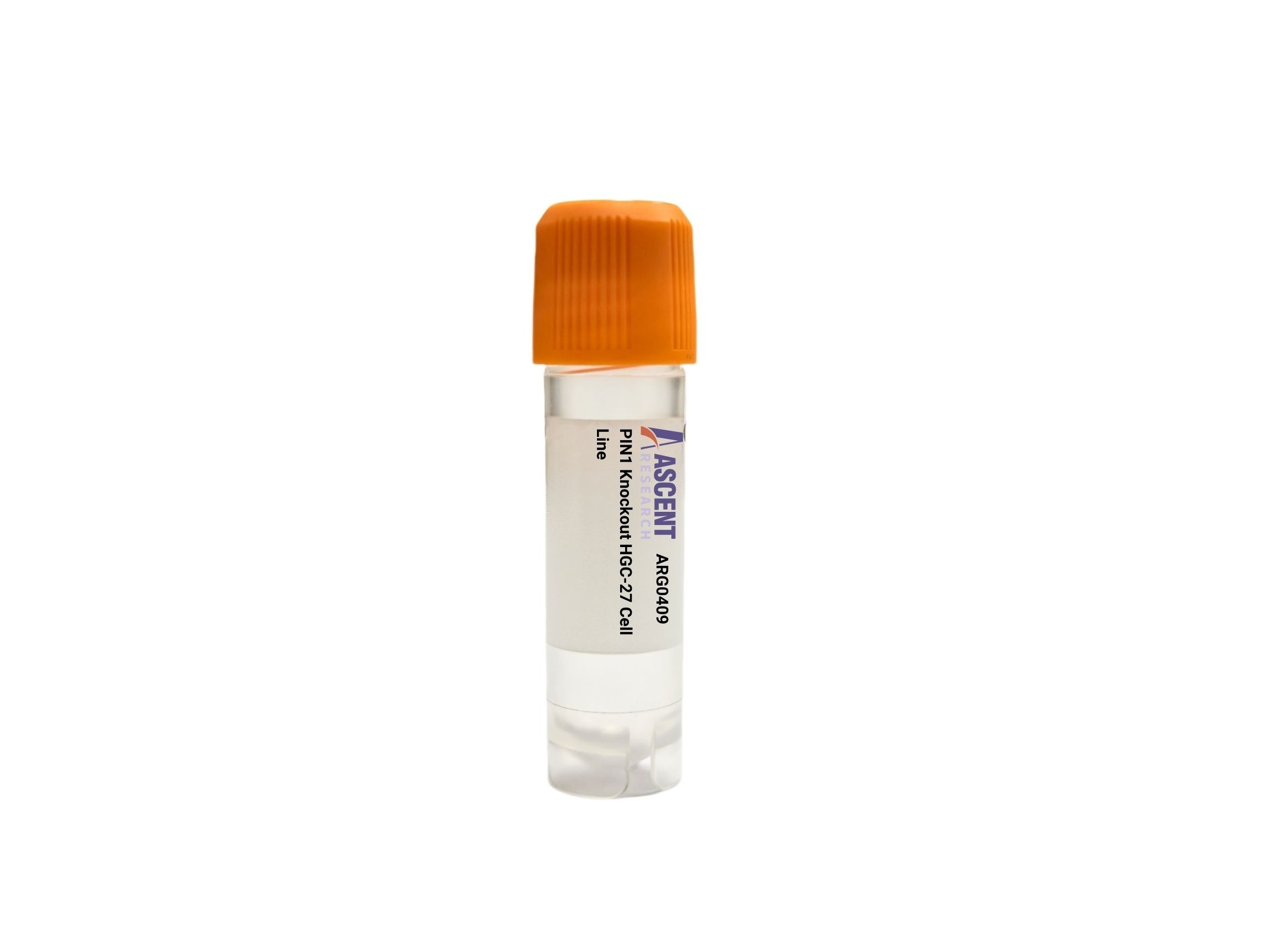
The PIN1 Knockout HGC-27 Cell Line is a CRISPR/Cas9-edited gastric carcinoma model with targeted disruption of the PIN1 gene, which encodes a peptidyl-prolyl isomerase critical for regulating protein conformation in oncogenic signaling. Derived from the metastatic HGC-27 cell line, this tool enables investigation of PIN1-dependent mechanisms in poorly differentiated gastric cancer. The knockout cell line facilitates analysis of pathways involving Cyclin D1, p53, ??-catenin, and NF-??B, and supports studies on tumorigenesis, metastasis, and drug resistance. Applications include proliferation assays, migration/invasion assays, apoptosis analysis, and screening of PIN1 inhibitors.
 CACNA2D1 Knockout HCT116 Polyclonal Cells
Cat. No. ARG34767
EPHA2 Knockout A2780 Polyclonal Cells
Cat. No. ARG18857
LY96 Knockout TE1 Polyclonal Cells
Cat. No. ARG12167
ABAT Knockout HAP1 Polyclonal Cells
Cat. No. ARG21534
DDC Knockout HCT116 Polyclonal Cells
Cat. No. ARG7129
PFKFB2 Knockout Raji Polyclonal Cells
Cat. No. ARG1601
CACNA2D1 Knockout HCT116 Polyclonal Cells
Cat. No. ARG34767
EPHA2 Knockout A2780 Polyclonal Cells
Cat. No. ARG18857
LY96 Knockout TE1 Polyclonal Cells
Cat. No. ARG12167
ABAT Knockout HAP1 Polyclonal Cells
Cat. No. ARG21534
DDC Knockout HCT116 Polyclonal Cells
Cat. No. ARG7129
PFKFB2 Knockout Raji Polyclonal Cells
Cat. No. ARG1601
The PIN1 Knockout HGC-27 Cell Line is a CRISPR/Cas9-edited human gastric carcinoma cell model in which the PIN1 gene has been disrupted to establish a loss-of-function system. This knockout cell line enables systematic interrogation of PIN1-dependent molecular mechanisms in a cellular background derived from a metastatic lymph node of a patient with poorly differentiated gastric adenocarcinoma. The engineered line serves as a critical tool for dissecting PIN1-driven oncogenic signaling and for evaluating therapeutic strategies targeting this peptidyl-prolyl isomerase.
HGC-27 is a human gastric adenocarcinoma cell line originally established from a metastatic lymph node of a patient with poorly differentiated gastric carcinoma. This cell line is widely employed in cancer research, particularly in studies focused on the molecular mechanisms of metastasis, invasion, and acquired drug resistance. Its poorly differentiated phenotype and metastatic origin make it a relevant model for aggressive gastric cancer, enabling investigation of signaling pathways that drive tumor progression and chemoresistance in gastric malignancies.
PIN1 encodes a peptidyl-prolyl cis/trans isomerase that specifically recognizes and catalyzes isomerization of phosphorylated serine/threonine-proline motifs. This conformational switch modulates the stability, activity, and interactions of numerous proteins involved in critical cellular processes. PIN1 is activated by upstream regulators such as E2F transcription factors, c-MYC, and kinases of the MAPK/ERK and PI3K/AKT pathways. It directly targets and stabilizes key oncogenic factors including Cyclin D1, ??-catenin, and NF-??B p65, while concurrently promoting degradation of tumor suppressors like p53 and C/EBP??. Additionally, PIN1 interacts with and regulates CDK complexes, PKC isoforms, and c-Jun, thereby integrating signals from multiple pathways??Wnt/??-catenin, NF-??B, and MAPK/ERK??to control cell cycle progression, apoptosis, and transcription.
In the context of gastric carcinoma, PIN1 overexpression is frequently associated with enhanced tumor cell proliferation, migration, and chemoresistance. The PIN1 knockout HGC-27 model provides a physiologically relevant platform to dissect the contribution of PIN1 to these malignant properties. Disruption of PIN1 is expected to attenuate oncogenic signaling cascades mediated by ??-catenin, NF-??B, and Cyclin D1, while restoring p53-mediated tumor suppression. Consequently, this model facilitates the study of how PIN1 orchestrates crosstalk between these pathways to promote gastric cancer aggressiveness and escape from apoptosis.
Researchers can employ this knockout cell line in a wide range of experimental workflows, including Western blotting and RT-qPCR for expression profiling, CCK-8 proliferation assays, transwell migration and invasion assays, and flow cytometry for cell cycle and apoptosis analysis. It is particularly suited for screening small-molecule PIN1 inhibitors, evaluating drug sensitivity to cisplatin or 5-fluorouracil, and performing co-immunoprecipitation studies to map protein interaction networks. ??-catenin reporter assays and phospho-protein analyses further allow examination of signaling dynamics in the absence of PIN1. For additional details, please contact Ascent Research.