Genome-edited Cells
Large intestine (colon)
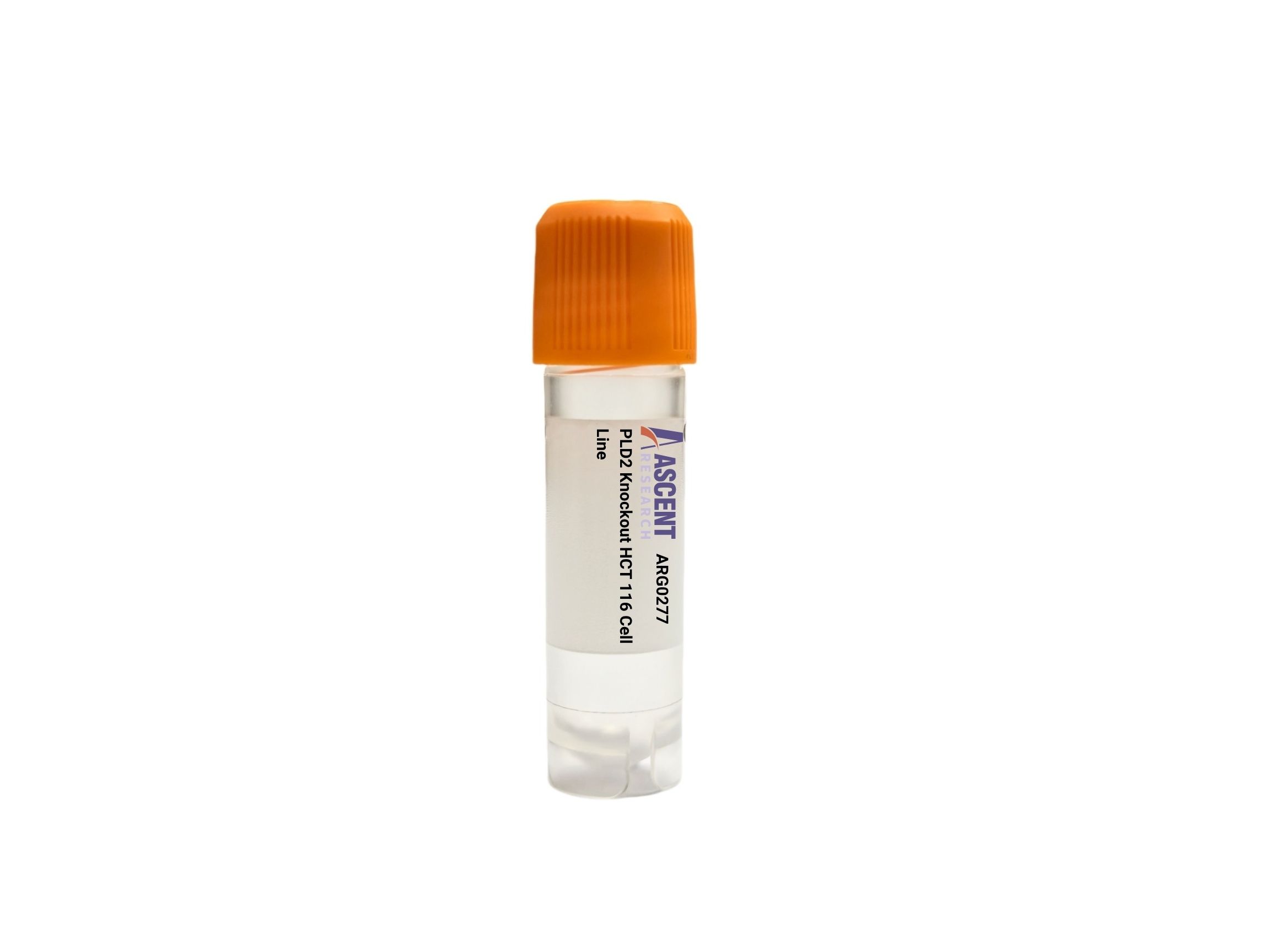
The PLD2 Knockout HCT 116 Cell Line is a CRISPR/Cas9-edited knockout cell line derived from HCT 116 colorectal carcinoma cells, providing a loss-of-function model for phospholipase D2 (PLD2). The parental line carries KRAS G13D and CTNNB1 mutations, driving constitutive ERK and Wnt signaling. PLD2 converts phosphatidylcholine to phosphatidic acid, activating mTORC1 and Raf/MEK/ERK cascades to regulate growth, migration, and survival. This knockout model is ideal for studying PLD2-dependent signaling in colorectal cancer, drug target validation, and lipid signaling research using immunoblotting, migration assays, and lipidomics.
 NDST1 Knockout NCI-H1299 Polyclonal Cells
Cat. No. ARG18146
BAD Knockout huh-7 Polyclonal Cells
Cat. No. ARG28080
ACY1 Knockout NCI-H1299 Polyclonal Cells
Cat. No. ARG30227
BAG3 Knockout HT29 Polyclonal Cells
Cat. No. ARG33127
DSC2 Knockout A2780 Polyclonal Cells
Cat. No. ARG39795
ETS1 Knockout MES-OV Polyclonal Cells
Cat. No. ARG6369
NDST1 Knockout NCI-H1299 Polyclonal Cells
Cat. No. ARG18146
BAD Knockout huh-7 Polyclonal Cells
Cat. No. ARG28080
ACY1 Knockout NCI-H1299 Polyclonal Cells
Cat. No. ARG30227
BAG3 Knockout HT29 Polyclonal Cells
Cat. No. ARG33127
DSC2 Knockout A2780 Polyclonal Cells
Cat. No. ARG39795
ETS1 Knockout MES-OV Polyclonal Cells
Cat. No. ARG6369
The PLD2 Knockout HCT 116 Cell Line is a CRISPR/Cas9-edited human colorectal carcinoma cell line with targeted disruption of the PLD2 gene, creating a stable loss-of-function model for phospholipase D2. This knockout cell line enables precise investigation of PLD2-dependent signaling in an epithelial context without reliance on transient suppression or pharmacological inhibitors.
The parental HCT 116 line is an intestinal epithelial model harboring oncogenic KRAS G13D and CTNNB1 (??-catenin) mutations, with MSI-low status and wild-type p53. These alterations drive constitutive ERK/MAPK and Wnt pathway activation, making it a relevant system for studying colorectal cancer signaling and therapeutic intervention.
PLD2 hydrolyzes phosphatidylcholine to produce phosphatidic acid (PA), a lipid second messenger that activates mTORC1 and the Raf/MEK/ERK kinase cascade. Upstream activators include EGF, PDGF, GPCRs, integrins, and ARF/Rho GTPases, while downstream effectors comprise mTORC1, Raf-1, PI3K, Akt, and S6 kinase. PLD2 interacts with actin, Grb2, PKC, and ??-catenin, linking lipid metabolism to cytoskeletal dynamics and transcription.
In HCT 116 cells, PLD2-generated PA amplifies oncogenic signals from mutant KRAS and ??-catenin, enhancing mTORC1/S6K and ERK phosphorylation. Knockout of PLD2 is therefore expected to attenuate proliferation, migration, and survival pathways, offering a clean genetic tool to dissect the role of phospholipid signaling in colorectal cancer progression.
This model is suited for drug target validation, signal transduction studies, and functional assays such as western blotting for phospho-ERK, phospho-Akt, and phospho-S6, migration/invasion tests, co-immunoprecipitation, and lipidomics. It facilitates investigation of therapy resistance and metastatic mechanisms. For technical inquiries or custom requests, contact Ascent Research.